
Summary: A new study finds that deletion of a gene linked to schizophrenia alters neuronal differentiation, producing fewer neurons and more astrocytes in developing brain tissue.
Source: RIKEN.
Researchers at the RIKEN Brain Science Institute used human-induced pluripotent stem cells (hiPSCs) to uncover a specific developmental abnormality associated with schizophrenia. Published in Translational Psychiatry, the study demonstrates that deletion of a gene within the 22q11.2 chromosomal region leads to abnormal neuronal differentiation and a persistent imbalance between neurons and astrocytes.
Schizophrenia risk is influenced by many genetic factors. Small deletions on chromosome 22 (22q11.2) are particularly notable because they remove multiple genes involved in brain development and neuronal function. To clarify how deletions in this region affect early brain cell development, Takeo Yoshikawa and colleagues generated hiPSCs from individuals without schizophrenia and from patients with schizophrenia who carry the 22q11.2 deletion, then compared how those stem cells developed into neural cell types.
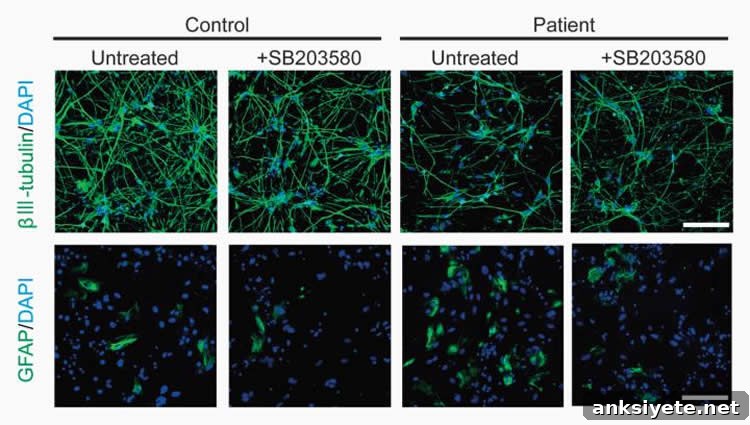
“When we analyzed the hiPSCs, patient-derived cells produced fewer neurons and more astrocytes,” explains Yoshikawa. “We then investigated the molecular mechanisms behind the altered neurogenic and gliogenic competences.”
In neural stem cell research, scientists often grow neurospheres—three-dimensional clusters containing neural stem and progenitor cells—to study differentiation. The team observed that neurospheres derived from patient hiPSCs were, on average, about 30% smaller than those from control lines. Size differences suggested altered proliferation or differentiation potential early in development.
Because neurosphere cells can mature into neurons or glia, the researchers quantified the resulting cell types. Patient-derived neurospheres produced roughly 10% fewer neurons and about 13% more astrocytes compared with controls. This shift in the ratio of neurons to astrocytes indicates a skewed developmental program favoring gliogenesis over neurogenesis in the affected lines.
The investigators then focused on the gene DGCR8, located within the deleted 22q11.2 region and known to be essential for microRNA processing. Reduced expression of DGCR8 in patient-derived neurospheres was confirmed. Loss of DGCR8 corresponded with increased levels of the protein p38α, a kinase that promotes glial differentiation. The team tested whether inhibiting p38α activity could restore neurogenic potential: pharmacological inhibition of MAPK14 (the gene encoding p38α) increased neuron numbers and reduced astrocyte production in patient-derived neurospheres.
To evaluate whether this cellular phenotype is relevant to human brain tissue, the researchers examined post-mortem frontal cortex samples from people diagnosed with schizophrenia. They found increased expression of astrocyte markers and decreased expression of neuronal markers compared with control brains, supporting the idea that altered neuron-to-astrocyte balance occurs in vivo in schizophrenia.
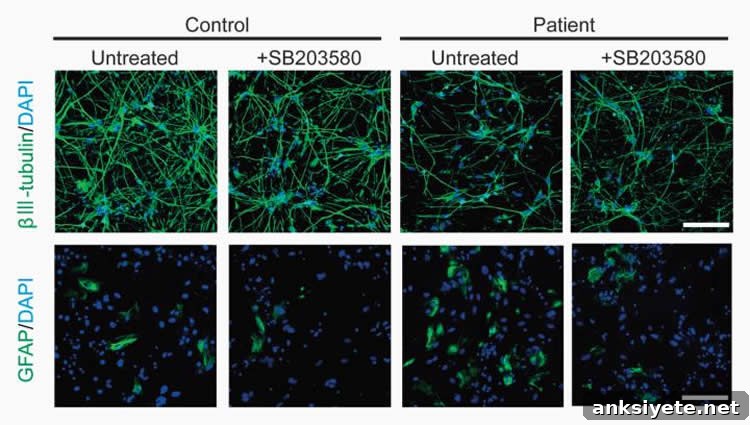
Yoshikawa notes, “We were able to partially correct the reduced neurogenic competence using a MAPK14 inhibitor. These findings suggest that targeting p38α signaling could be a therapeutic strategy, provided the correct timing for intervention can be identified—potentially during early, prodromal stages of schizophrenia.”
He also cautions that the mechanism described here may not account for all cases of schizophrenia. The hiPSCs used in this study represent a distinct subgroup of patients who carry the 22q11.2 deletion; other genetic or environmental factors could produce similar imbalances between neuron and astrocyte development through different molecular pathways.
Source: Adam Phillips – RIKEN
Image source: RIKEN
Original research: Toyoshima M., Akamatsu W., Okada Y., Ohnishi T., Balan S., Hisano Y., Iwayama Y., Toyota T., Matsumoto T., Itasaka N., Sugiyama S., Tanaka M., Yano M., Dean B., Okano H., Yoshikawa T. “Analysis of induced pluripotent stem cells carrying 22q11.2 deletion.” Translational Psychiatry. Published online November 1, 2016.
Analysis of induced pluripotent stem cells carrying 22q11.2 deletion
Because schizophrenia is genetically complex and heterogeneous, studying patients with clearly defined, high-impact genomic defects can reveal mechanisms underlying the disorder. The authors established hiPSC lines from two schizophrenia patients with the 22q11.2 deletion (four lines total) and from healthy controls (four lines). Patient-derived cells showed reduced neurosphere size, lower neural differentiation efficiency, impaired neurite outgrowth and migration, and a decreased neurogenic-to-gliogenic competence ratio. The study focused on DGCR8, a gene important for microRNA processing located in the deleted region. miRNA profiling showed reduced levels of miRNAs from the miR-17/92 cluster and miR-106a/b in patient-derived neurospheres; these miRNAs are reported to target p38α. Correspondingly, p38α levels were elevated in patient cells, and pharmacological inhibition of p38 activity partially restored neurogenic competence. Post-mortem schizophrenia brains (without 22q11.2 deletion) also showed elevated GFAP (an astrocyte marker) and reduced MAP2 (a neuronal marker), while inflammation markers remained unchanged. These results support the idea that a dysregulated balance between neurogenesis and gliogenesis may contribute to neurodevelopmental disorders such as schizophrenia.
Reference: Toyoshima M. et al., Translational Psychiatry (2016).