
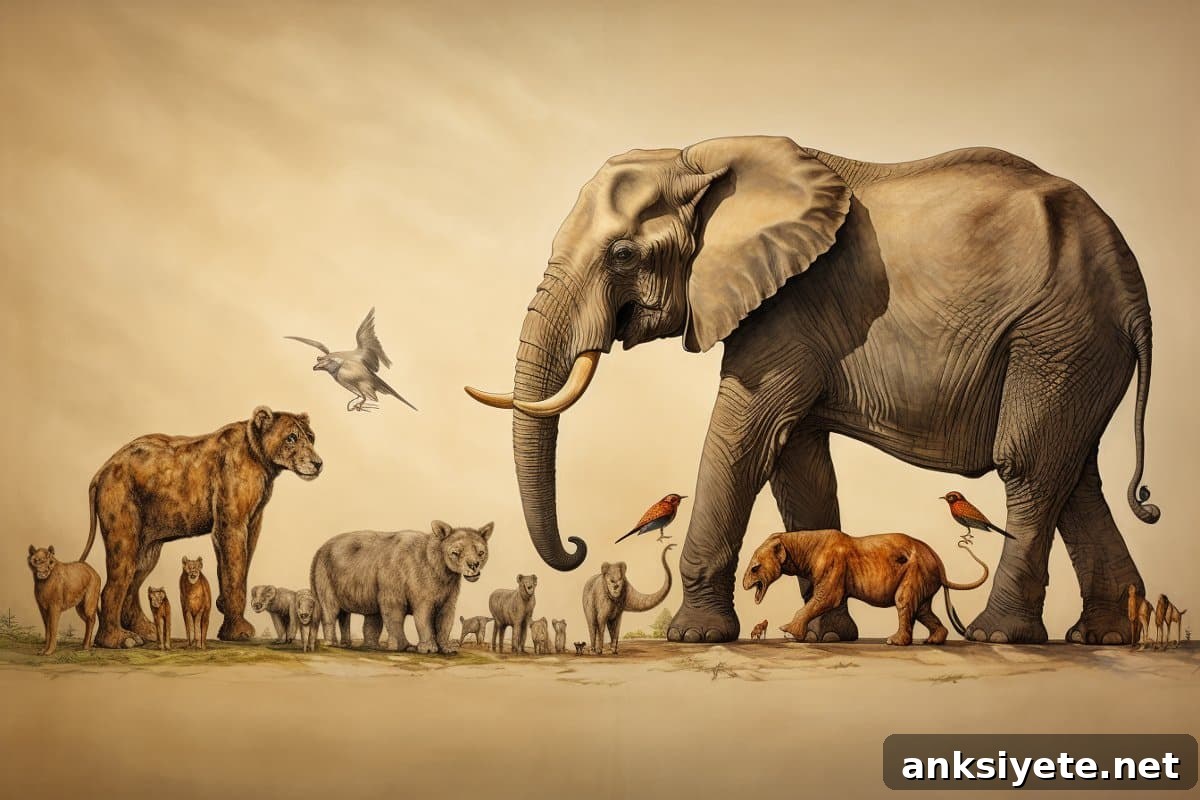
Summary: New theoretical research challenges long-standing assumptions about animal size evolution. Using computer simulations, the study shows how ecological factors—especially competition for resources and extinction risk—drive long-term changes in body size, helping to explain conflicting patterns seen in the fossil record.
Contrary to a simplified reading of Cope’s rule, which suggests a general tendency for lineages to evolve larger body sizes over time, this research demonstrates that strong competition can favor smaller sizes. The models account for examples such as shrinking Alaskan horses, reduced sizes in some island lizards, and size trends in cryptodiran turtles, providing a clearer, ecology-based explanation for why some groups get larger while others become smaller.
Key Facts:
- The study highlights two primary ecological drivers of body-size evolution: the intensity of direct competition for resources between species, and the environmental risk of extinction.
- Results qualify Cope’s rule by showing that high competition and overlapping niches can select for smaller body sizes over evolutionary time.
- Computer simulations reproduce diverse size-evolution patterns observed in the fossil record, including steady increases, steady decreases, and cycles of size increase followed by extinctions.
Source: University of Reading
The mystery behind why some animals—like Alaskan horses, certain cryptodiran turtles, and island lizards—shrunk over time may be explained by new modelling research.
The study proposes that long-term changes in animal size are governed primarily by two interacting ecological factors: how strongly species compete with one another for shared resources, and how vulnerable larger or rarer species are to extinction in changing environments. Rather than invoking a single universal trend toward larger size, the research emphasizes context-dependent outcomes driven by ecological dynamics.
Published on 18 January in Communications Biology, the study used evolutionary computer models to simulate how lineages evolve under different competitive regimes and extinction pressures. The simulations reveal why fossil sequences sometimes show consistent size increases, sometimes steady decreases, and sometimes patterns in which size increases precede extinction events.
Dr Shovonlal Roy, an ecosystem modeller at the University of Reading and lead author, explained: “Just as organisms adapt physiologically to different climates, body size can adapt over long timescales to the ecological context. In environments where species face intense direct competition for food or habitat, evolutionary pressures favor smaller, more specialized body sizes. Conversely, where competition is less direct, species can trend toward larger sizes—despite the greater extinction risk that large size can entail.”
For example, small horse species that lived in Alaska during the Pleistocene appear to have reduced in size in response to climatic and vegetation shifts, while on islands, limited resources and high competition commonly produce dwarfism in reptiles and mammals. The models show these outcomes emerge naturally from simple ecological rules about resource use and competitive overlap.
Cope’s rule
Cope’s rule is the historical observation—named for 19th-century paleontologist Edward Cope—that many animal groups tend to evolve larger body sizes over geological time. Classic examples include the horse lineage, where early dog-sized ancestors evolved into the much larger modern horse. However, the fossil record does not consistently support a single directional trend: some clades show increases, others decreases, and many show mixed patterns.
Evolutionary pressure
The simulations identify three distinct size-evolution patterns that result from different balances of competition and extinction risk:
- Gradual size increase: When competition is primarily structured by relative body size—so that larger size confers competitive advantage—lineages can gradually grow larger over millions of years. This pattern matches some marine invertebrate trends and other groups where larger size reduces predation or increases access to resources.
- Size increase followed by extinctions: In some scenarios, species evolve ever larger sizes until large-bodied taxa experience higher extinction risk. Recurrent extinctions of these apex, large-bodied species open ecological space for other lineages to expand in size, producing a cycle of growth and loss. Mass extinctions tend to disproportionately affect the largest animals.
- Gradual size decrease: When competition is intense and niches overlap, the models predict shrinking body sizes as species diversify into finer-scale niches and resources become partitioned. This mechanism helps explain documented size declines in various vertebrates, some bony fishes, certain cryptodiran turtles, Alaskan Pleistocene horses, and island lizard populations.
About this evolutionary neuroscience research news
Author: Ollie Sirrell
Source: University of Reading
Contact: Ollie Sirrell – University of Reading
Image: The image is credited to Neuroscience News
Original Research: The findings appear in Communications Biology