
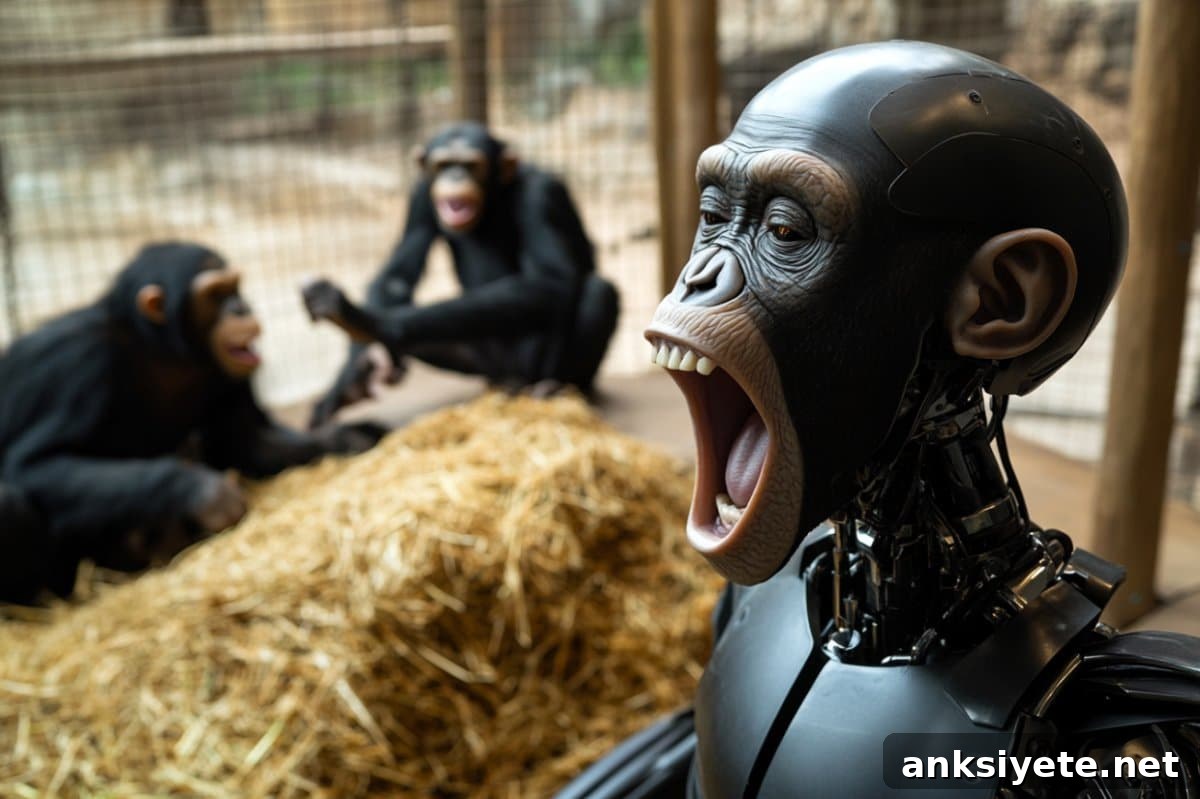
Summary: Researchers observed contagious yawning and rest-related behaviors in chimpanzees after an android—designed to mimic human facial expressions—displayed a yawning face. The study provides the first evidence that an inanimate humanoid model can trigger yawn contagion, and it suggests that yawning may act not only as an automatic social reflex but also as a contextual cue for rest.
The strongest response occurred when the android showed a fully open mouth; partial mouth opening produced a reduced effect, and neutral expressions produced little to no response. These graded reactions reveal perceptual sensitivity to facial configuration and broaden our understanding of non-verbal communication and the evolutionary roots of social responsiveness across species.
Key facts:
- First inanimate trigger: Chimpanzees exhibited contagious yawning in response to a humanoid android—an unprecedented observation.
- Graded response: Yawn contagion depended on how widely the robot’s mouth opened, reflecting perceptual discrimination.
- Rest-related behaviors: Chimpanzees gathered bedding and lay down only during the full-yawn condition, linking yawning to drowsiness cues as well as social contagion.
Source: St. George’s University of London
Chimpanzees (Pan troglodytes) ‘catch’ yawns from an android that imitates human facial expressions, new research from St. George’s, University of London reports.
Published in Scientific Reports, the study shows that adult chimpanzees both yawn and assume rest behaviors when they observe an android displaying a yawning expression. The results suggest that yawning may function as a contextual signal for rest as well as an example of contagious behavior across agents, including non-biological ones.
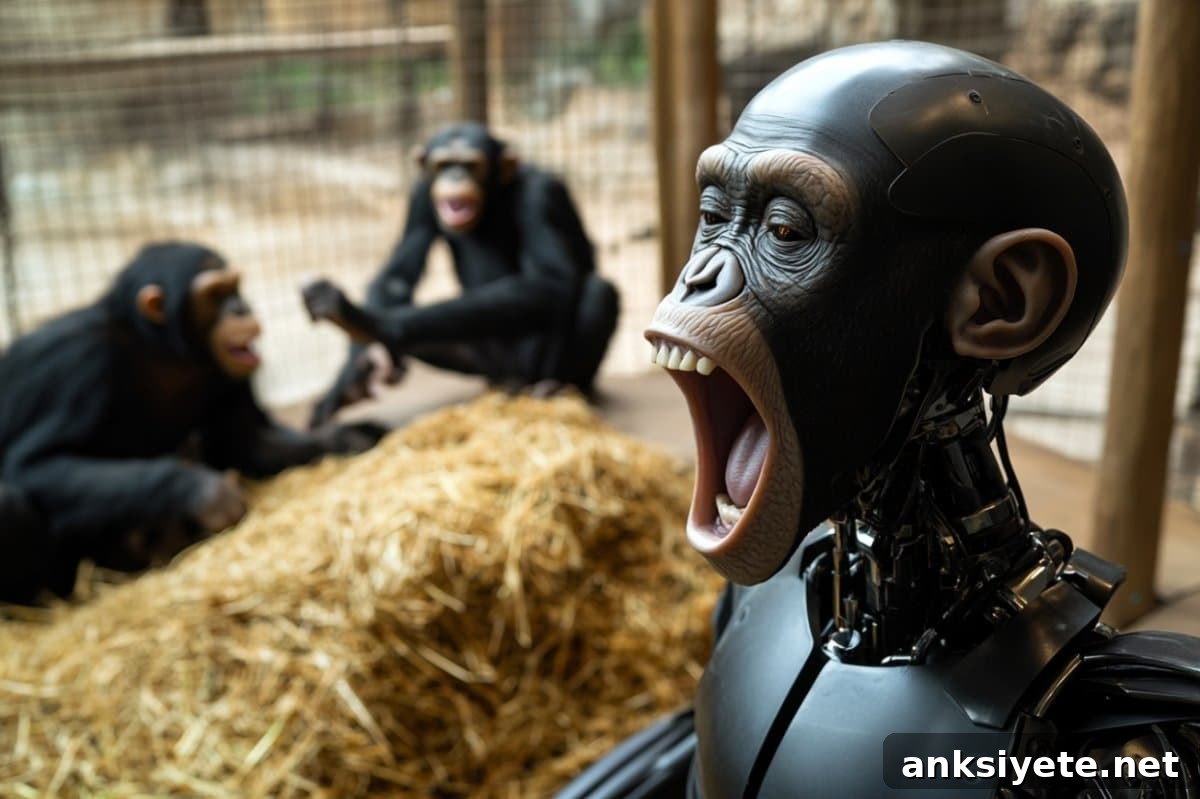
According to the authors, these findings represent the first demonstration of contagious yawning induced by an inanimate model. The work also emphasizes how social and perceptual factors shape yawn contagion, offering new perspectives on primate social cognition.
Contagious yawning—when observing another individual’s yawn triggers a yawn—is well documented in many mammals and has even been reported across species. Although the evolutionary roots and primary functions of yawning remain debated, this study indicates chimpanzees are susceptible to yawning cues produced by an artificial agent and that those cues can be associated with behaviors consistent with drowsiness.
The research team, led by Dr Ramiro Joly-Mascheroni (Honorary Research Fellow at St. George’s) with Professors Beatriz Calvo-Merino and Tina Forster (Cognitive Neuroscience at St. George’s) and collaborators at Universitat de Girona, tested 14 adult chimpanzees aged 10 to 33 at the Fundació Mona Primate Sanctuary in Spain. They used a humanoid android head capable of reproducing controlled facial movements to present three conditions: ‘yawning’ (fully open mouth), ‘gaping’ (partially open mouth) and ‘neutral’ (mouth closed). Each facial movement was presented for 10 seconds.
Results showed a clear, graded pattern. The highest yawn contagion occurred during the fully open-mouth (Yawn) condition. A smaller but measurable response was observed during the Gape condition, and no contagion was recorded in the Close (neutral) condition. Notably, only in the Yawn condition did chimpanzees gather bedding materials and lie down while observing the android—behaviors typically associated with rest or drowsiness.
Lead author Dr Joly-Mascheroni commented that the findings demonstrate yawn contagion can be triggered by a non-biological humanoid that appears to yawn. He noted that, although the primary purpose of yawning and the reasons for its contagiousness remain uncertain, yawning could have an evolutionarily old communicative role, and its contagious aspect may illuminate how social communication and interaction developed in humans and other animals.
Professor Calvo-Merino added that studying primates’ responses to an artificial agent helps illuminate the mechanisms underlying social cognition beyond the human species. She emphasized that this interdisciplinary research bridges psychology, robotics and zoology to address questions about perception and social influence.
The authors caution that the underlying mechanisms behind these effects are not yet fully understood. Further research is needed to determine whether other behaviors shown by robots or artificial agents can be contagious to animals, how such responses compare with human reactions, and what neural or cognitive processes mediate cross-agent contagion.
About this social contagion research news
Author: George Wigmore
Source: St. George’s University of London
Contact: George Wigmore – St. George’s University of London
Image credit: Neuroscience News
Original research (open access): “Chimpanzees yawn when observing an android yawn” by Ramiro Joly-Mascheroni et al., Scientific Reports. DOI: 10.1038/s41598-025-98639-z
Abstract
Chimpanzees yawn when observing an android yawn
This study investigated contagious yawning in adult chimpanzees (Pan troglodytes) exposed to a non-biological humanoid agent. Chimpanzees observed an android that displayed specific facial expressions—yawn, gape and neutral—each presented for 10 seconds. The results show across-agent yawn contagion with a graded effect: the highest contagion occurred in the fully wide-open mouth (Yawn) condition, a reduced response in the partially open mouth (Gape) condition, and no contagion when the mouth was closed (Close).
Chimpanzees also engaged in behaviors typically associated with drowsiness—gathering bedding, building nests and lying down—while observing the android yawning. These observations suggest that yawning by an unfamiliar or artificial model may serve as a contextual cue for rest in addition to eliciting motor resonance or automatic mimicry.
Overall, the findings expand current understanding of non-human primate susceptibility to contagiously induced behaviors, demonstrating that contagious yawning can be evoked by an artificial agent. The study underscores the influence of social and perceptual factors on yawn contagion and calls for further work on cross-species and cross-agent interactions.