
Researchers at the University of Washington (UW) have applied a noninvasive, light-based imaging technology to visualize living brain tissue at depths previously unreachable without surgery, offering a powerful new method to study how conditions such as dementia, Alzheimer’s disease, and brain tumors alter brain structure over time.
The advance, reported by Woo June Choi and Ruikang Wang from the UW Department of Bioengineering, appears in the Journal of Biomedical Optics published by SPIE, the international society for optics and photonics.
“This work demonstrates a significant increase in imaging depth using a noninvasive laser-based technique for deep tissue imaging. In the brain, the imaging depth is nearly doubled,” said Martin Leahy of the National University of Ireland, Galway, a member of the journal’s editorial board. “For the first time, this capability opens up a new window into the intact, living hippocampus, providing opportunities for discovery in brain research.”
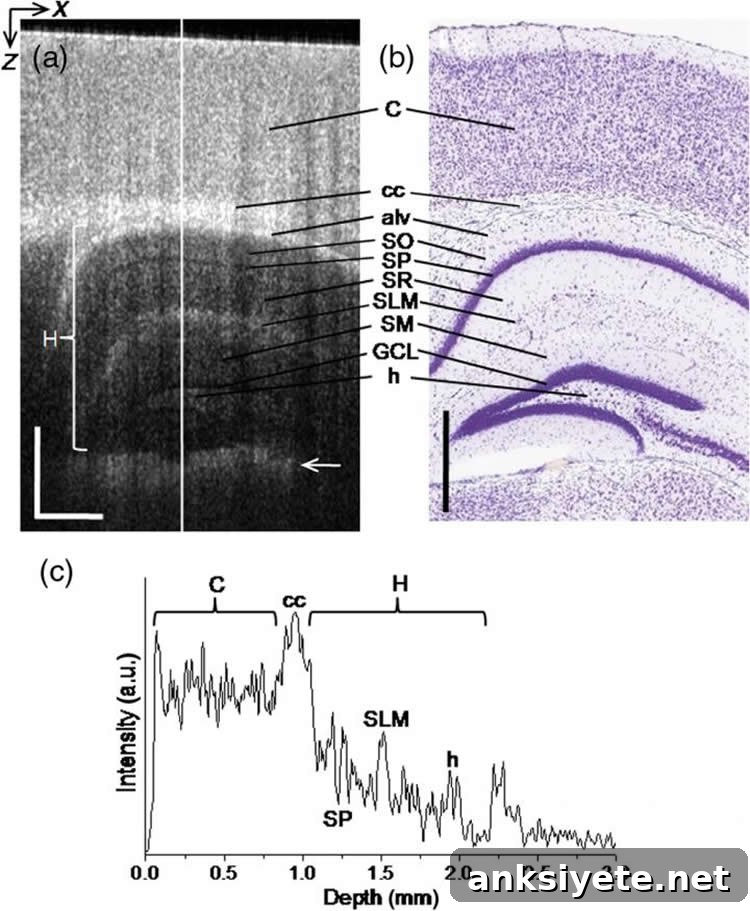
Using an approach called swept-source optical coherence tomography (SS-OCT) driven by a vertical-cavity surface-emitting laser (VCSEL), the UW team was able to image deep brain structures in living mice through an open-skull cranial window. Their results reveal intact brain anatomy from the superficial cerebral cortex down to the hippocampus, a deeper brain region implicated in memory and many neurological disorders.
The authors describe how the VCSEL-powered SS-OCT system increases usable imaging range by maintaining higher and more constant sensitivity across depth. Conventional OCT systems have traditionally been limited to about 1 millimeter of penetration in turbid biological tissue because backscattered light drops rapidly with depth. The VCSEL SS-OCT approach extends the effective imaging range to more than 2 millimeters, enabling visualization of deeper compartments that were previously difficult to reach noninvasively.
Optical coherence tomography (OCT) is an established imaging method that creates high-resolution, cross-sectional images of tissue by measuring light reflected from subsurface structures. OCT delivers near-microscopic resolution without requiring invasive procedures or ionizing radiation, which has made it a mainstay in ophthalmology for over two decades. More recently, researchers have adapted OCT for neuroscience studies in small animal models to examine structure, neural activity, and blood flow in the cerebral cortex.
However, conventional OCT’s practical imaging depth has limited its application in studying deeper brain regions, such as the hippocampus, where many disease processes start or progress. At depths beyond roughly 1 mm, the number of ballistic photons—light that travels through tissue without scattering—falls so low that conventional systems cannot reliably form an image. The VCSEL-enhanced swept-source OCT overcomes much of this limitation by improving system sensitivity and maintaining a steady signal over a greater depth range.
Choi and Wang’s experiments used a 1.3 μm VCSEL light source with SS-OCT, achieving a constant signal sensitivity of approximately 105 dB across an extended axial range in air and an effective imaging depth exceeding 2 mm in scattering biological tissue. This sensitivity profile allowed imaging of intact mouse brain anatomy down to the hippocampus in vivo, offering a noninvasive view of deep brain compartments suitable for longitudinal studies.
The authors suggest several promising applications for this improved OCT technique. In small-animal neuroscience, VCSEL SS-OCT could be used to monitor both acute and chronic morphological changes, microvascular dynamics, and functional vascular responses in deep brain regions over time—investigations that have been difficult with traditional OCT. The team also notes that further refinements of VCSEL-based systems could expand opportunities in other biomedical imaging arenas; for example, the extended coherent range raises the possibility of comprehensive, full-length imaging of the human eye from cornea to retina, a task that has been only rarely attempted with older OCT generations.
By providing high-resolution, noninvasive imaging deeper into living brain tissue, VCSEL-powered swept-source OCT adds a valuable tool to the neuroimaging toolkit. It enables researchers to track structural and vascular changes associated with aging, neurodegenerative disease, and tumors in ways that were previously impractical without invasive methods.
Source: Amy Nelson – SPIE
Image Source: The image is reprinted with a public courtesy from Allen Institute for Brain Science.
Original Research: Abstract for “Swept-source optical coherence tomography powered by a 1.3-μm vertical cavity surface emitting laser enables 2.3-mm-deep brain imaging in mice in vivo” by Woo June Choi and Ruikang K. Wang in Journal of Biomedical Optics. Published online October 8 2015 doi:10.1117/1.JBO.20.10.106004
Abstract
Swept-source optical coherence tomography powered by a 1.3-μm vertical cavity surface emitting laser enables 2.3-mm-deep brain imaging in mice in vivo
The authors report noninvasive, in vivo optical imaging deep within a mouse brain using swept-source optical coherence tomography (SS-OCT) enabled by a 1.3-μm vertical-cavity surface-emitting laser (VCSEL). The VCSEL SS-OCT system provides a roughly constant signal sensitivity of 105 dB across an extended axial range in air, which translates into an effective imaging depth exceeding 2 mm in scattering biological tissue. With this setup and an open-skull cranial window preparation, the team visualized intact mouse brain anatomy from the superficial cortex down to the deep hippocampus. The VCSEL SS-OCT approach is well suited to small-animal studies that investigate deep tissue compartments in living brains, where conditions such as dementia and tumors can affect structure and function over time.
“Swept-source optical coherence tomography powered by a 1.3-μm vertical cavity surface emitting laser enables 2.3-mm-deep brain imaging in mice in vivo” by Woo June Choi and Ruikang K. Wang in Journal of Biomedical Optics. Published online October 8 2015 doi:10.1117/1.JBO.20.10.106004