
Summary: Researchers have developed a high-resolution imaging workflow that enables visualization of several dozen proteins within a single thin tissue section using fluorescence microscopy.
Using this approach, the team produced a detailed spatiotemporal map of human retinal organoid development, capturing how healthy retinal tissue forms over time and assembling a time series that spans the full 39-week developmental course of the organoids.
The investigators plan to extend this multimodal mapping approach to other tissue types, including regions of the human brain and various tumor tissues, with the goal of building an atlas that documents organoid and tissue development and supports disease research.
Key Facts:
- Scientists are assembling an atlas that maps the cell types, proteins and gene activity present in human tissues and organoids to better understand development and disease.
- The team applied an imaging method called iterative indirect immunofluorescence imaging (4i) to reveal dozens of proteins in single tissue sections at high spatial resolution using standard fluorescence microscopy.
- They used this multimodal workflow on stem-cell-derived human retinal organoids to produce an integrated time series of images and genomic information that captures the organoids’ 39-week developmental trajectory.
Source: ETH Zurich
What cell types reside in each human tissue, and where exactly are they located? Which genes are active in individual cells, and which proteins do those cells contain?
A dedicated atlas aims to answer these questions and more, documenting how tissues form during development and identifying molecular changes linked to disease. The atlas will cover tissue sampled directly from humans as well as organoids—three-dimensional, lab-grown tissue aggregates that recapitulate many features of human organs at a smaller scale.
“Organoids let us intervene in development and test candidate drugs, so they are powerful models for studying both healthy tissue formation and disease mechanisms,” says Barbara Treutlein, Professor of Quantitative Developmental Biology at the Department of Biosystems Science and Engineering at ETH Zurich in Basel.
To contribute to that atlas, Treutlein and collaborators from the Universities of Zurich and Basel developed an approach to collect and integrate large amounts of spatial and molecular data from organoids. They applied this workflow to retinal organoids generated from human pluripotent stem cells.
Visualizing many proteins at once
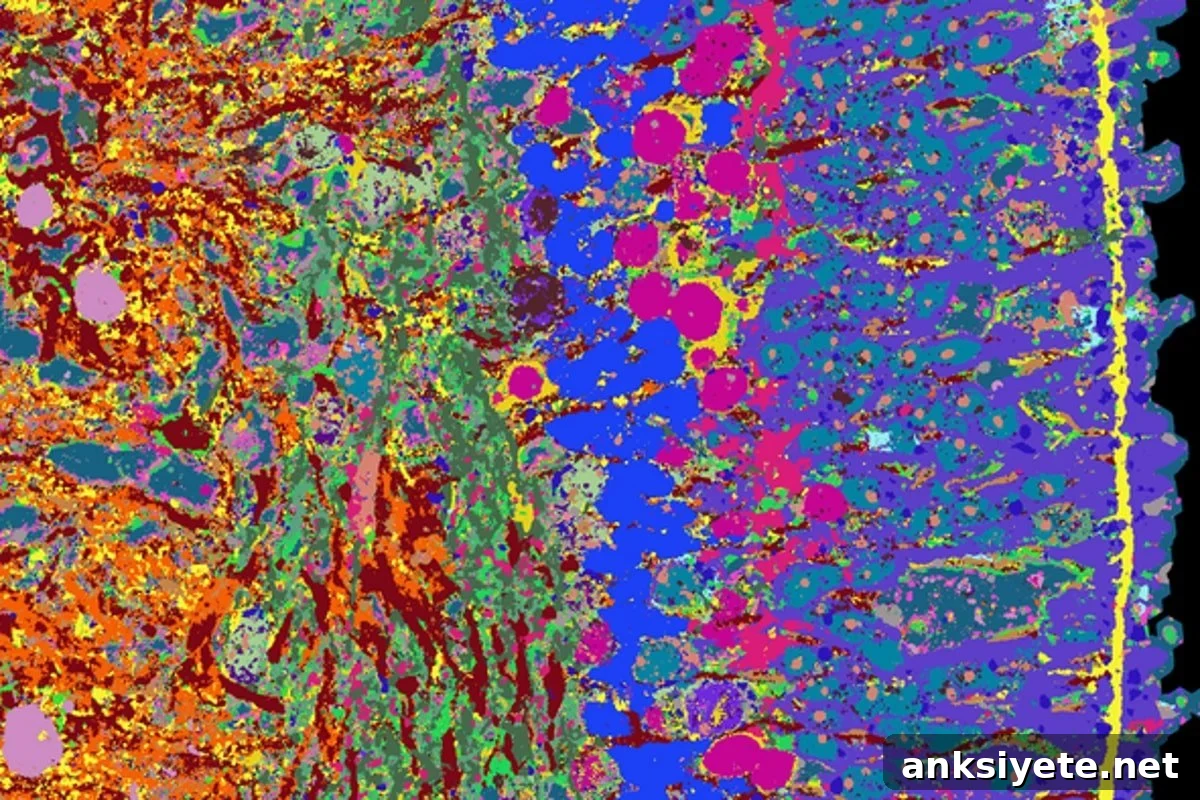
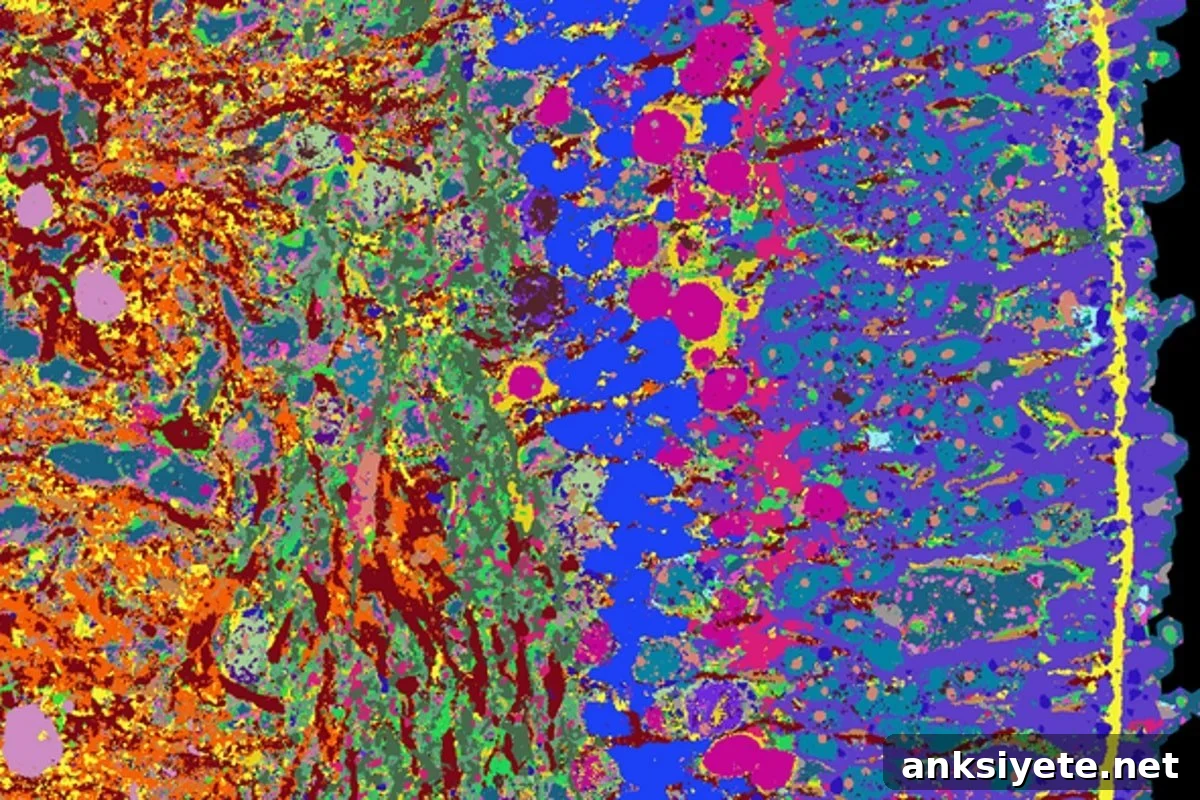
Central to their method is 4i—iterative indirect immunofluorescence imaging—which allows visualization of several dozen proteins within a single thin section at high resolution using fluorescence microscopy. The 4i technique was developed by Lucas Pelkmans at the University of Zurich and was implemented here for the first time in organoid tissue, as reported in Nature Biotechnology.
Traditional fluorescence imaging typically labels only two to three proteins per sample, with technical limits making more simultaneous stains impractical. 4i overcomes this by staining three proteins, imaging them, chemically removing those dyes, and then re-staining for another set of proteins. In this study the automated workflow repeated that cycle 18 times over 18 days. A computational pipeline then aligned and merged all images into a single composite in which 53 distinct proteins are visible simultaneously, revealing the molecular signatures of retinal cell types such as rods, cones and ganglion cells.
The protein localization maps were complemented by parallel molecular profiling that identifies which genes are being expressed in individual cells. Integrating protein-level spatial maps with single-cell genomic information allows a richer description of cell state, position and function than either modality alone.
High spatial and temporal resolution
The researchers applied their multimodal measurements across organoids at a series of developmental ages. By sampling many time points, they built a high-resolution time series that describes organoid maturation over the full 39-week period. This series shows how retinal tissue architecture emerges: where specific cell types proliferate and differentiate, when synapses form, and how spatial neighborhoods of cells develop—processes that mirror retinal formation during embryogenesis.
“The time series lets us visualise how tissue structure evolves, track the appearance of distinct cell populations, and locate where functional connections form,” explains Gray Camp, Professor at the University of Basel and senior author on the study.
The team has made their imaging data and additional results on retinal development available through a public portal named EyeSee4is (eyesee4is.ethz.ch), allowing other researchers to explore the multimodal atlas.
Extending to other tissues and disease models
To date the project has focused on normal retinal development. Going forward, the researchers plan to perturb retinal organoids using drugs or targeted genetic changes to model disease processes. These experiments aim to reveal the onset and progression of conditions such as retinitis pigmentosa, an inherited disorder in which light-sensitive photoreceptors progressively degenerate and lead to vision loss. By pinpointing when degenerative processes begin and how they spread through tissue, the atlas approach could help identify windows for therapeutic intervention.
Treutlein and colleagues are also preparing to apply their detailed mapping strategy to other tissue types, including specific brain regions and different tumor tissues. Gradually, these efforts will expand the multimodal atlas and provide a resource that documents human organoid and tissue development in space and time.
About this neuroscience research news
Author: Press Office ([email protected])
Source: ETH Zurich
Contact: Press Office – ETH Zurich
Image: The image is credited to Wahle et al., Nature Biotechnology 2023
Original Research: Open access. “Multimodal spatiotemporal phenotyping of human retinal organoid development” by Barbara Treutlein et al., published in Nature Biotechnology.
Abstract
Multimodal spatiotemporal phenotyping of human retinal organoid development
Organoids generated from human pluripotent stem cells provide experimental systems to study development and disease, but quantitative measurements that span multiple spatial scales and molecular modalities are still limited. This study generated multiplexed protein maps across a time course of retinal organoid development and compared these maps to primary adult human retinal tissue.
The team developed a toolkit to visualize progenitor and neuronal positions, spatial arrangements of extracellular and subcellular components, and global patterning within each organoid and in primary tissue. They also produced single-cell transcriptome and chromatin accessibility time-course datasets and inferred a gene regulatory network that underlies organoid development.
By integrating genomic data with spatially segmented nuclei, the authors built a multimodal atlas to investigate organoid patterning and retinal ganglion cell spatial neighborhoods, highlighted pathways implicated in retinal ganglion cell death, and demonstrated that mosaic genetic perturbations in retinal organoids can shed light on cell fate regulation.