
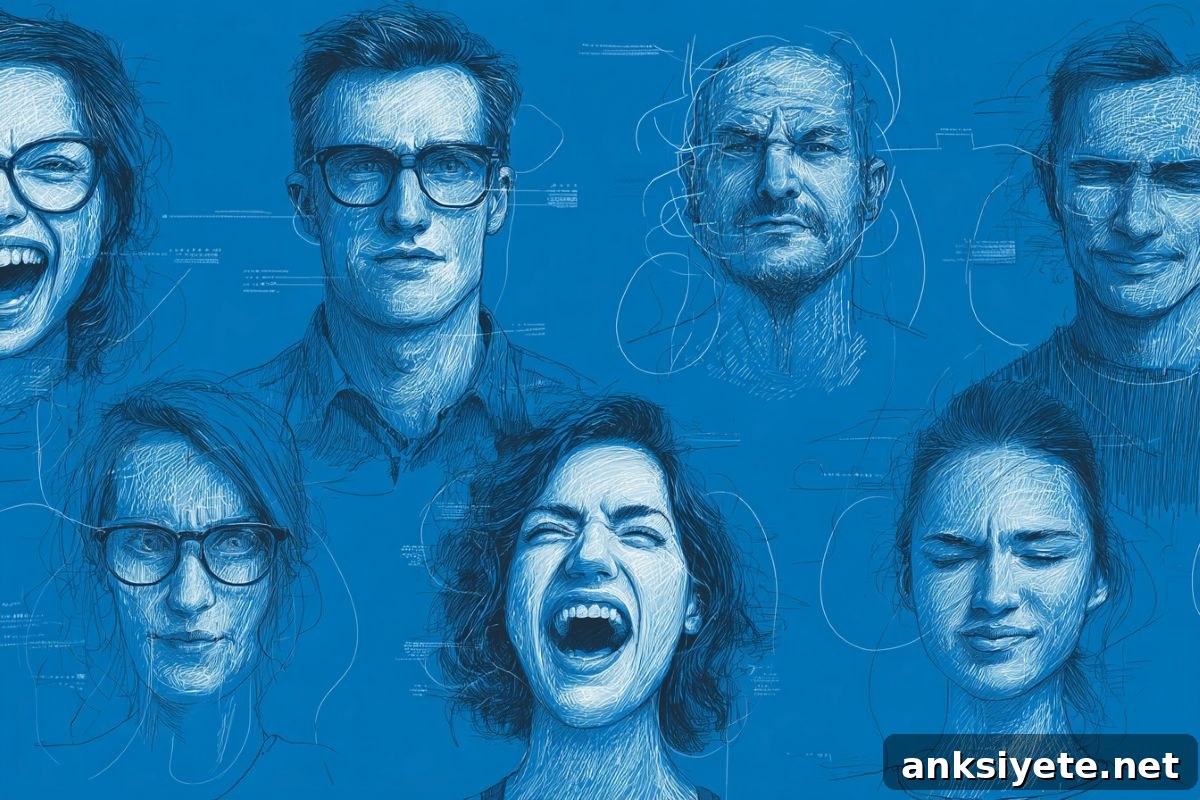
Summary: People automatically mirror the facial expressions of others, but new research finds we do this much more for joyful faces than for sadness or anger. The intensity of that mimicry predicts how much we trust someone. Across three experiments using facial electromyography (EMG) and behavioral measures, participants copied smiles more readily and consistently rated smiling individuals as more attractive, confident, and trustworthy.
Mimicking positive expressions strengthened social judgments, while anger was rarely imitated and led to the lowest trust ratings. These results identify emotional mimicry—particularly of happiness—as a central mechanism shaping first impressions and guiding social decision-making.
Key Facts
- Joy Is Most Contagious: Participants showed stronger and more frequent mimicry for happy expressions than for sadness or anger.
- Mimicry Builds Trust: Greater facial mimicry, especially of smiles, predicted higher trust and more favorable trait assessments.
- Smiling Shapes Perception: Faces displaying smiles were consistently rated as more trustworthy, attractive, and confident.
Source: SWPS University
How does mimicry influence who we trust and how we judge others?
People are more prone to mimic expressions of joy, and this tendency affects how we evaluate others: smiling individuals are perceived as more attractive and more trustworthy. Researchers from SWPS University and Humboldt University examined how emotional mimicry contributes to trait judgments and real decisions about trust.
Facial features and expressions offer rapid cues about personality and intent. While structural features (like jawline or brow shape) can imply dominance, dynamic cues — especially facial expressions — carry immediate emotional and social information. Emotional mimicry, the automatic imitation of another’s facial expression, is one way observers may internally simulate and better understand another person’s state, which in turn shapes social impressions.
The role of emotional mimicry in trait judgments
The research team investigated whether mimicry varies by emotion, whether context influences when we imitate, and whether the degree of mimicry predicts trait attributions. The study was led by Michał Olszanowski, PhD (SWPS University), Aleksandra Tołopiło, PhD (Center for Research on Biological Basis of Social Behavior, SWPS University), and Professor Ursula Hess (Humboldt University, Berlin).
The researchers predicted that smiling faces would be evaluated more positively and trusted more than faces expressing anger or sadness. They also expected participants to mimic happiness more readily than sadness, with anger being the least imitated emotion. Crucially, they hypothesized that the intensity of mimicry would predict the level of trust: the stronger the smile imitation, the greater the trust.
Three experiments: methods and findings
To test these predictions, the team ran three experiments. In two studies they recorded facial muscle activity using EMG to capture subtle mimicry responses; in the third, they measured behavioral trust in a game-based task.
Experiment 1 involved 62 participants (43 women). Participants viewed brief video clips of faces showing happiness, sadness, or anger and rated trustworthiness, confidence, and attractiveness. EMG data confirmed that participants were more inclined to mimic joyful expressions than sad or angry ones. Mimicry of happiness was especially pronounced when observers believed they shared social affinities with the person they watched; participants completed a pre-experiment questionnaire designed to create a sense of social similarity with some targets.
Experiment 2 (46 participants, 32 women) tested causality. Participants watched recordings and judged credibility while performing facial movements that either facilitated or interfered with natural mimicry. Some expressions and required actions were mismatched to probe whether altering facial activity changed trait judgments. Participants knew their facial responses were being recorded. Results supported the idea that facial muscle activity associated with imitation can influence how observers assess others’ character.
Experiment 3 used a behavioral trust task with 64 participants (43 women). After viewing people’s expressions, participants played a trust/investment game where they decided how many virtual points to share with other players. This study replicated the finding that smiling targets were imitated more than sad ones and showed that emotional mimicry predicted willingness to share resources. Unlike Experiment 1, perceived social similarity did not significantly affect mimicry in this behavioral setting.
A smile signals trust
Across the three experiments, the authors confirmed that smiling people are judged more favorably and trusted more. People tend to mimic affiliative displays (happiness and, to some extent, sadness) more than antagonistic displays (anger), with happiness driving the strongest mimicry. Importantly, the intensity of smile mimicry was linked to higher trust ratings and more cooperative choices in the investment game.
“Our results show that facial expressions inform trait inferences, and that happiness plays a particularly important role,” says Michał Olszanowski, PhD. “Expressing positive emotions can lead to more favorable attitudes toward a person, and emotional mimicry appears to be one mechanism through which those impressions form.”
Key Questions Answered:
A: The study shows people instinctively mimic joyful expressions more than sadness or anger, and that mimicry directly shapes social judgments. When participants copied a smile, they consistently rated the target as more trustworthy, attractive, and confident. Negative expressions were mimicked less and produced weaker positive impressions.
A: Happiness triggers the strongest and most frequent mimicry, while sadness and anger are imitated less. Mimicking joy is closely associated with higher trust and more cooperative attitudes, indicating that positive emotional signals play a key role in strengthening social bonds and shaping first impressions.
A: Yes. In a behavioral trust game, participants who mimicked smiles were more willing to share resources with the smiling individuals they observed. This confirms that emotional mimicry influences real decisions, making it a mechanism that drives cooperative behavior.
Editorial Notes:
- This article was edited by a Neuroscience News editor.
- The journal paper was reviewed in full by editorial staff.
- Additional context was provided by the reporting team.
About this social neuroscience research news
Author: Marta Danowska-Kisiel ([email protected])
Source: SWPS University
Contact: Marta Danowska-Kisiel – SWPS University
Image: The image is credited to Neuroscience News
Original Research: Closed access. “Smile and the world smiles (and trusts) with you: Happiness mimicry shapes first impressions” by Michał Olszanowski et al., published in the journal Emotion.
Abstract
Smile and the world smiles (and trusts) with you: Happiness mimicry shapes first impressions
A growing body of research suggests that affective processing influences trait judgments. This project examined how emotional mimicry contributes to attributing social traits to others. Across three experiments, participants evaluated faces displaying happiness, sadness, and anger.
In Experiments 1 and 3, facial EMG predicted inferences about trustworthiness, confidence, and attractiveness (Experiment 1) and behaviorally measured trust in a trust/investment game (Experiment 3). Experiment 2 tested causality by having participants make facial movements that either enhanced or inhibited muscle activity during mimicry while rating trustworthiness.
Findings indicate that mimicry of happiness not only predicts but can be causally linked to perceptions of trustworthiness—the stronger the imitation, the more positive the evaluation. Increased mimicry of sadness was associated with lower trust ratings in some measures, though causal evidence was weaker for sadness. The studies also confirmed that affiliative displays (happiness and sadness) are more likely to be mimicked than antagonistic displays (anger), with happiness being most frequently imitated.
Overall, these results provide evidence that facial mimicry modulates social trait inferences and underscore the functional role of mimicry in everyday social interactions.