
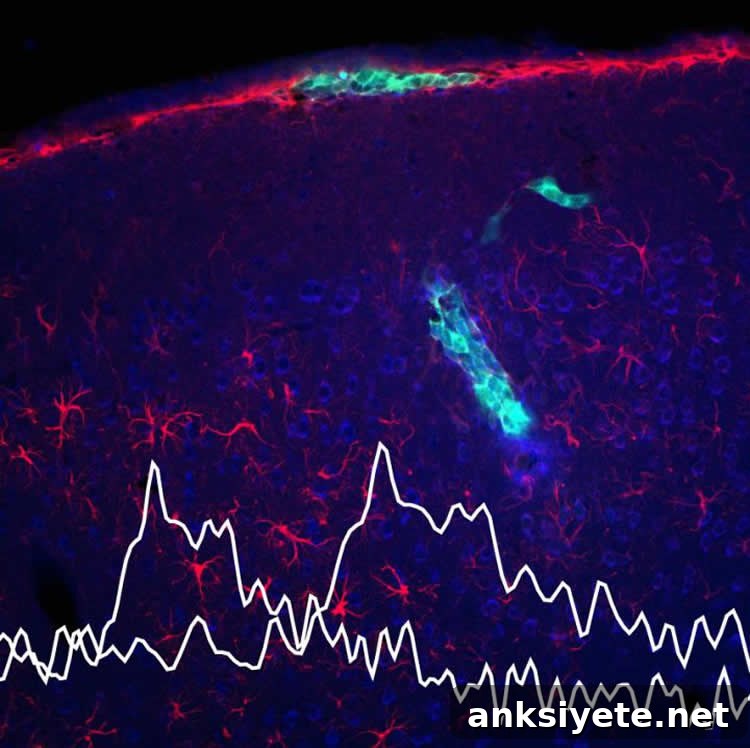
Engineered cells reveal changes associated with learning, memory and reward.
Researchers have developed living cellular sensors that fluoresce in response to specific neurochemicals, enabling direct, real-time observation of chemical signaling in the mammalian brain. By implanting these engineered cells into mouse cortex, the team tracked how neurochemical release shifts as animals learn to associate a sound with a sweet reward, demonstrating a clear link between dopamine signaling and learning-related changes in timing and anticipation.
These cellular reporters, termed CNiFERs (cell-based neurotransmitter fluorescent engineered reporters, pronounced “sniffers”), are designed to detect minute concentrations of neurotransmitters with fine spatial and temporal resolution. The current work focused on sensors tuned to dopamine and to norepinephrine, two closely related catecholamines whose chemical similarity has made selective measurement difficult with earlier techniques.
Dopamine has long been central to studies of reward, motivation, learning and addiction. According to David Kleinfeld, professor of physics at UC San Diego and senior author on the study, dopamine acts as a widespread signal that marks successful outcomes and helps guide the formation of new memories. Disruptions to dopamine signaling are implicated in neuropsychiatric disorders including schizophrenia and addiction, making precise measurement tools essential for both basic neuroscience and potential clinical advances.
The CNiFERs were developed through a collaboration between Kleinfeld and Paul Slesinger, professor of neuroscience at Icahn School of Medicine at Mount Sinai. The modified cells combine selective receptor elements and fluorescent reporters so that binding of a target neurotransmitter produces a measurable optical change. Because the reporters are cellular, they can be implanted directly into brain tissue to monitor local neurochemical dynamics in living animals, providing a complementary approach to existing electrochemical and imaging methods.
In the reported experiments, researchers Arnaud Muller and Victory Joseph implanted dopamine- and norepinephrine-sensitive CNiFERs into the frontal cortex of mice engaged in a classical conditioning task. The paradigm involved pairing a brief tone with a small drop of sweet water; over repeated trials the tone came to predict the reward and elicited anticipatory licking. Using the CNiFERs to record chemical signals during training, the team observed that dopamine release shifted earlier in time as learning progressed.
Specifically, dopamine release that initially coincided with delivery of the sweet reward began to occur at the moment the predictive tone was played, indicating that dopamine signaling moved from responding to the outcome to signaling the predictive cue. This anticipatory dopamine response correlated with behavioral learning: mice that formed a strong association between tone and reward showed pronounced early dopamine release, while animals that failed to learn or learned only weakly showed reduced anticipatory signaling. Importantly, the norepinephrine-sensitive reporters did not show the same pattern, supporting the selectivity of the CNiFER approach for distinguishing closely related neurochemicals.
The results reinforce long-standing theories linking dopamine to reward prediction and reinforcement learning, and they demonstrate the power of cell-based reporters to resolve neurochemical events with high temporal precision in vivo. Because the CNiFER design is modular, the same strategy can be adapted to sense a wide range of signaling molecules, opening the door to mapping diverse neuromodulatory dynamics across brain regions and behavioral states.
Beyond basic research, these cellular sensors may help researchers study the neurochemical basis of addiction, psychiatric illness and memory disorders, and could inform development of targeted therapies. By providing a method to visualize when and where specific neurotransmitters are released during behavior, CNiFERs add a valuable tool for experiments that require both chemical specificity and the ability to monitor naturalistic neural processes.
Funding for the project was provided by the National Institute on Drug Abuse, the National Institute of Biomedical Imaging and Bioengineering, and Hoffman‑La Roche.
Contact: Susan Brown – UCSD
Source: UCSD press release
Image Source: Kleinfeld Lab, UC San Diego (adapted from the press release)
Original Research: “Cell-based reporters reveal in vivo dynamics of dopamine and norepinephrine release in murine cortex” by Arnaud Muller, Victory Joseph, Paul A. Slesinger & David Kleinfeld, published in Nature Methods (online October 26, 2014).