Summary:
Researchers at EPFL’s Integrated Neurotechnologies Laboratory have created LogSync, an ultra-low-power, implantable system-on-chip (SoC) designed to advance deep brain stimulation (DBS) for severe psychiatric disorders such as treatment-resistant depression, PTSD, and other mood and anxiety conditions. Unlike conventional open-loop stimulators or single-site implants, LogSync continuously monitors oscillatory synchrony across distributed brain networks and runs on-chip machine learning to deliver stimulation only when signatures of pathological emotional or cognitive states are detected—while keeping total power consumption below 200 microwatts.
Key Facts:
- Distributed network decoding: LogSync measures multi-region biomarkers, quantifying oscillatory power and phase synchrony across interacting circuits implicated in mood and anxiety disorders rather than relying on a single recording site.
- Sub-200 microwatt power budget: Through algorithm–hardware co-design and logarithmic arithmetic, the chip performs real-time neural decoding and feature extraction at under 200 μW, meeting stringent thermal and battery constraints for long-term cranial implantation.
- Validated in human and animal data: The system was tested on human intracranial datasets to distinguish cognitive engagement and emotional arousal from oscillatory activity alone, and in vivo rodent experiments confirmed precise phase-locked stimulation delivery.
Source: EPFL (École Polytechnique Fédérale de Lausanne)
Deep brain stimulation (DBS) has transformed treatment of movement disorders and is now being explored for severe psychiatric illnesses. Delivering targeted electrical pulses through implanted electrodes, DBS can modulate subcortical networks, but applying it to psychiatric care faces unique engineering and scientific challenges.
Most commercial neurostimulators run in open-loop mode, providing continuous stimulation without adapting to a person’s moment-to-moment brain state. Even many closed-loop prototypes monitor activity from a single brain region, missing the distributed network interactions that underlie complex psychiatric symptoms. Because disorders like major depression and PTSD often arise from disrupted communication across brain circuits, single-site devices can fail to capture clinically relevant fluctuations in mood and cognition.
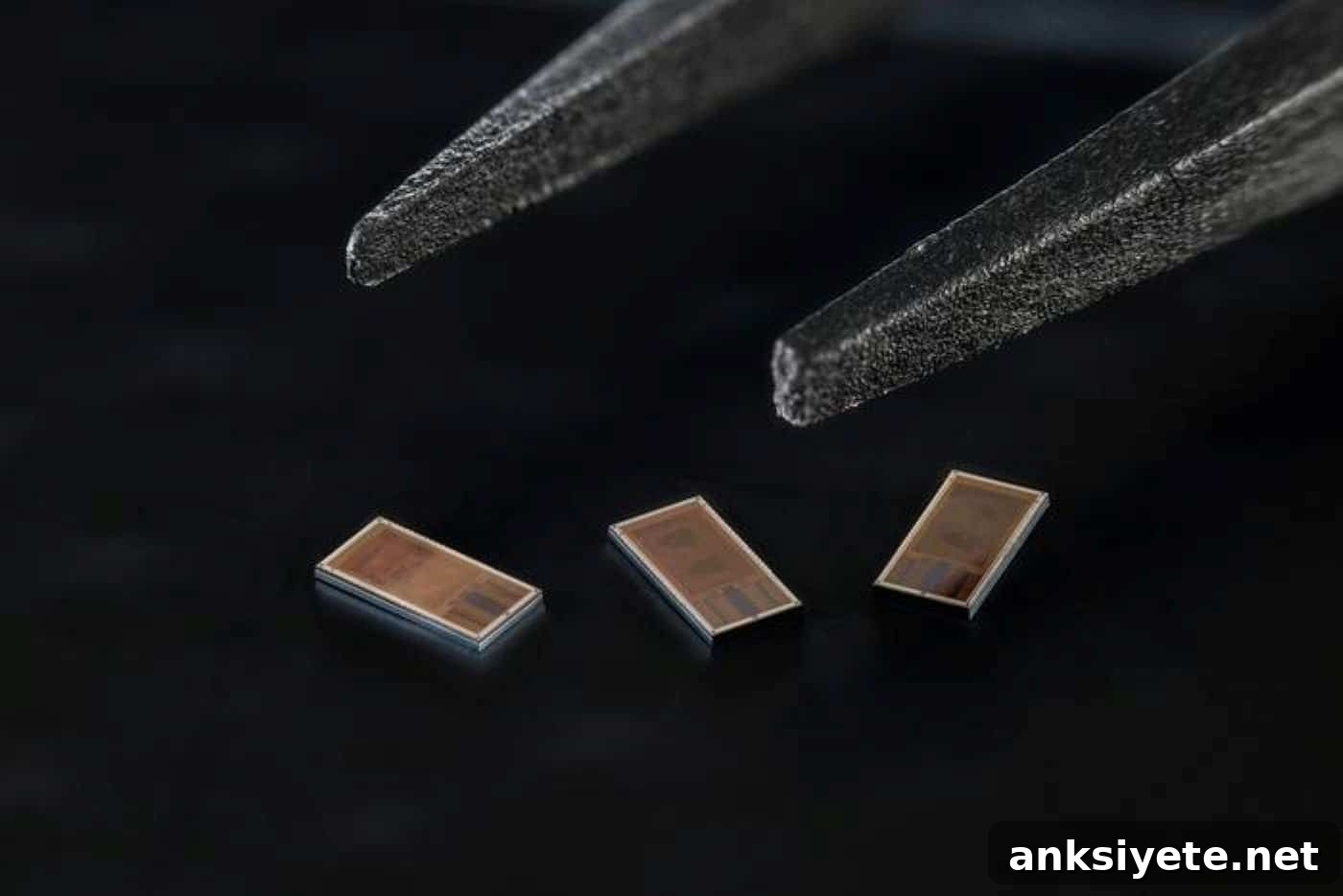
To address these limitations, Mahsa Shoaran, PhD, and her team at EPFL’s Integrated Neurotechnologies Lab developed LogSync: a 32-channel BCI SoC that decodes cross-regional synchrony and delivers adaptive, phase-locked stimulation when pathological neural states are detected.
Published in the IEEE Journal of Solid-State Circuits, the project is part of a CHF 6.6 million initiative, funded in part by the U.S. National Institute of Mental Health (NIMH), to create intelligent, network-responsive neural implants for severe mood and anxiety disorders.
Decoding the Language of Brain Networks
“Psychiatric disorders often reflect altered communication between brain regions rather than a single dysfunctional locus,” explains Dr. Shoaran. LogSync captures that distributed activity by sampling multiple electrodes and computing two primary biomarkers in real time: spectral power across frequency bands and phase synchrony, which measures how precisely different regions oscillate together.
These multi-site features feed into a hardware-efficient machine learning classifier embedded on the chip. When the classifier recognizes patterns linked to depressive withdrawal, anxiety-driven hyperarousal, or cognitive dysregulation, the system generates an adaptive trigger to deliver therapeutic pulses, intervening before symptoms escalate.
High performance under a tight power envelope
Power dissipation is the central engineering constraint for implanted intelligent devices. Sophisticated ML methods typically require substantial computation, which can shorten battery life and increase tissue heating risk. LogSync overcomes this through co-design of algorithms and hardware and by operating in the logarithmic arithmetic domain.
Shifting complex operations—such as cross-frequency coupling and synchrony calculations—into the log domain reduces multiplications to simpler additions and subtractions, eliminating energy-intensive hardware multipliers while preserving classification accuracy. This approach enables network-level signal processing and decoding on a single chip while keeping consumption under 200 μW, a tiny fraction of what many implantable interfaces require.
Validation across human recordings and animal models
The team validated LogSync using intracranial human recordings. In experimental tasks, the chip differentiated shifting levels of cognitive engagement and identified emotionally arousing states from oscillatory biomarkers alone. Additional testing on public EEG emotion datasets demonstrated robust sensitivity and specificity for arousal and valence decoding.
In vivo experiments with Long-Evans rats, performed in collaboration with the University of Minnesota, confirmed the SoC’s analog front end and phase-locked stimulation controller could track continuous oscillations and deliver precise, phase-targeted stimulation in real time.
Path to clinical translation
Although designed to address treatment-resistant mood disorders, LogSync’s architecture applies broadly across neuromodulation: adaptive DBS for Parkinson’s motor fluctuations, responsive neurostimulation for refractory epilepsy, and interfaces that coordinate with noninvasive modalities such as focused ultrasound or acoustic stimulation.
To accelerate clinical readiness, Shoaran’s lab is developing self-supervised foundational models that learn directly from raw neural telemetry across channels and time, work they presented at ICML 2026. Commercial translation is underway through Infera Neuro, an EPFL spin-off co-founded by Shoaran to bring intelligent, network-responsive neural interfaces to patients with debilitating neurological and neuropsychiatric conditions.
Editorial Notes:
- This article was edited by a Neuroscience News editor.
- The journal paper was reviewed in full.
- Additional context was added by editorial staff.
About this neurotech and depression research:
- Media Contact: Shira Polan
- Source: EPFL
- Image Credit: Image credited to 2026 EPFL/Lundi13
- Original Research (Open Access): IEEE Journal of Solid-State Circuits (Oct 1, 2026). Title: “LogSync: A Low-Power Logarithmic SoC for Cross-Regional Synchrony Extraction and Adaptive Psychiatric State Classification.” Authors: Daney Alex; Amitabh Yadav; Jieun Joo; Uisub Shin; Jinhan Liu; Geoffrey W. Diehl.
- DOI: 10.1109/JSSC.2026.3728617
Abstract
LogSync: A Low-Power Logarithmic SoC for Cross-Regional Synchrony Extraction and Adaptive Psychiatric State Classification
Closed-loop deep brain stimulation is a promising therapy for treatment-resistant psychiatric disorders because it can modulate pathological network activity in real time. LogSync is a 32-channel brain–computer interface system-on-chip that integrates two key capabilities: adaptive, biomarker-driven classification of psychiatric states and phase-locked closed-loop DBS.
The SoC includes a 32-channel low-noise analog front end, a logarithmic arithmetic unit for efficient feature extraction (spectral power, phase, and connectivity biomarkers), a neural additive model classifier that supports online adaptation without backpropagation, and a programmable stimulation controller that coordinates with external stimulators.
Manufactured in 65-nm CMOS, the chip measures 5.46 mm² and consumes 6.14 μW per channel while achieving 0.197 μJ per classification. Validation on intracranial EEG datasets related to psychiatric tasks showed strong sensitivity and specificity for cognitive and emotional state detection. Additional evaluation on public EEG emotion datasets and in vitro and in vivo tests in a Long-Evans rat confirmed the AFE and phase-locked stimulation controller, demonstrating the feasibility of a real-time, low-power system for adaptive neuromodulation.
Overall, LogSync offers an accurate, low-power, and interpretable architecture for decoding complex neural states and supporting adaptive DBS and other brain-computer interface applications.