
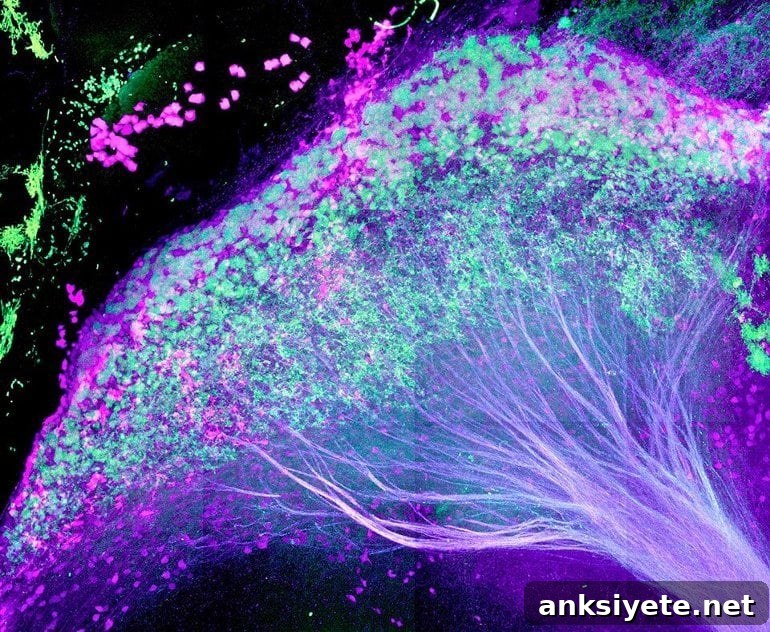
Summary: The lateral habenula acts as a neural switch that controls whether an animal continues to pursue rewards or stops working for them.
Source: Cornell University
A small but crucial brain structure has been identified as a control point for reward-seeking behavior. A study published Aug. 31 in the journal Current Biology shows that the lateral habenula determines when an animal will keep working for rewards and when it will disengage.
“This study changes how we think about this particular brain region,” said senior author Melissa Warden, assistant professor and Miriam M. Salpeter Fellow in the Department of Neurobiology and Behavior. Her appointment is shared between the College of Arts and Sciences and the College of Agriculture and Life Sciences.
Warden noted the findings have implications for psychiatric conditions, especially those involving motivation such as depression, anxiety and apathy.
The paper, titled “Tonic Activity in Lateral Habenula Neurons Acts as a Neutral Valence Brake on Reward-Seeking Behavior,” clarifies the role of the lateral habenula (LHb). This compact structure above the thalamus channels higher-level signals from frontal brain regions to neurotransmitter centers that release serotonin and dopamine.
Until now, the LHb’s function was debated. The new results demonstrate that when LHb neurons are silent, animals remain engaged and continue to work for rewards. Conversely, when LHb neurons fire persistently, animals disengage and stop pursuing rewards.
The researchers found that LHb activity increases specifically when an animal either has consumed enough reward and becomes satiated, or when the effort no longer produces reward. In short, LHb activity signals the transition from engagement to disengagement in reward-seeking tasks.
Historically, neuroscientists have described brain regions in terms of positive or negative valence. Prior studies associated LHb activation with depressive-like states—low mood and anxiety—leading to its characterization as a “negative” region. This study reframes that view.
“A more general explanation for the habenula is not negative versus positive,” Warden said. “It’s whether an animal is willing to work or not.”
This distinction matters for clinical approaches. Neurosurgeons have explored LHb as a target for deep-brain stimulation to treat severe depression. Because the LHb appears to regulate willingness to work for rewards, Warden suggests it may be a better target for conditions marked by apathy and disengagement rather than mood alone.
Apathy can occur independently of low mood in certain conditions, including specific forms of schizophrenia, localized brain damage, and Parkinson’s disease. While depressive symptoms and apathy often overlap, current psychiatric research increasingly aims to map individual symptoms to distinct neural circuits.
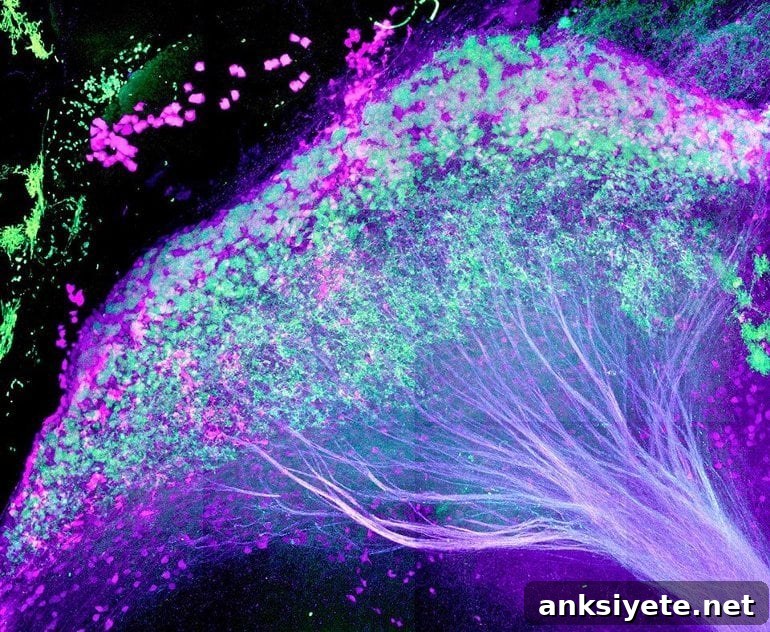
To observe LHb activity, the team used genetically modified mice whose LHb neurons fluoresce when active and dim when inactive. A fiber-optic probe positioned above the LHb detected those fluorescence photons, providing a population-level measure of neural activity over time.
Mice performed a simple task: poke their head through a hole to access a water spout and receive a water reward. Recordings revealed sustained LHb firing during extended periods when mice stopped working—both when they were satiated and when rewards were no longer available.
When rewards were removed, LHb activity rose as mice ultimately quit the task, indicating LHb firing is linked specifically to the decision to stop. In contrast, when LHb activity was suppressed using optogenetics—mice were engineered so light could inhibit LHb neurons—the animals worked for longer despite having received rewards.
These experiments show LHb tonic activity acts as a brake on reward-seeking: elevated LHb activity promotes disengagement, while inhibiting LHb extends engagement. Importantly, the study did not find similar tonic changes in ventral tegmental area dopamine neurons, suggesting a specific role for the LHb.
Ryan Post, Ph.D. ’20, and David Bulkin, a former research associate in Warden’s lab, are co-first authors of the paper.
About this neuroscience research news
Author: Press Office
Source: Cornell University
Contact: Press Office – Cornell University
Image: The image is credited to Warden Lab
Original Research: Closed access.
“Tonic activity in lateral habenula neurons acts as a neutral valence brake on reward-seeking behavior” by Ryan J. Post et al. Current Biology
Abstract
Tonic activity in lateral habenula neurons acts as a neutral valence brake on reward-seeking behavior
Highlights
- Tonic LHb activity reflects engagement and disengagement in reward-seeking tasks
- LHb activity rises during disengagement caused by satiety or repeated reward omission
- Inhibiting LHb prolongs reward-seeking behavioral states
- The Klk8-Cre (NP171) mouse line enables targeted LHb gene expression
Summary
Adaptive behavior requires a balance between persistence in pursuing goals and the ability to stop when continuing is no longer beneficial. While LHb activity has been associated with negative valence in prior work, its role in regulating the transition between engaged reward seeking and disengagement was unclear.
This study demonstrates that LHb neurons show sustained, minutes-long increases in activity during disengagement from reward-seeking, whether the disengagement results from negative valence (repeated reward omission) or positive valence (satiation). Inhibition of LHb activity extends ongoing reward-seeking states but does not by itself trigger re-engagement after quitting. The results point to a model in which tonic LHb activity functions as a neutral-valence brake that suppresses reward-seeking behavior in response to both lack of reward and sufficient reward consumption.