Hallucinations Skew Perception of Crowd Size

featured 100582

Summary: Presence hallucinations—reports of an unseen person nearby—are linked to an increased tendency to overestimate the number of people in a scene. Researchers at EPFL show this overcounting is specific to social stimuli (people) and does not occur for inanimate objects such as boxes. Using a combined virtual reality and robotics platform, the team developed … Read more

Primate vs Non-Primate Neuron Architecture: Key Differences

featured 83380

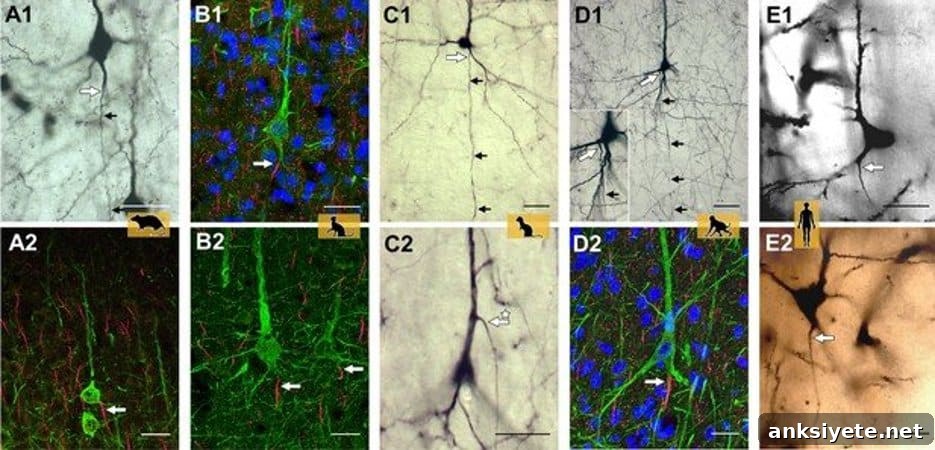
Summary: A new comparative study reveals that the site where an axon emerges from a neuron differs between primates and non-primates, indicating a fundamental architectural distinction in their cortical neurons. Source: RUB Researchers in the Developmental Neurobiology group at Ruhr-Universität Bochum, led by Professor Petra Wahle and collaborating with teams from Mannheim, Jülich, Linz, and … Read more

How Oxytocin May Influence Instagram Behavior

featured 77491

Summary: In a small college-student sample, researchers found that people carrying a specific variant of the oxytocin receptor gene (OXTR) tended to follow more accounts on Instagram. The study did not find evidence that interactions between these genetic variants and relationship-related environmental factors affected online sociability. Source: Cell Press A brief exploratory study of university … Read more

Scientists Restore Neurons Lost to Huntington’s Disease

featured 9973

Researchers have activated the brain’s own stem cells to regenerate a neuron type lost in Huntington’s disease, producing new neurons that integrate into neural circuits and substantially prolong survival in affected mice, a study in Cell Stem Cell reports. Scientists at the University of Rochester Medical Center (URMC) triggered the production of medium spiny neurons— … Read more

How a Hidden Brain Circuit Keeps Vision Reliable

featured 77250

Summary: Excitatory neurons in the visual cortex encode images, while two distinct types of inhibitory interneurons work together in a circuit that improves the stability and reliability of those visual representations. Source: Picower Institute for Learning and Memory Visual processing in the brain is inherently noisy. As signals travel from the eye through multiple brain … Read more

Boost Medication Effectiveness by Playing Your Favorite Song

featured 91718

Summary: Listening to favorite music may enhance the effects of medication and reduce side effects. In a pilot study, cancer patients who listened to music while taking anti-nausea medication reported lower nausea severity and less distress during chemotherapy-related nausea episodes. Source: Michigan State University Music is more than a mood booster; it may act as … Read more

Why Your Brain Idealizes Someone You Love

featured 99304

Summary: A new, world-first study examines how romantic love interacts with the brain’s Behavioral Activation System (BAS), revealing how love shifts attention and motivation toward a romantic partner. Researchers surveyed 1,556 young adults who described themselves as “in love,” asking about their emotional reactions to their partners, the behaviors they display around them, and the … Read more

How Personality Shapes Your Email Habits

featured 38219

Summary: Sending and checking email outside of working hours increases stress, and personality differences influence how people use email and what they find stressful. Source: BPS. Email Use, Personality, and Work-Related Stress A recent study presented at a professional psychology conference finds that email, while essential for many jobs, can be a significant source of … Read more

What Dreams Reveal About Brain Disease

featured 41183

REM Sleep Disorders May Be an Early Warning Sign of Neurodegenerative Disease Summary: Researchers report that disturbances in dreaming and specific sleep disorders can precede clear neurological symptoms by many years, offering a potential early indicator of diseases such as Parkinson’s and Lewy body dementia. REM sleep disturbances could indicate increased risk for neurodegenerative disease … Read more

How the Brain Multitasks: The Science of Attention

featured 24771

Findings clarify how the brain prioritizes important information and how neural circuits may malfunction in attention disorders. Researchers at NYU Langone Medical Center report new evidence that a thin, shell-like structure deep in the mammalian brain—the thalamic reticular nucleus (TRN)—helps the brain focus and multitask by selectively gating sensory information. The team’s experiments in mice … Read more