
Summary: A new comparative study reveals that the site where an axon emerges from a neuron differs between primates and non-primates, indicating a fundamental architectural distinction in their cortical neurons.
Source: RUB
Researchers in the Developmental Neurobiology group at Ruhr-Universität Bochum, led by Professor Petra Wahle and collaborating with teams from Mannheim, Jülich, Linz, and La Laguna, have identified a pronounced species difference in neuronal architecture: the anatomical origin of the axon, the process that transmits action potentials.
The study’s results were published on 20 April 2022 in the journal eLife.
Axons can originate from dendrites
Textbook descriptions typically state that axons arise from the neuronal cell body, but some neurons instead give rise to axons from dendrites. These are called axon-carrying dendrites (AcDs). Dendrites normally collect and integrate synaptic inputs, yet when an axon begins on a dendrite, inputs to that dendrite can in some cases trigger action potentials more directly.
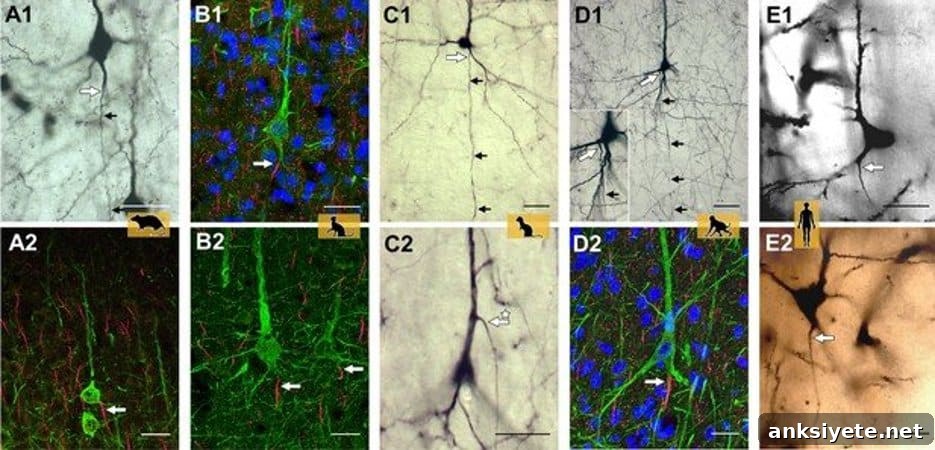
“One distinctive feature of this project was the use of archived tissue and slide preparations, many of which have long been used for teaching,” explains Petra Wahle. The team analyzed material across multiple species—mouse and rat (rodents), pig (ungulate), cat and ferret (carnivores), and macaque and human (primates)—and applied five different staining and labeling methods.
After examining more than 34,000 neurons, the researchers concluded that there is a clear species difference: excitatory pyramidal neurons in the outer cortical layers II and III of primates show far fewer axon-carrying dendrites than those of non-primate mammals.
The study also found quantitative differences in AcD prevalence among inhibitory interneurons in cat and human cortex, while comparisons across macaque cortical areas—covering primary sensory and higher-order regions—showed no systematic differences in AcD proportion.
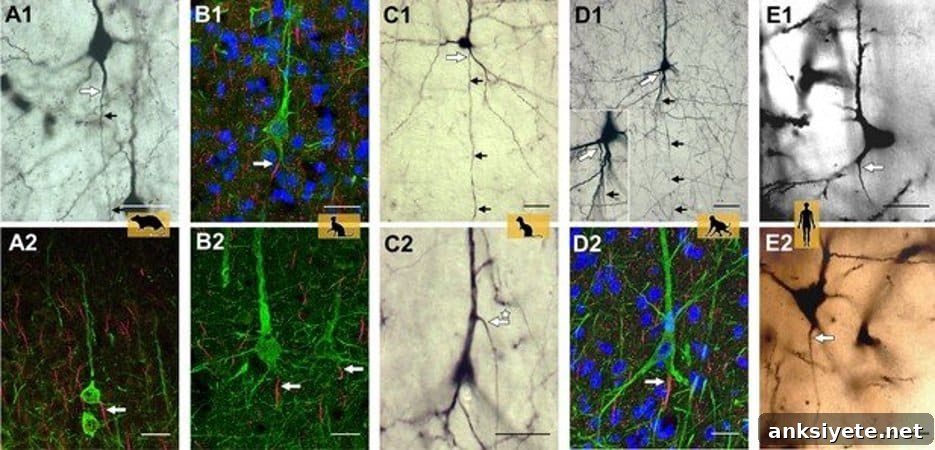
High-resolution microscopy played a crucial role in the analysis. According to Wahle, this level of resolution enabled the team to trace axonal origins at the micrometer scale, resolving details that can be missed with conventional light microscopy.
Functional and evolutionary implications remain unclear
The functional role of axon-carrying dendrites is not yet fully understood. In standard somatodendritic integration, a neuron sums excitatory and inhibitory inputs arriving at dendrites and the soma; if the combined input reaches threshold, an action potential is generated at the axon initial segment. AcD neurons are thought to be privileged in that depolarization on an axon-carrying dendrite can trigger action potentials directly, potentially bypassing somatic integration and somatic inhibition.
Why primates evolved to have far fewer AcD neurons in superficial cortical layers, and what advantage this might afford primate neocortex in information processing, remains an open question for future research.
About this evolutionary neuroscience research news
Author: Press Office
Source: RUB
Contact: Press Office – RUB
Image: The image is credited to the researchers
Original Research: Open access.
“Neocortical pyramidal neurons with axons emerging from dendrites are frequent in non-primates, but rare in monkey and human” by Petra Wahle et al. eLife
Abstract
Neocortical pyramidal neurons with axons emerging from dendrites are frequent in non-primates, but rare in monkey and human
The classic model of neuronal signaling holds that synaptic inputs arrive on dendrites and soma, are integrated in the somatodendritic compartment, and—when threshold is reached—produce axonal output originating at the cell body. However, axonal origins can instead arise on dendrites, a configuration described by the terms “axon-carrying dendrite” (AcD) and “AcD neurons.” In rodent hippocampus, AcD cells behave as functionally privileged elements because inputs to the AcD can bypass somatic integration and rapidly initiate action potentials.
This study surveys axon origin diversity in neocortical pyramidal cells across multiple mammalian taxa: rodents, ungulates, carnivores, and primates. Detection methods included Thy-1-EGFP labeling in mouse; retrograde biocytin tracing in rat, cat, ferret, and macaque; SMI-32/βIV-spectrin immunofluorescence in pig, cat, and macaque; and Golgi staining in macaque and human.
In non-primate mammals, 10–21% of pyramidal cells across layers II–VI exhibited AcDs. By contrast, macaque and human cortex showed substantially lower proportions of AcD cells, particularly among supragranular neurons. Analysis of six cortical areas in three macaques—covering sensory, association, and limbic regions—revealed area- and individual-dependent variation in AcD percentages by roughly a factor of two. Unexpectedly, pyramidal cells in postnatal cat white matter and in aged human cortex showed much higher proportions of AcDs. Additionally, interneuron subtypes in developing cat and adult human cortex presented AcD proportions that were type-specific and, for some interneuron types, exceeded those of pyramidal cells.
Overall, these findings broaden our understanding of how AcD neurons are distributed across mammalian neocortex, highlighting a pronounced difference between non-primate mammals—where AcD cells are relatively common—and primates, where such cells are largely confined to deeper layers and white matter.