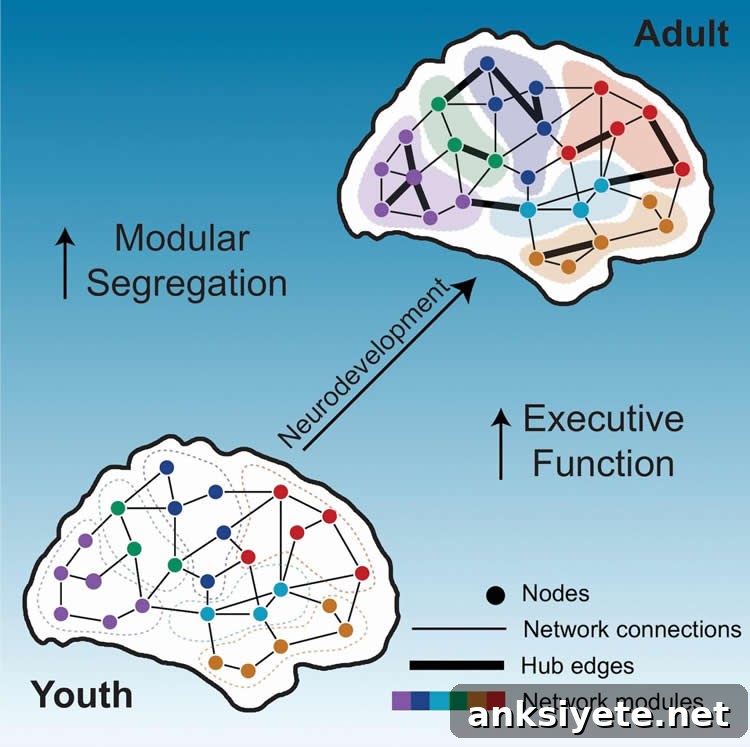
Summary: New research shows that changes in brain network organization during adolescence support improvements in executive function.
Source: University of Pennsylvania
Changes in network organization support improvements in executive function during adolescence and young adulthood
As children grow into adolescence and then into young adulthood, they typically show striking gains in executive functions—skills that include impulse control, planning, organization, and decision-making. These abilities predict important outcomes such as academic achievement, susceptibility to substance use, and risk for psychiatric disorders. A new study from the University of Pennsylvania, published in Current Biology, maps how structural brain network organization changes across youth and how those changes relate to the development of executive function.
The research team, led by Theodore D. Satterthwaite, MD, Danielle S. Bassett, PhD, and doctoral student Graham L. Baum, examined how the brain’s white matter architecture becomes organized into modules during development. Modules are sub-networks of brain regions that are strongly connected internally and relatively weakly connected to other modules. Such modular organization is believed to support specialized processing—ranging from basic sensory and motor functions to higher-level cognitive processes like executive control. The study shows that as young people mature, their structural networks become more clearly modular, and this modular segregation is associated with better executive performance.
“We were surprised to find that development produced both more distinct modules and greater global integration,” Satterthwaite said. In other words, maturation creates specialized subnetworks while preserving—and even improving—the brain’s ability to communicate efficiently across the whole network.
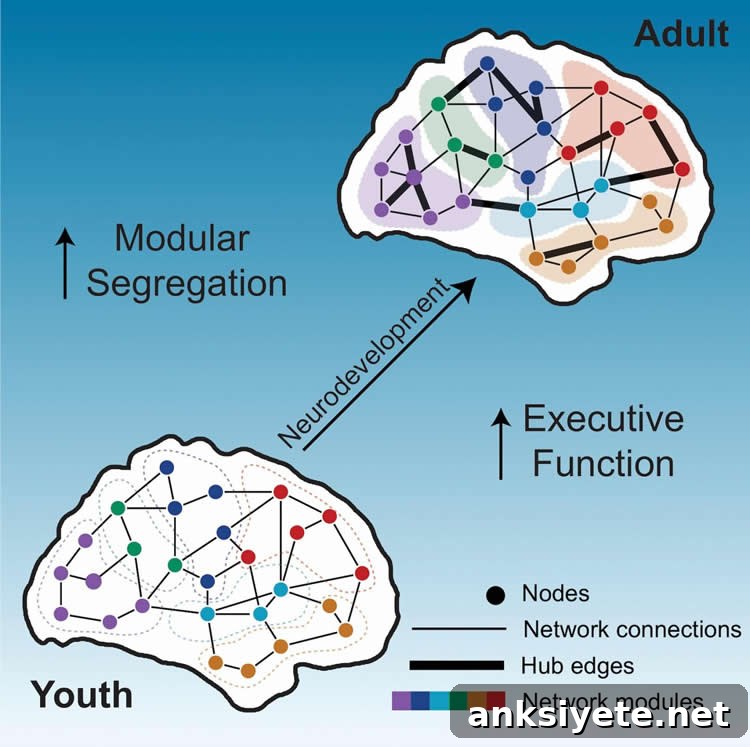
The team analyzed diffusion MRI scans from a large, community-based sample of 882 participants, ages 8–22, collected as part of the Philadelphia Neurodevelopmental Cohort, a National Institute of Mental Health–funded study of brain development. Consistent with expectation, executive function scores improved substantially with age. Structural network analyses revealed two concurrent trends: increasing segregation of modules (stronger within-module connections and weaker between-module connections) and enhanced global network efficiency. These changes were driven in part by targeted strengthening of connector hubs—white matter connections that link important regions both within and across modules.
Graham Baum emphasized that increased modular segregation did not fragment the network. “Rather than isolating parts of the brain, development strengthens specialized modules while simultaneously improving the network’s ability to transmit information efficiently across modules,” he explained. This balance between specialization and integration appears important for the maturation of advanced cognitive abilities.
Critically, the researchers found that both greater modular segregation and higher network efficiency were associated with better executive performance. Statistical mediation analyses indicated that changes in network organization help explain why executive function improves with age. In short, structural maturation of the brain’s network architecture supports the emergence of stronger executive skills in youth.
The research has potential clinical implications. By characterizing normative trajectories of structural network development, the findings may help identify biomarkers of atypical brain maturation that increase risk for psychosis, mood disorders, or other psychiatric conditions. The authors are extending this work by combining structural and functional imaging to examine how white matter architecture constrains functional network activity, and by testing whether early network features predict later emergence of psychiatric symptoms.
The study, “Modular Segregation of Structural Brain Networks Supports the Development of Executive Function in Youth,” used diffusion imaging and network analysis in 882 youths (ages 8–22) from the Philadelphia Neurodevelopmental Cohort. Lead authors include Graham L. Baum, Rastko Ciric, David R. Roalf, Richard F. Betzel, Tyler M. Moore, Russell T. Shinohara, Ari E. Kahn, Simon N. Vandekar, Petra E. Rupert, Megan Quarmley, Philip A. Cook, Mark A. Elliott, Kosha Ruparel, Raquel E. Gur, Ruben C. Gur, Danielle S. Bassett, and Theodore D. Satterthwaite. The study was published online May 25, 2017 in Current Biology (doi:10.1016/j.cub.2017.04.051).
• Structural brain modules become more segregated from childhood through young adulthood.
• Strengthening of hub connections supports both modular segregation and improved global efficiency.
• Enhanced modular segregation and network efficiency mediate age-related improvements in executive function.
Abstract (summary)
Large-scale functional modules in the human brain refine across development, but until now it has been unclear whether the underlying white matter architecture follows a similar pattern. In this sample of 882 participants aged 8–22, diffusion imaging shows that structural network modules become more segregated with age—characterized by weaker connections between modules and stronger connections within modules—while global efficiency increases. These changes are driven by age-related strengthening of hub edges and are associated with improved executive performance, indicating that structural network maturation supports the development of executive function in youth.