
Summary: Red does not produce uniquely strong gamma-band oscillations in the human visual cortex when retinal input is controlled for; red and green elicit comparable gamma responses at equal cone contrast.
Source: ESI
Red traffic lights make drivers stop. The color red functions as a signal and warning cue in everyday life. But does red also drive particularly strong neural oscillations in the brain?
Researchers at the Ernst Strüngmann Institute (ESI) for Neuroscience investigated whether red selectively evokes stronger gamma-band activity in early visual cortex than other colors. Their study, “Human visual gamma for color stimuli,” appears in the journal eLife and was led by Benjamin J. Stauch, Alina Peter, Isabelle Ehrlich, Zora Nolte, and ESI director Pascal Fries.
The team focused on the primary visual cortex (V1), the first and largest cortical area to receive input from the retina. When V1 is stimulated by large, spatially uniform images, neural activity often shows prominent oscillations in the gamma frequency band (roughly 30–80 Hz). Previous reports suggested that colored surfaces, and red in particular, can produce especially strong gamma oscillations. The ESI group set out to test that claim while carefully controlling the retinal input that reaches V1.
Defining color objectively
A major challenge in comparing color effects across studies is that color is not an absolute property of a stimulus as presented on different displays. Monitors vary in how they render color, and researchers can define colors in different ways: by display output, by subjective perception, or by how the stimulus excites the retina. The ESI team argued that the most objective approach for studying early visual responses is to define colors by their activation of the retinal cone photoreceptors.
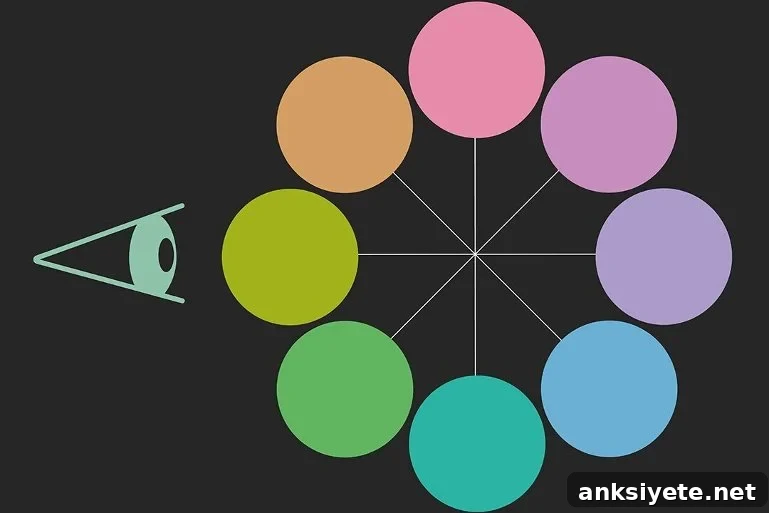
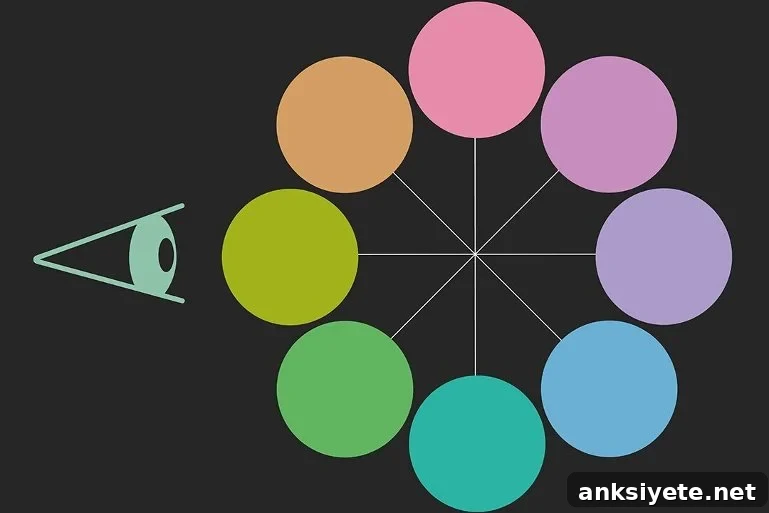
Human color vision depends on three types of cone photoreceptors—L cones (long-wavelength, sensitive to red), M cones (medium-wavelength, sensitive to green), and S cones (short-wavelength, sensitive to blue). The brain infers color from relative activation across these cones. In primates, early visual pathways represent color along two principal axes derived from cone signals: the L–M axis (red versus green) and the S–(L+M) axis (blue–yellow axis). Defining stimuli in that cone-contrast space allows direct control of the input arriving at V1.
Study design and participants
To obtain robust, generalizable results, the researchers tested a larger human sample (N = 30) than many previous studies, which often used only a few animals or participants. Stimuli were matched for luminance and for cone contrast values in a color coordinate system informed by responses from the lateral geniculate nucleus, V1’s main subcortical input. While equating cone contrast, the team compared red and green stimuli along the L–M axis and also tested stimuli that selectively targeted the S-cone axis (blue stimuli).
Key findings
Using magnetoencephalography (MEG) to record cortical activity, the authors found that when L–M cone contrast is equalized, red and green stimuli elicit similarly strong gamma-band oscillations in early visual cortex. In other words, red is not inherently special in producing stronger gamma—its apparent advantage in earlier reports likely stemmed from differences in retinal input rather than a unique cortical bias.
Stimuli that isolated the S-cone axis (blue) produced comparatively weak gamma responses, smaller event-related fields, and worse behavioral performance in a change-detection task. This weaker response aligns with known properties of the S-cone system: S cones are less numerous, have different retinal distributions, and often produce slower, smaller responses in early visual pathways.
Importantly, the study demonstrates that color-induced gamma oscillations can be measured robustly with MEG when stimuli are designed to control retinal cone activation. This opens the door to future noninvasive human studies that can reduce reliance on animal experiments while addressing questions about cortical encoding of color.
Implications and future directions
These results clarify how early human visual cortex represents chromatic input: gamma-band strength for stimuli along the L–M axis scales with L–M cone contrast and does not show a distinct red bias after proper stimulus control. The finding that S-cone–driven stimuli evoke weaker responses highlights the importance of considering cone-specific input when interpreting cortical activity.
A better understanding of how V1 responds to controlled chromatic input may inform basic models of cortical processing and could eventually contribute to technologies such as visual prostheses that attempt to stimulate visual cortex to restore perception—although practical applications remain a long-term goal.
About this visual neuroscience research news
Author: Press Office
Source: ESI
Contact: Press Office – ESI
Image: The image is credited to ESI/C. Kernberger
Original Research: Open access. “Human visual gamma for color stimuli” by Benjamin J. Stauch et al., eLife.
Abstract
Human visual gamma for color stimuli
Strong gamma-band oscillations in primate early visual cortex can be induced by homogeneous color surfaces. Earlier studies reported particularly strong gamma for red stimuli, but those studies did not always control precortical color processing and the resulting strength of V1 input. Differences favoring red could therefore reflect unequal retinal drive rather than a cortical preference.
In the present study, stimuli were matched for luminance and cone contrast using a color coordinate system based on lateral geniculate nucleus responses. Magnetoencephalography was recorded in 30 human participants. When L–M cone contrast was equalized, gamma oscillations in early visual cortex did not differ between red and green stimuli. Stimuli that isolated the S-cone axis induced very weak gamma responses, smaller event-related fields, and poorer behavioral detection. Overall, gamma strength for L–M stimuli was well predicted by L–M cone contrast and showed no clear red bias once cone contrast was properly controlled.