
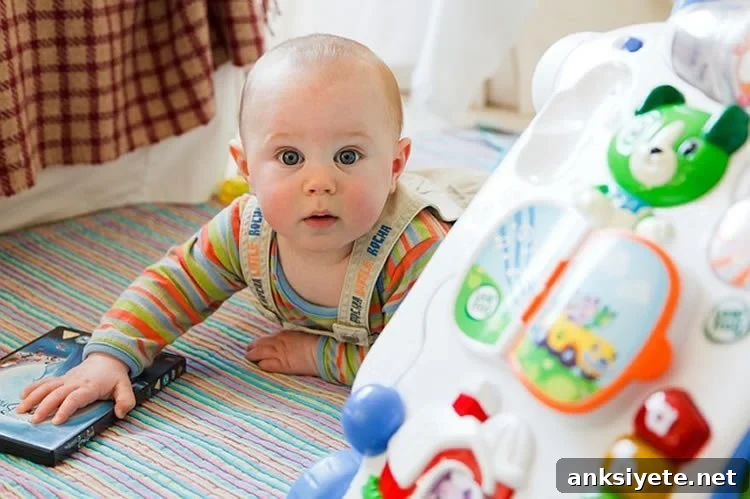
Infants can recognize and use new communicative signals in their environment
A recent study from Northwestern University reveals that the remarkable flexibility adults show in creating new ways to communicate — such as smoke signals or Morse code — is already present in infancy. The research demonstrates that 6-month-old babies can identify a novel sound as a communicative signal and then use that signal to support learning in much the same way they use spoken language.
The research team investigated whether infants would treat an unfamiliar sound as a communicator of meaning and whether that interpretation would help them learn about the world. Specifically, they tested whether a sequence of tones could function like speech to promote object categorization, a foundational cognitive ability that previous work has shown is supported by exposure to speech.
To test this, infants watched a short video in which two adults engaged in a conversation. In one version of the video, one adult spoke in English while the other responded using a series of beep-like tones. In a control version, infants heard the identical tones but the sounds were not embedded in a communicative exchange and therefore were uncoupled from the people’s interaction and behavior. After viewing these vignettes, infants completed a categorization task involving novel objects while they either listened to the tones or experienced silence.
The findings were striking. Infants who had observed the tones being used communicatively were able to link those tones to the task of categorization; they formed object categories as reliably as infants who heard speech. By contrast, infants who heard the same tones without any communicative context failed to form categories, performing like infants with no prior exposure to the tones. In other words, merely hearing tones was not enough — infants needed to see the tones used as communication before those sounds could support learning.
Lead author Brock Ferguson, a doctoral candidate in cognitive psychology at Northwestern’s Weinberg College of Arts and Sciences, explained the hypothesis driving the research: if infants could learn that a new signal was communicative, then that signal might confer the same learning benefits as speech. The results supported this prediction, showing that infants treated the new communicative sound much like they treat spoken language when it came to promoting categorization.
Sandra Waxman, senior author of the study and director of the Project on Child Development at Northwestern, emphasized the broader significance. She noted that infants’ rapid acceptance of a novel communicative signal demonstrates an early-developing social ability to detect and exploit new forms of communication in their environment. Once infants recognize a signal as communicative, they can use it to guide core cognitive tasks such as grouping objects into categories.
Source: Hilary Hurd Anyaso — Northwestern University
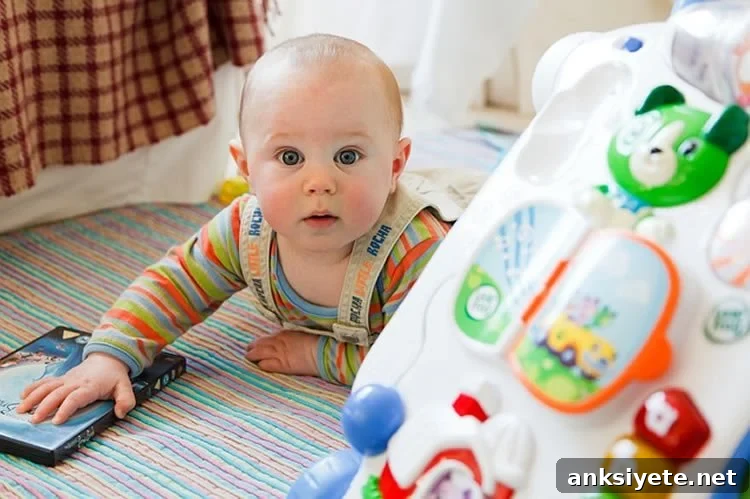
Image source: Public domain image used for illustration only
Original research: Ferguson, B. & Waxman, S. R., “What the [beep]? Six-month-olds link novel communicative signals to meaning,” published in Cognition (online September 30, 2015), doi:10.1016/j.cognition.2015.09.020
Abstract
What the [beep]? Six-month-olds link novel communicative signals to meaning
During the first year of life, infants become increasingly attuned to the signals of their native language and begin connecting those signals to meaning. This study examined whether 6-month-old infants can similarly treat otherwise arbitrary signals — here, sine-wave tone sequences — as communicative and use them to support cognition. Infants were exposed to tones either embedded in a rich communicative exchange between two adults or presented in a non-communicative context. Only infants who observed the tones used within the communicative exchange later formed object categories when tested; infants who heard the same tones outside of a communicative context failed to categorize. The results reveal that 6-month-olds are flexible in identifying which ambient signals function as communication and in recruiting those signals to support core cognitive abilities such as categorization.
Ferguson, B., & Waxman, S. R. (2015). What the [beep]? Six-month-olds link novel communicative signals to meaning. Cognition. doi:10.1016/j.cognition.2015.09.020