
Summary: A large new meta-analysis of hundreds of task-based brain scans identifies specific error-processing and inhibitory control problems in obsessive-compulsive disorder (OCD) that may explain repetitive compulsions.
Source: University of Michigan
They wash their hands repeatedly. They flip switches over and over. They check—and recheck—that the stove is off.
Obsessive-compulsive disorder (OCD) drives people to perform repetitive actions even when they know these behaviors are unnecessary and when those actions interfere with daily life. Scientific uncertainty about the brain mechanisms behind those compulsions means roughly half of people with OCD do not get adequate relief from current treatments.
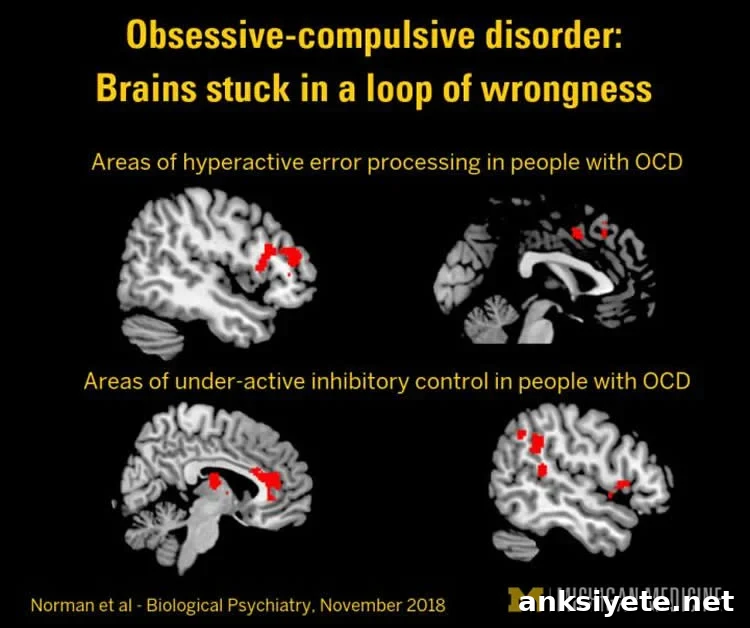
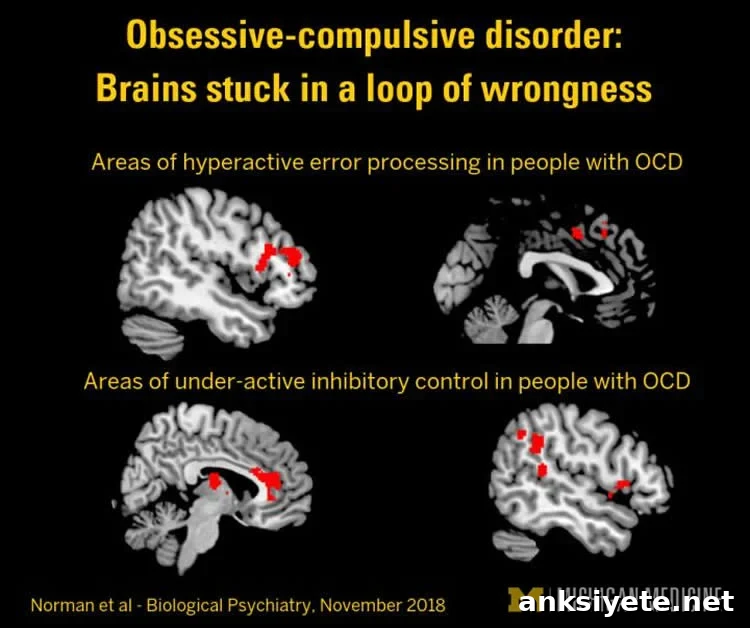
A new meta-analysis of task-based functional MRI (fMRI) scans collected from nearly 500 participants—both people with OCD and healthy volunteers—clarifies which brain systems are most involved. The combined data, larger than any single prior study, points to an overactive error-detection system paired with underactive inhibitory control networks. Put simply, the brain appears to detect “something is wrong” too strongly, while the circuits that would stop the behavior do not respond enough—leaving patients locked in repetitive actions they cannot easily stop.
Errors and stop signals
Researchers at the University of Michigan pooled unthresholded statistical maps and other task-based fMRI data from multiple studies worldwide and published their findings in Biological Psychiatry. Luke Norman, Ph.D., the study’s lead author, reports that this collaborative approach allowed the team to confirm hypothesized brain-circuit abnormalities that smaller studies could not reliably demonstrate.
“In OCD, the brain responds too strongly to errors and too weakly to stop signals,” Norman says, summarizing the core result. By aggregating data from ten different studies and nearly 500 individuals, the team was able to show consistent differences in brain activity in regions previously suspected to underlie OCD symptoms.
New targets for therapy
Co-investigators include Kate Fitzgerald, M.D., M.S., and Stephan Taylor, M.D., both faculty in U-M’s Department of Psychiatry. Fitzgerald, who co-directs Michigan Medicine’s Pediatric Anxiety Program, emphasizes that the findings point to concrete therapeutic targets. “Error processing and inhibitory control are both altered in people with OCD,” she explains. “Patients often know their rituals are unnecessary, but the error signal does not properly engage the brain network required to stop the behavior.”
Those insights are already informing clinical work. Fitzgerald leads a clinical trial testing whether targeted cognitive-behavioral therapy (CBT) sessions can reduce compulsive symptoms in teens and adults. The trial combines repeated brain scans with structured therapy to examine whether strengthening communication between error-detection and control networks improves outcomes.
Zeroing in on brain differences
The analysis particularly implicates the cingulo-opercular network—a set of centrally located brain regions connected by dense nerve pathways. This network normally monitors performance, detects errors or conflicts, and recruits frontal decision-making regions when something is “off.”
Participants performed error-detection and response-inhibition tasks while undergoing fMRI. The pooled dataset included 484 children and adults across different sites, some taking medication and some not. Unlike prior work, this meta-analysis included brain maps from tasks that explicitly tested how participants responded to errors and how they stopped ongoing actions.
Across studies, a consistent pattern emerged: people with OCD showed greater activation in areas that register errors (for example, dorsal anterior cingulate cortex and parts of the insula) but reduced activation in regions that implement stopping or inhibit an action (including rostral and ventral anterior cingulate, thalamus/caudate, and parietal areas).
Disconnected brakes
The investigators note that these activity differences do not by themselves resolve whether altered brain responses cause OCD or develop as a consequence of chronic compulsions. However, the pattern suggests an “inefficient” connection between systems that detect mistakes and systems that execute control. In other words, the brain’s error signal may be strong, but the “braking” system that should translate that signal into stopping behavior is underpowered or poorly connected.
Fitzgerald offers a useful metaphor: “It’s like the foot is pushing the brake pedal, but the pedal isn’t linked to the wheels. In CBT we teach patients to recognize urges and resist compulsions to strengthen the connection between the brake and the wheels, but that approach only helps about half of patients. Findings like these could help refine CBT or develop new, more targeted treatments.”
Translating findings into clinical care
OCD used to be classified as an anxiety disorder; today it is considered a distinct condition. Many patients experience anxiety as a secondary effect of being unable to stop repetitive behaviors they recognize as unnecessary.
The U-M team’s clinical trial aims to test techniques that reduce the compulsive drive and the resulting anxiety. The trial recruits teens and adults up to age 45, includes two fMRI sessions at U-M’s research facility, and provides 12 weeks of free, targeted therapy between scans to measure brain and symptom changes.
Emerging treatments such as repetitive transcranial magnetic stimulation (rTMS), now approved for OCD, target some of the same circuits the U-M team has identified. rTMS uses focused magnetic fields to modulate activity in specific brain regions. Mapping the interactions between error-detection and inhibitory-control regions helps clinicians decide where to apply such stimulation for optimal effect.
For severe, treatment-resistant cases, neurosurgical approaches—such as targeted disconnection of specific circuits or implanted stimulators—have been used in the last decade. The new meta-analytic findings may help neurosurgeons consider which parts of the cingulo-opercular and related networks to target when planning interventions.
The bottom line for patients
The authors call for longitudinal research that combines genetic testing with repeated fMRI scans of the same people over time. Long-term studies could clarify whether impaired error processing and inhibitory control are primary causes of OCD or develop secondary to years of compulsive behavior.
In the meantime, the research team hopes the findings reassure patients and families that OCD is a brain-based medical condition that can be studied and treated scientifically. “We are gaining a clearer picture of the brain mechanisms that make it difficult for patients to control compulsions,” Norman says. Fitzgerald adds, “OCD is not a moral failing or bad behavior—it is a medical disorder. Brain imaging gives us objective insight, similar to how cardiology uses EKGs, and this knowledge will help improve care.”
Funding: The study was supported by the National Institutes of Health (grant MH102242).
Source and publisher: University of Michigan; organized coverage by Neuroscience News.
Original research: Norman LJ et al., “Error-processing and inhibitory control in obsessive-compulsive disorder: a meta-analysis using statistical parametric maps,” published in Biological Psychiatry (2018). The paper reports voxel-wise meta-analytic results comparing patients with OCD and healthy controls during error-processing and inhibitory-control tasks.
Abstract (concise)
This meta-analysis combined unthresholded statistical maps from multiple fMRI studies to examine error-processing and inhibitory control in OCD. Across studies, patients showed hyperactivation in dorsal anterior cingulate cortex, supplementary motor areas, and right anterior insula during error-processing, but hypoactivation in rostral and ventral anterior cingulate, thalamus/caudate, parietal regions, and medial orbitofrontal cortex during inhibitory control. Behaviorally, patients had slower inhibitory responses and made more inhibitory errors. Results support a model in which intact or overactive error detection, combined with impaired implementation of inhibitory control, contributes to difficulty stopping compulsive behaviors in OCD.