

 Our family of origin plays a powerful role in shaping who we become.
From our habits and emotional responses to the choices we make in life, family dynamics influence us whether we feel close to our relatives or distant from them.
Bowenian family systems theory views the family as an emotional unit: individual behavior is best understood in the context of family patterns. When family members struggle to maintain individuality within that system, conflict and dysfunction can arise. Bowen identified differentiation of self—the ability to remain emotionally autonomous while staying connected—as central to resolving conflict and promoting emotional health.
This article explains how Bowenian therapy concepts and techniques can help families resolve conflict and support individual members in developing emotional independence.
This Article Contains:
- What Is Bowenian Family and Couples Therapy?
- Six Core Concepts of Bowenian Therapy
- How It Works: A Case Study
- Five Practical Techniques for Sessions
- The Genogram: A Bowenian Intervention
- Resources and Tools
- Key Takeaway
- References
What Is Bowenian Family and Couples Therapy?
Murray Bowen began his work in the mid-20th century while treating patients at the Menninger Clinic. Over time he shifted attention from individual pathology to how family relationships shape emotional functioning.
Bowen developed the idea of differentiation of self—the capacity to hold one’s own thoughts and values while remaining emotionally connected to others. A well-differentiated person can make reasoned decisions rather than simply reacting to emotional pressure from family members. In contrast, a poorly differentiated person tends to depend on others’ approval and adapts their thinking and behavior to fit the emotional climate.
In Bowenian therapy the therapist helps family members recognize these patterns and supports them in increasing differentiation. By doing so, family systems can reduce reactive cycles and manage conflict more effectively.
Six Core Concepts of Bowenian Therapy
 Bowen’s theory is often summarized by three central concepts and three related processes.
- Core concepts: differentiation of self, triangulation (triangles), and emotional cutoff.
- Processes: the family projection process, multi-generational transmission process, and societal emotional process.
Differentiation of self
Working toward greater differentiation is the main aim of Bowenian therapy. Differentiated individuals balance emotion and reason, maintain a stable sense of self, and can engage in relationships without being overwhelmed by anxiety or dependency. This capacity supports healthier decision-making and interpersonal functioning.
Triangulation and triangles
Triangulation occurs when tension between two people draws a third person into the conflict. Anxiety between two partners or family members often leads one of them to involve someone else to reduce immediate tension. While a temporary triangle can ease stress, chronic triangulation undermines direct communication and perpetuates dysfunction. A common example is when parents involve a child in their disputes, placing the child in a stressful mediating role.
Emotional cutoff
Emotional cutoff describes strategies people use to manage family anxiety—by avoiding contact, moving away, or refusing to discuss important topics. While distancing can be protective short-term, unresolved cutoffs can cause patterns to repeat in other relationships and lead to substitute family ties in work or social circles.
Processes
Bowen emphasized how family dynamics extend across generations and into society. The family projection process describes how parents unintentionally transfer their anxieties to a child, leading them to treat the child as if a problem exists. The multi-generational transmission process explains how patterns of differentiation (or lack of it) pass from one generation to the next, shaping partner choice and parenting styles. The societal emotional process applies these ideas to larger groups: undifferentiated emotional patterns can contribute to social polarization and conflict.
How Does It Work? A Case Study
Consider a married couple with a nine-year-old son: Rose, Frank, and Michael. Frank wants another child, but Rose, focused on her career, fears another child could jeopardize her promotion. Instead of addressing Rose directly, Frank asks Michael whether he wants a baby sister, drawing the child into the parents’ disagreement.
This is triangulation: Frank avoids direct conversation with Rose and involves Michael, who then feels pressured and worries about his mother’s feelings. Rose, in turn, becomes anxious and doubts her parenting. Her mother’s expectations to have more children further complicate Rose’s ability to set boundaries.
A Bowenian therapist would focus less on whether the couple should have another child and more on how they communicate. The therapist would identify the triangulation and guide the couple toward detriangulation—encouraging Frank to voice his wishes directly to Rose and helping both parents talk about the emotional distance they feel without pulling Michael into that conflict. Over time, this process supports clearer communication and greater differentiation for each family member.
Five Practical Techniques for Your Sessions
 Use these evidence-informed techniques in Bowenian family or couple sessions.
Process questions
Process questions shift attention from content to the way the family interacts. Instead of asking “Why do you want another child?” a process question would ask, “What happens when you try to raise this topic with your partner?” Process questions slow reactivity and reveal interaction patterns.
Neutralizing triangulation
The therapist must avoid becoming part of a triangle. Remaining neutral, focusing on patterns rather than taking sides, and encouraging direct communication between the primary parties helps dissolve unhealthy triangles.
Relationship experiments
Relationship experiments invite family members to try new interaction patterns between sessions. These short, structured experiments reveal how small changes can shift entrenched reactions and create options for healthier engagement.
The “I” position
Teaching family members to express their perspective using “I” statements reduces blame and lowers emotional escalation. Replacing “You never listen” with “I feel unheard when conversations end quickly” opens the door to more productive dialogue.
Coaching
In Bowenian work the therapist acts as a coach—supporting clients to identify their roles in recurring patterns and to practice new responses. Coaching emphasizes empowerment and skill development rather than providing direct solutions.

Supportive Tools for Practitioners
Practical worksheets and structured exercises can help families rehearse direct communication, manage triangulation, and practice differentiation between sessions.
The Genogram: A Bowenian Intervention to Try
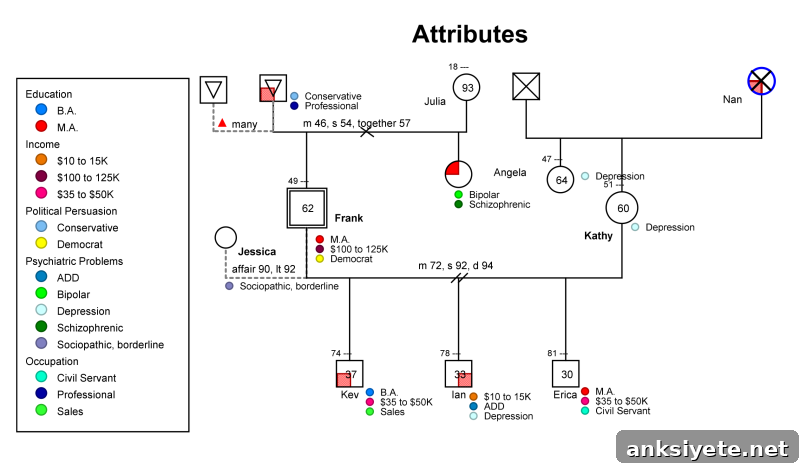
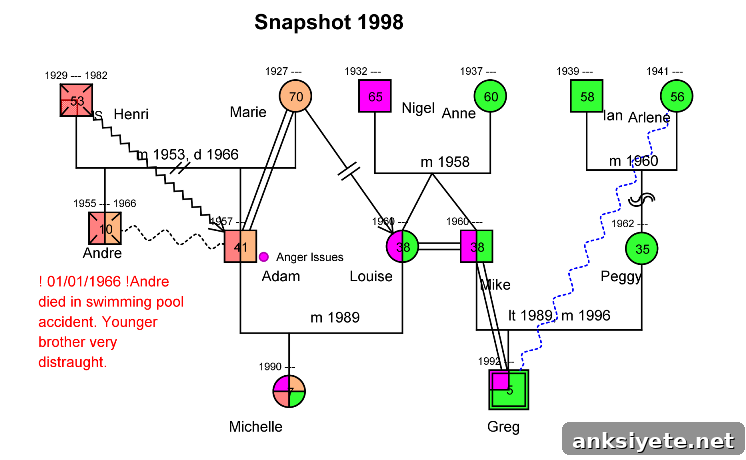
Bowen popularized the genogram as a clinical tool. A genogram looks like a family tree but maps relational patterns, medical and mental health issues, and emotional distances across generations. Building a genogram collaboratively helps clients and therapists visualize inherited patterns and how those patterns influence current problems.
Genograms use standardized symbols and line styles to indicate closeness, conflict, estrangement, and other relationship qualities. Seeing these patterns laid out often prompts insight and points to places where family members can experiment with different ways of relating.
Resources and Tools
Therapists using Bowenian approaches often pair theory with practical tools that promote clearer communication and guided reflection. Worksheets that help clients convert accusatory “you” statements into constructive “I” statements, tools for mapping family narratives, and exercises that identify unmet needs can all support the therapeutic process.
Structured worksheets and step-by-step exercises also help clients plan relationship experiments between sessions and reflect on progress in a concrete way.
Key Takeaway
Family patterns formed in the family of origin profoundly shape how individuals relate to others. Bowenian therapy offers a clear framework for understanding these patterns and practical techniques for increasing differentiation, reducing triangulation, and improving communication.
By cultivating emotional maturity and learning new ways to interact, family members can strengthen relationships at home and carry healthier patterns into their broader social contexts.
- The Bowen Center for the Study of the Family. Introduction to Bowen’s concepts.
- Brown, J. (1999). Bowen family systems theory and practice: Illustration and critique. Australian and New Zealand Journal of Family Therapy, 20(2), 94–103.
- Charles, R. (2001). Empirical support for Bowen’s concepts of differentiation, triangulation, and fusion. American Journal of Family Therapy, 29(4), 279–292.
- DeLisi, L. E. (2021). Commentary on genetics in schizophrenia research. Schizophrenia Research.
- McGoldrick, M., Gerson, R., & Petry, S. (2020). Genograms: Assessment and Intervention (4th ed.).
- Nichols, M. P., & Schwartz, R. C. (1984). Family Therapy: Concepts and Methods.