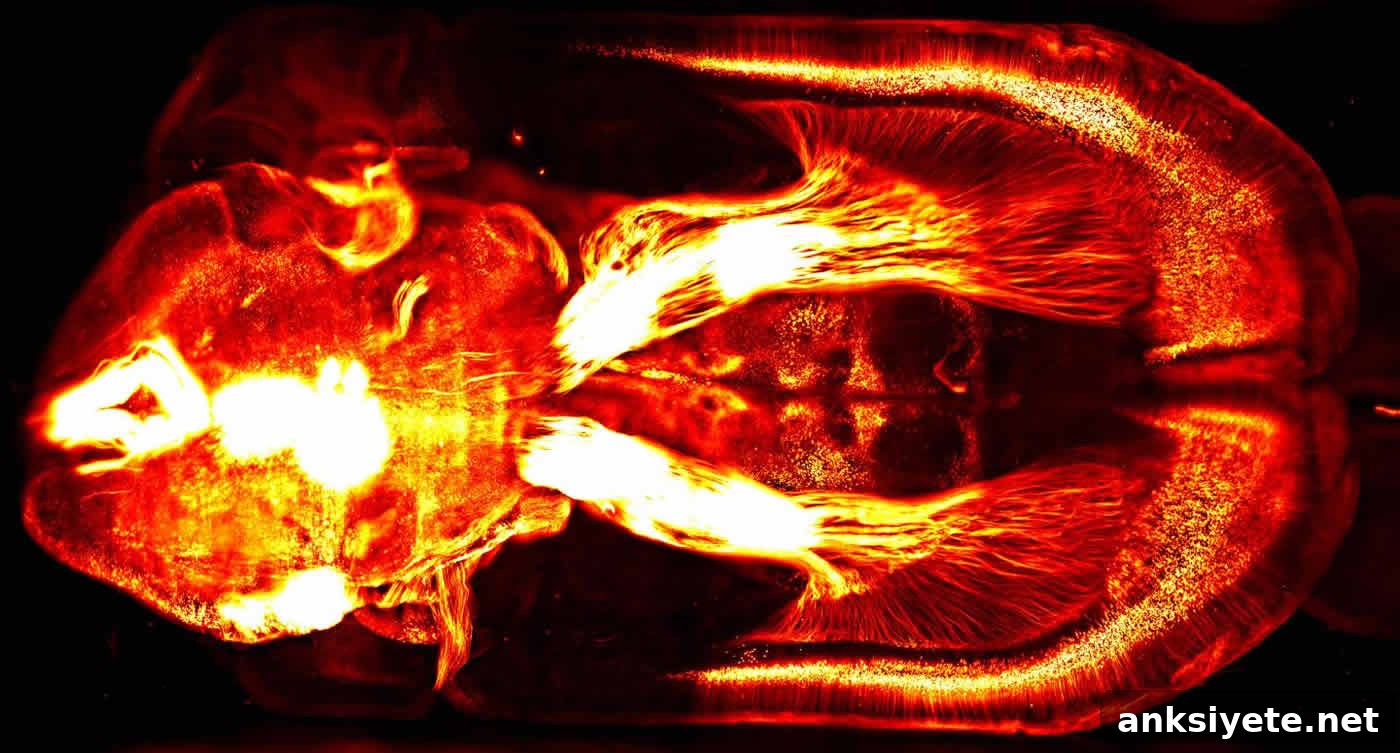
Summary: Researchers will unveil a new immersive virtual reality system that allows users a novel, intuitive way to visualize and interact with large three-dimensional anatomical brain datasets at Neuroscience 2017.
Source: Wyss Center.
A new immersive virtual reality (VR) platform delivers a powerful and practical way to visualize and interact with very large volumes of 3D anatomical brain data. Created by teams at the Wyss Center for Bio and Neuroengineering and the University of Geneva, the system supports neurotechnology development, basic neuroscience research, and surgical or procedural training. A poster describing the system was scheduled for presentation on Wednesday 15 November at the Society for Neuroscience annual meeting in Washington, D.C., as part of Neuroscience 2017.
Wearing VR headsets, users can place themselves inside a fully rendered mouse brain and examine cellular-scale structures in three dimensions. Natural, hand-held controllers allow users to point, select, highlight, slice, measure, and zoom through tissue volumes with rapid, intuitive gestures. This hands-on approach makes it easier to explore complex anatomical relationships, compare regions, and follow neuronal pathways than is typically possible on a flat computer screen.
The platform was developed specifically to address the challenges posed by the massive datasets now generated by the latest high-resolution optical imaging methods. Modern lightsheet and other high-throughput microscopes routinely produce terabyte-scale image volumes that are difficult to inspect and interpret using traditional desktop visualization tools. This VR solution offers an immersive environment optimized for navigating those large data volumes while preserving cellular detail and anatomical context.
Dr. Stéphane Pages, Staff Scientist at the Wyss Center and Senior Research Associate at the University of Geneva, who oversaw microscope construction and is lead author on the project description, said: “The immense data volumes produced by today’s high-performance microscopes are driving the development of new methods to visualize the brain. We have developed this virtual reality system to reconstruct cellular level neuroanatomical data in 3D space. The system provides a practical solution to experience, analyze and quickly understand these exquisite, high-resolution images.”
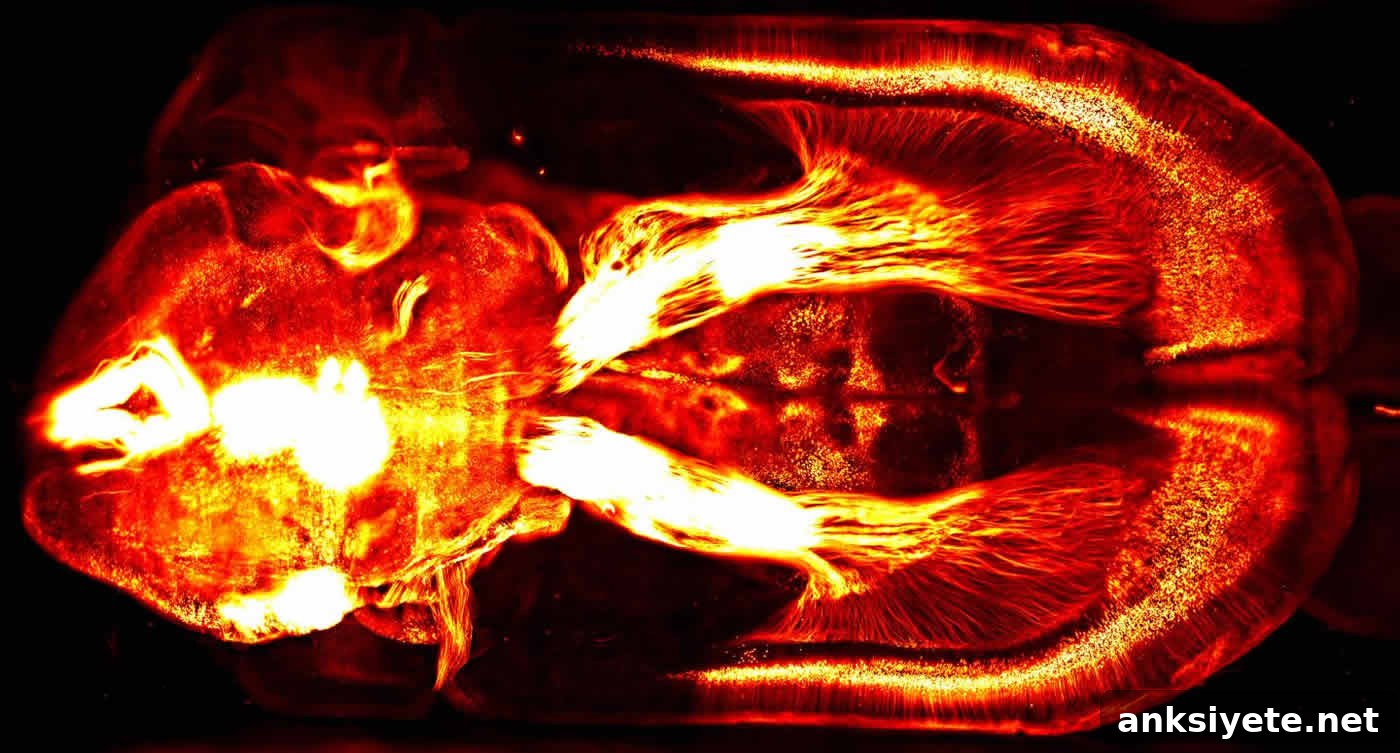
One of only three such lightsheet microscopes in the world, the Wyss Center instrument is capable of resolving individual neuronal processes that are on the order of microns in diameter—several times thinner than a human hair. Using viral tracers, the microscope can reveal the distribution of long-range neuronal pathways, axonal projections, and even fine structures such as dendritic spines, which are the tiny protrusions where most synaptic communication occurs. This level of anatomical detail is essential for mapping connectivity and for assessing how novel neural implants interact mechanically and biologically with surrounding tissue—a major focus of the Wyss Center’s translational neurotechnology program.
Importantly, the VR system is designed to work alongside semi-automated image analysis and segmentation tools. Integrating VR with computational workflows speeds up the process of identifying and validating structures that can be hard to discern on flat displays. Analysts and neuroscientists can flag regions of interest in the virtual environment, export coordinates or annotations, and feed those results back into automated pipelines to refine algorithms or guide further imaging and experiment planning.
The immersive environment also has clear value for education and training. Neurosurgeons, trainees, and device developers can rehearse procedures, review spatial relationships between targets and critical structures, and gain a more intuitive appreciation of three-dimensional anatomy before entering the operating room or the laboratory. By combining high-resolution microscopy data with real-time VR interaction, the platform bridges a gap between data acquisition and human understanding.
Source: Jo Bowler – Wyss Center
Publisher: Organized by NeuroscienceNews.com.
Image source: Image credited to Courtine Lab, EPFL (Leonie Asboth and Elodie Rey).
Video source: Video credited to IB Times UK.
Original research: The study was presented at Neuroscience 2017.
MLA: Wyss Center. “Take a Fantastic 3-D Voyage Through the Brain with New Immersive Virtual Reality System.” NeuroscienceNews, 15 November 2017.
APA: Wyss Center (2017, November 15). Take a Fantastic 3-D Voyage Through the Brain with New Immersive Virtual Reality System. NeuroscienceNews.
Chicago: Wyss Center. “Take a Fantastic 3-D Voyage Through the Brain with New Immersive Virtual Reality System.” (accessed November 15, 2017).