
Summary: People with social anxiety show increased amygdala activity during social decision-making and reduced nucleus accumbens (ventral striatum) activity during social feedback. In contrast, lonely individuals do not display these same neural signatures, suggesting that loneliness and social anxiety are distinct conditions that may require different interventions.
Source: SfN
New research published in the Journal of Neuroscience finds that, despite overlapping symptoms, loneliness and social anxiety are driven by different neural processes.
Loneliness is increasingly recognized as a major public health concern because of its harmful effects on both physical and mental health. Despite this, effective behavioral treatments specifically tailored to loneliness remain limited. Because loneliness and social anxiety share some outward similarities, researchers sought to determine whether the two conditions also share underlying behavioral and neural mechanisms.
Lieberz and colleagues investigated this question by comparing people with high versus low loneliness using a social gambling task paired with fMRI. The task asked participants to choose between a safe option that paid a modest reward and a risky option that offered a larger reward but included social feedback. When participants chose the risky option, they viewed short videos of a virtual partner—either a human or a computer—displaying approval or disapproval.
Behaviorally, people with social anxiety more often chose the safe option, appearing to avoid situations that could produce social feedback—even if those situations offered a higher reward. By contrast, participants with high loneliness did not consistently avoid the social option, indicating that loneliness does not necessarily lead to the same social withdrawal seen with social anxiety.
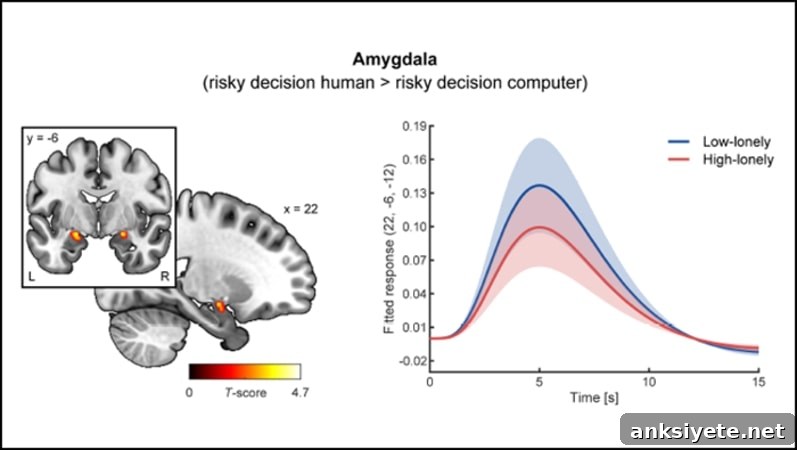
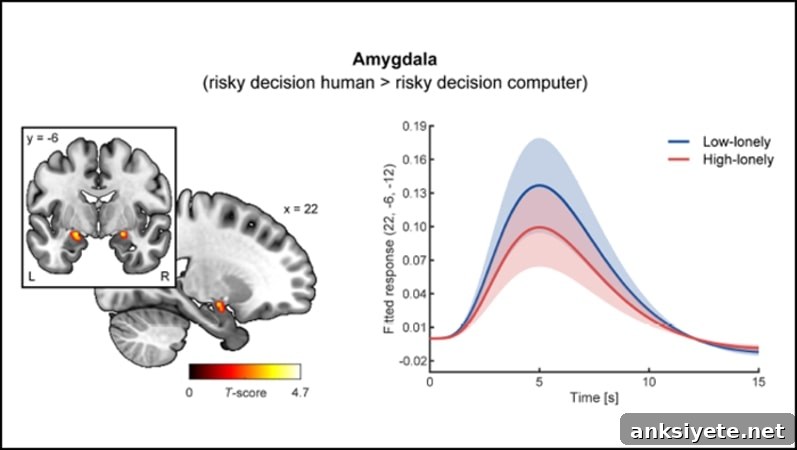
Neuroimaging results clarified these behavioral differences. Individuals with social anxiety exhibited elevated amygdala activation during the decision phase of the task, a pattern consistent with heightened anxiety in social choice situations. They also showed reduced activation in the nucleus accumbens during positive social feedback, suggesting diminished neural responses to social reward. These two neural markers—enhanced amygdala reactivity during decisions and blunted ventral striatal responses to positive feedback—were not observed in the lonely group.
Instead, the lonely participants displayed a distinct profile. Bayesian analyses indicated that lonely and non-lonely participants had similar subjective values for engaging in social situations and comparable amygdala responses during social decision-making. Striatal responses to positive social feedback were also similar across groups. Exploratory analyses did reveal that lonely individuals rated certain negative feedback as less pleasant, showed increased striatal activity and decreased striatal–hippocampal connectivity in response to negative feedback from the computer partner, and that these effects were attenuated for negative social feedback.
About this social anxiety and loneliness research news
Author: Calli McMurray
Source: SfN
Contact: Calli McMurray – SfN
Image credit: Lieberz et al., JNeurosci 2021
Original Research: Closed access. “Behavioral and neural dissociation of social anxiety and loneliness” by Lieberz et al., Journal of Neuroscience.
Abstract
Behavioral and neural dissociation of social anxiety and loneliness
Loneliness is a widespread public health concern associated with adverse physical and mental health outcomes. Because loneliness and social anxiety (SA) share some observable traits, clinicians and researchers have proposed adapting cognitive-behavioral treatments for SA to address loneliness. However, it remains unclear whether the two conditions share the same neurocognitive mechanisms.
This study examined whether established behavioral and neural signatures of social avoidance in social anxiety are also present in loneliness. The authors used a pre-stratified sample of 82 adults (42 with high loneliness and 40 with low loneliness) who completed a social gambling task during functional magnetic resonance imaging (fMRI). The task measured participants’ subjective value of engaging in social situations and recorded neural responses to social feedback. Univariate and multivariate analyses replicated known task effects across participants.
Contrary to expectations based on social anxiety research, Bayesian analyses provided moderate evidence that lonely and non-lonely participants had equal subjective valuations for social engagement, similar amygdala responses during social decision-making, and comparable striatal responses to positive social feedback. Thus, loneliness did not show the same pattern of social withdrawal and corresponding neural markers seen in social anxiety.
Exploratory results indicated that lonely participants reported reduced pleasantness ratings for certain negative feedback, exhibited increased striatal activity and decreased striatal–hippocampal connectivity in response to negative computer feedback, and that these effects were weaker for negative social feedback. These patterns point to biased emotional reactivity to negative stimuli rather than a general tendency to avoid social contact.
Overall, the findings suggest that loneliness and social anxiety are neurobiologically distinct. Loneliness appears linked to altered emotional responses to negative events rather than to avoidance of social interaction. Therefore, interventions designed for social anxiety should be carefully adapted rather than directly applied to treat loneliness.
SIGNIFICANCE STATEMENT
Loneliness can lead to serious health consequences. While adapting established cognitive-behavioral therapies for social anxiety might seem promising for reducing chronic loneliness, a clearer understanding of the behavioral and neural mechanisms specific to loneliness is necessary. This study demonstrates that loneliness exhibits a distinctive pattern of behavioral and neural responses to social decision-making and feedback—characterized more by biased emotional reactivity to negative events than by social avoidance—highlighting the need for tailored psychotherapeutic approaches.