Summary: Researchers have identified a neural mechanism that helps the brain decide whether a complex social situation feels emotionally positive or negative.
Source: University of Haifa and Max Planck Institute for Human Cognitive and Brain Sciences
How the Brain Decides If a Complicated Social Situation Is Pleasant or Unpleasant
Researchers from the Max Planck Institute for Human Cognitive and Brain Sciences in Leipzig and the University of Haifa in Israel have uncovered neural processes that guide our judgments when social situations carry both positive and negative signals. “Imagine someone insults you while smiling — should your brain treat that moment as a smile or an offense?” says Dr. Hadas Okon-Singer of the University of Haifa, a lead investigator on the study. The team found that two brain regions act like control hubs that help determine which emotional value—positive or negative—will dominate a conflicted scene, and which other brain areas should switch on or off accordingly.
Everyday life often presents emotionally mixed scenarios: a joke that stings, a smile that masks hostility, or scenes in films that blend violence with laughter. Previous research typically examined clear-cut, dichotomous stimuli — for example, a purely positive image like a smiling baby versus an obviously negative image such as a damaged or deceased figure. Those studies clarified how the brain responds to straightforward valence cues, but they left open the question of how the brain resolves ambiguous, emotionally conflicting inputs.
To probe this, the researchers used short clips from emotionally ambiguous films. Participants watched scenes that combined conflicting cues—such as a person smiling while committing a harmful act—while undergoing functional MRI scans. The film excerpts included sequences that are socially complex and emotionally ambiguous. Immediately after scanning, participants rated each scene for perceived conflict and indicated whether they felt the positive or negative elements predominated, reporting how pleasant or unpleasant the scene felt to them.
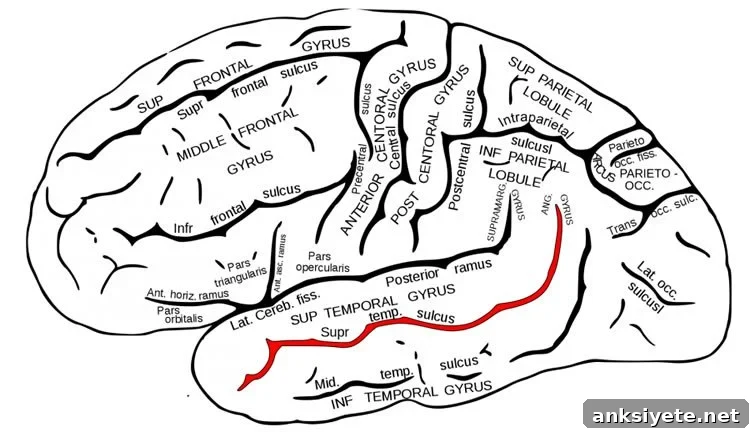
Consistent with earlier findings, the team observed two large-scale networks that become active when the brain favors positive or negative interpretations. Importantly, the study identified how the brain switches between these networks in ambiguous contexts. The transition is mainly facilitated by two regions: the superior temporal sulcus (STS) and the inferior parietal lobule (IPL). Both areas are components of broader social and emotional networks and appear to take on a coordinative role when the observer perceives emotional conflict.
Specifically, the STS was associated with responses tied to positive interpretations, while the IPL was linked to negative interpretations. When participants judged a scene to embody conflict, both STS and IPL increased their engagement. Dr. Okon-Singer explains that these regions act like remote controls: when the brain detects an emotional ambiguity, STS and IPL ‘negotiate’ which interpretation should dominate. They influence downstream regions and thus help determine which broader network becomes active, shaping the subjective experience of a scene as pleasant or unpleasant.
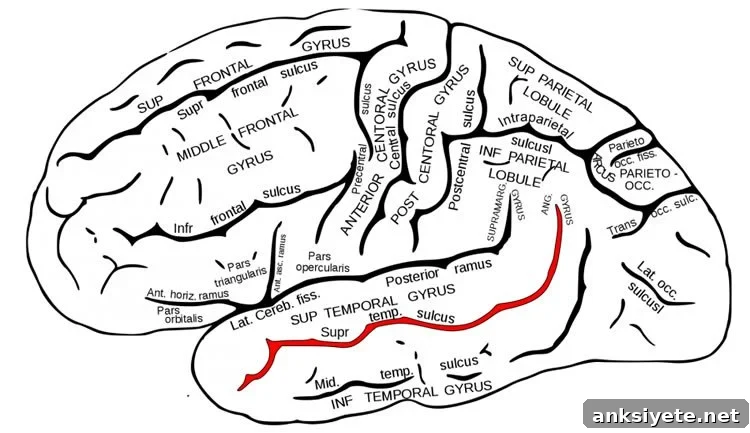
Beyond identifying these hub regions, the study examined how they connect with prefrontal and medial parietal control centers. When participants prioritized negative cues, functional connectivity strengthened between the IPL and ventral prefrontal–medial parietal areas. When positive cues were prioritized, the STS showed stronger coupling with dorsal-rostral prefrontal–medial parietal regions. These dynamic connectivity patterns suggest that STS and IPL not only register conflicting signals but also bias the flow of information toward networks that implement either a positive or a negative interpretation.
Understanding this switching mechanism has potential clinical relevance. Dr. Okon-Singer and colleagues suggest that identifying the neural bases of how we interpret ambiguous social situations could help explain why some individuals consistently interpret interactions more negatively or have difficulty resolving emotional conflicts. Future research can explore whether atypical function or connectivity of STS and IPL contributes to emotional disorders and whether targeted interventions could rebalance how emotional value is assigned in complex social contexts.
About the Study
The research, led by Dr. Christiane Rohr at the Max Planck Institute and Dr. Hadas Okon-Singer at the University of Haifa, was published in the journal Human Brain Mapping. Healthy volunteers freely viewed short film scenes that produced emotional conflicts while BOLD responses were recorded with fMRI. Individual ratings of perceived conflict and valence were collected and correlated with brain activity. Analyses highlighted the amygdala and medial prefrontal cortex in valence prioritization, and identified STS and IPL as central hubs involved both in evaluating conflict and guiding which valence cues are prioritized. The authors discuss how these hubs influence prefrontal and parietal control centers depending on whether positive or negative cues are dominant.
Research Reference
Title: “The neural networks of subjectively evaluated emotional conflicts” — Christiane S. Rohr, Arno Villringer, Carolina Solms-Baruth, Elke van der Meer, Daniel S. Margulies, and Hadas Okon-Singer. Human Brain Mapping. Published online September 2016. DOI: 10.1002/hbm.23169
Contact and credit: Article summary prepared based on research conducted at the University of Haifa and the Max Planck Institute for Human Cognitive and Brain Sciences. Image used for illustrative purposes.
Abstract (Concise)
Previous work on emotional conflict often instructed participants to ignore conflicting distractors. This study examined how people naturally evaluate emotional conflicts without explicit instructions. Participants watched emotionally conflicting film scenes while undergoing fMRI. Ratings of conflict and perceived valence were correlated with brain activity. The study found that while amygdala and medial prefrontal cortex are involved in valence prioritization, the superior temporal sulcus (STS) and inferior parietal lobule (IPL) play a dual role: they contribute to both valence prioritization and subjective evaluations of conflict, acting as neural hubs or switches. Functional connectivity patterns further revealed distinct prefrontal and parietal circuits associated with prioritizing positive versus negative cues.