
Summary: New research shows frontal brain regions are essential for interpreting emotions conveyed by the voice.
Source: University of Geneva.
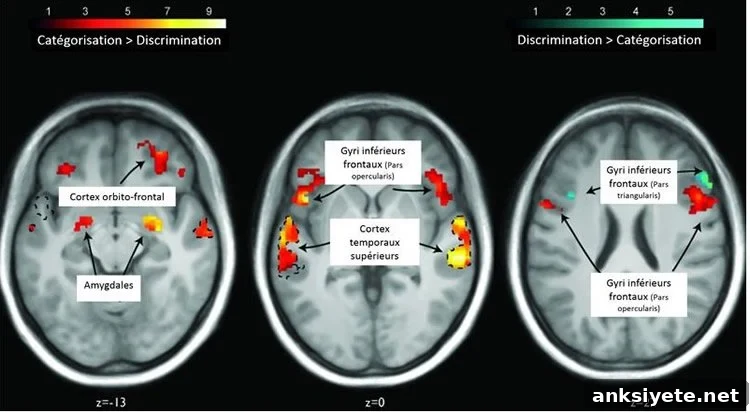
Gestures and facial expressions reveal our feelings, but our voices do as well. Simple changes in intonation let us infer emotions over the phone or in conversation. Researchers at the University of Geneva (UNIGE) used brain imaging to identify the regions involved in interpreting and categorizing emotional information from speech. Their results, published in Scientific Reports, highlight the key contribution of frontal brain areas—especially the inferior frontal gyri—in forming vocal emotional representations. When these frontal networks are disrupted, for example after a brain injury, people can lose the ability to understand others’ emotions and intentions. The study also documents strong connections between frontal regions and the amygdala, a central structure for emotional processing.
The upper temporal lobe in mammals is closely linked to auditory processing, with specific zones tuned to conspecific vocalizations and distinguishing them from background noises. However, the voice carries more than basic sound: it conveys affective states that listeners decode rapidly in social situations.
Categorization versus discrimination
“When someone speaks, we extract acoustic cues and classify them into categories like anger, fear or happiness,” says Didier Grandjean, professor at UNIGE’s Faculty of Psychology and Educational Sciences and at the Swiss Centre for Affective Sciences. This process—categorization—lets us recognize whether a person is sad or joyful during an interaction. Discrimination, by contrast, is the more selective detection of a particular state, such as searching for a happy person in a crowd. To determine how the brain performs these operations, Grandjean’s team mapped the neural activation patterns involved in forming vocal emotional representations.
Sixteen adult participants listened to a database of pseudo-words spoken by six male and six female actors. The pseudo-words had no semantic content but were delivered with clear emotional tones. In one task, participants categorized each utterance as angry, neutral, or happy, allowing researchers to observe brain regions engaged in categorization. In a second task, participants made simpler discrimination judgments—deciding whether a voice was angry or happy—so the team could isolate the neural substrates for discrimination. Functional magnetic resonance imaging (fMRI) revealed that categorization and discrimination activate distinct subregions within the inferior frontal cortex rather than identical areas, according to Sascha Frühholz, who led parts of the analysis while at UNIGE.
The frontal lobe’s central role
Whereas the temporal lobe supports basic distinctions between voices and background sounds, the frontal lobe—specifically the inferior frontal gyri—underpins higher-level operations such as categorizing and discriminating vocal emotions. The study found that categorization primarily engaged the pars opercularis, while discrimination relied more on the pars triangularis. “We anticipated frontal involvement and expected different subregions to be recruited by categorization versus discrimination,” Grandjean explains. “Categorization requires greater precision, which is why the pars opercularis shows stronger functional connectivity with auditory regions, the amygdala, and the orbitofrontal cortex—areas crucial for emotional processing—compared with the pars triangularis.”
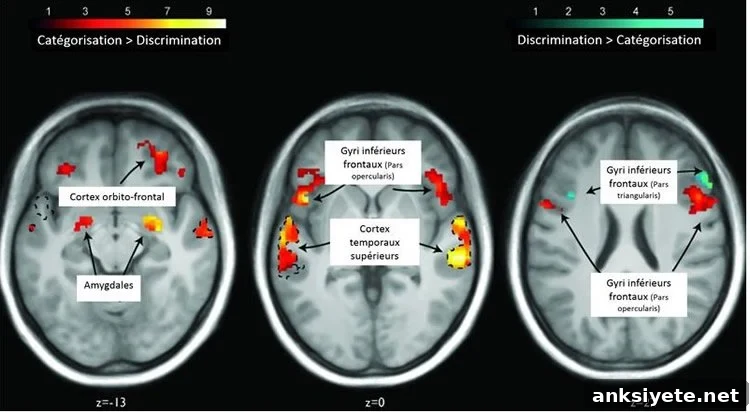
The findings emphasize a functional hierarchy in vocal emotion processing. Basic sound recognition—separating voices from noise—relies primarily on superior temporal areas. In contrast, interpreting emotional meaning and speaker intent depends on frontal networks and their links to auditory and limbic structures. These higher-level processes enable nuanced social understanding, such as recognizing sarcasm or inferring expectations. When the inferior frontal gyrus or orbitofrontal regions are damaged, patients may struggle to represent others’ emotions from voice alone, leading to misunderstandings and socially inappropriate behavior.
Source: Hannah Pietsch — University of Geneva
Publisher: NeuroscienceNews.com (organized summary)
Image source: Image credited to UNIGE.
Original research: “Biased and unbiased perceptual decision-making on vocal emotions” by Mihai Dricu, Leonardo Ceravolo, Didier Grandjean & Sascha Frühholz, published in Scientific Reports. DOI: 10.1038/s41598-017-16594-w
University of Geneva. “Voices and Emotions: The Forehead is the Key.” NeuroscienceNews, December 2017.
Abstract
Biased and unbiased perceptual decision-making on vocal emotions
Perceptual decisions about emotions require gathering acoustic cues about another person’s affective state and judging the likelihood of a specific emotion. Decision complexity varies with context. Using fMRI and a region-of-interest approach, the study compared brain activation and functional connectivity during two types of perceptual decisions. More complex, unbiased decisions engaged a bilateral network including the posterior inferior frontal cortex, orbitofrontal cortex, amygdala, and voice-sensitive auditory areas. Simpler, biased decisions selectively recruited the right mid-inferior frontal cortex, indicating a functional dissociation within the inferior frontal region according to task demands. Task-induced connectivity was stronger among frontal, auditory, and limbic regions during unbiased versus biased decisions. These results show that different perceptual strategies for decoding auditory emotions rely on distinct activation patterns and functional coupling that reflect their cognitive requirements.
Study: Mihai Dricu, Leonardo Ceravolo, Didier Grandjean & Sascha Frühholz, Scientific Reports, published online November 24, 2017. DOI: 10.1038/s41598-017-16594-w