
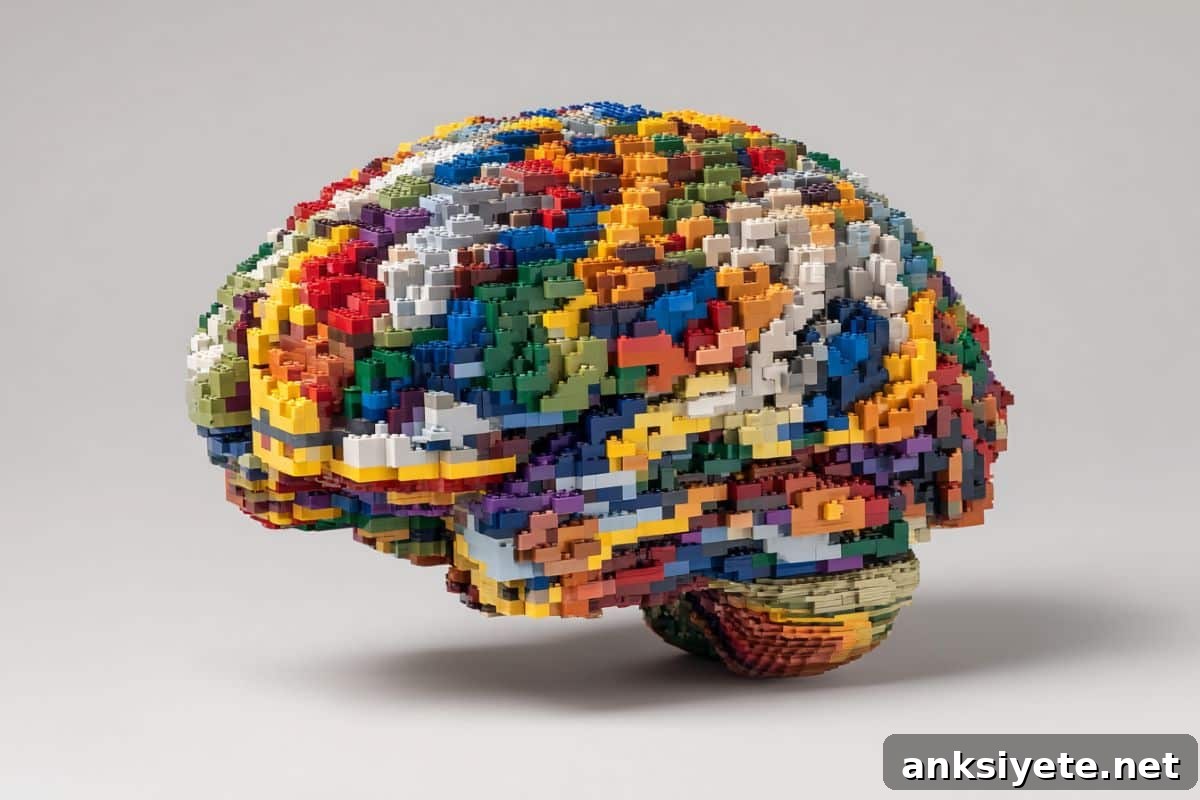
Summary: New research shows that the brain’s remarkable flexibility stems from its ability to reuse modular “cognitive building blocks” across different tasks. Studying monkeys trained on related categorization challenges, researchers discovered that the prefrontal cortex assembles and reassembles shared neural activity patterns—like components in a modular system—so the brain can adapt quickly with little need to relearn from scratch.
These reusable neural components are activated or suppressed depending on task demands, enabling rapid strategy shifts and efficient construction of new behaviors. The results help explain human quick-learning abilities and point to possible improvements in artificial intelligence and treatments for disorders that reduce cognitive flexibility.
Key Facts:
- Reusable neural patterns: The prefrontal cortex uses shared activity patterns across multiple tasks to form new behaviors.
- Compositional flexibility: The brain composes task-specific operations—such as evaluating color, shape, or action—by combining the same neural subcomponents in different ways.
- AI and clinical relevance: Understanding these building blocks could reduce catastrophic forgetting in AI and guide therapies for conditions that impair strategy shifting.
Source: Princeton University
Why biological brains remain more flexible than today’s AI
Artificial intelligence can achieve or exceed human-level performance on narrow tasks, yet it struggles to flexibly learn and perform many different tasks without extensive retraining. Humans, by contrast, adapt quickly to new tools and new rules—learning new software, recipes, or games with relative ease.
A new study from Princeton neuroscientists offers a clear mechanism that helps explain this gap: the brain composes tasks from a limited set of reconfigurable cognitive components. By recombining these components, the brain rapidly assembles new task-specific solutions without relearning every element.
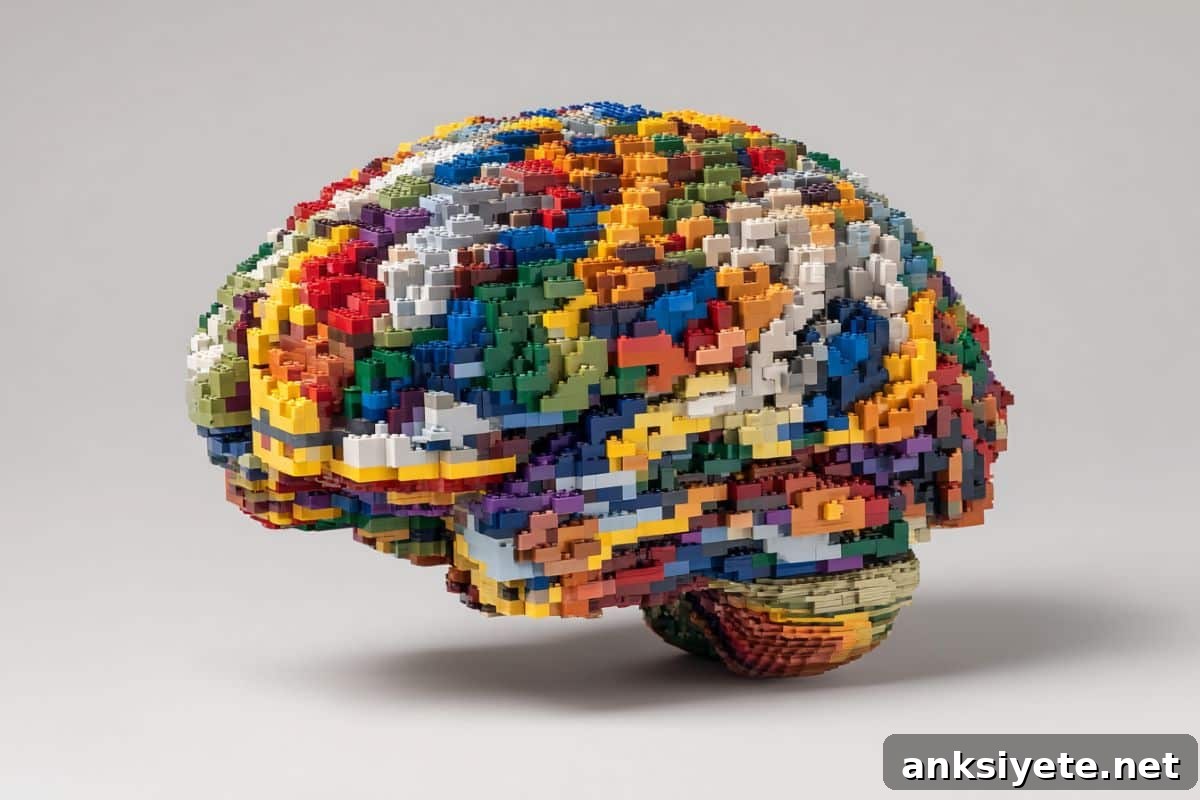
“State-of-the-art AI excels on individual tasks but struggles to learn many different tasks,” said Tim Buschman, Ph.D., associate director of the Princeton Neuroscience Institute and senior author of the study. “We show the brain’s flexibility comes from reusing components of cognition in many tasks. By snapping together these ‘cognitive Legos,’ the brain builds new abilities quickly.”
The study was published on November 26 in the journal Nature.
Reusing skills to meet new demands
Compositionality describes the ability to combine simpler skills to solve new, more complex problems. Just as knowing how to bake bread makes it easier to learn cake baking—because you reuse ovens, measuring, and mixing—brains reuse cognitive subcomponents to handle new tasks faster.
Lead author Sina Tafazoli, Ph.D., a postdoctoral researcher in the Buschman lab, explains: “You don’t rebuild basic skills every time. Instead you reapply familiar operations and add or modify a few steps to produce a new behavior.”
To reveal how the brain does this, the team recorded neural activity from the prefrontal cortex of two male rhesus macaques trained to switch among three related categorization tasks. Rather than real-world chores, the tasks required the animals to classify ambiguous, balloon-like images by shape (bunny versus letter “T”) or by color (more red versus more green).
The stimuli varied in difficulty: some images clearly resembled a bunny or an intense red, while others were intentionally ambiguous. The animals reported their judgment by making eye movements in one of four directions. Notably, task rules overlapped: some tasks shared response mappings while others shared the categorization rule, providing a controlled way to test whether the brain reuses neural patterns across tasks with shared components.
How reusable neural blocks create cognitive flexibility
Analysis of neural recordings revealed that the prefrontal cortex contains several shared patterns of activity—subspaces of neural firing—that consistently represented task-relevant information, such as color or shape. The brain combined these subspaces in task-specific ways to produce the appropriate behavior.
Buschman likens these shared patterns to “cognitive Legos” or software functions: “One group of neurons evaluates color, another maps that evaluation into an action. By chaining these components, the brain performs a full task.”
When the monkeys performed a color task, the circuit that encoded color information connected to the motor circuit that controlled eye movements. When the task switched to shape, the system linked the shape-encoding subspace to the same or different motor subspace as required. Importantly, this compositional reuse was strongest in the prefrontal cortex, suggesting the area specializes in assembling and reconfiguring these cognitive blocks.
The researchers also observed that the prefrontal cortex suppresses blocks that are irrelevant for the current task, which helps focus processing on what matters. “Cognitive control capacity is limited,” Tafazoli notes. “Suppressing unrelated representations helps the brain concentrate on the current goal.”
Implications for AI and clinical practice
These findings suggest a general principle for efficient learning: reuse and recombine modular components rather than relearn everything. For AI, adopting compositional architectures could reduce catastrophic forgetting—when learning new skills overwrites old ones—and enable continual learning that better mirrors biological flexibility.
Clinically, the same organizational principle may underlie deficits in conditions that impair flexible behavior, such as schizophrenia, obsessive-compulsive disorder, and some brain injuries. If those disorders disrupt the brain’s ability to reconfigure cognitive components, therapies that restore or compensate for this recombination could improve patients’ ability to shift strategies and acquire new routines.
“Understanding how knowledge is reused and recombined in the brain could help design interventions that restore adaptive behavior,” Tafazoli said.
Funding: The study was supported by the National Institutes of Health (R01MH129492, 5T32MH065214).
Key Questions Answered:
A: The brain reuses core cognitive building blocks across many tasks, enabling fast adaptation without relearning every component.
A: They are primarily observed in the prefrontal cortex, which assembles, engages, and quiets these blocks depending on task demands.
A: Combining and recombining cognitive components enables quick learning and reduces redundant relearning, a capability current AI systems often lack.
Editorial Notes:
- This article was edited by a Neuroscience News editor.
- The journal paper was reviewed in full by editorial staff.
- Additional context and clarifications were added for readers.
About this cognition and neuroscience research news
Author: Daniel Vahaba
Source: Princeton University
Contact: Daniel Vahaba – Princeton University
Image: Image credited to Neuroscience News
Original Research: Open access. “Building compositional tasks with shared neural subspaces” by Tim Buschman et al., Nature.
Abstract
Building compositional tasks with shared neural subspaces
Cognition is highly flexible: we perform many different tasks and adapt our behavior to changing demands. Artificial neural networks trained on multiple tasks tend to reuse representations and computational components across tasks; by composing tasks from these subcomponents, an agent can flexibly switch between tasks and rapidly learn new ones. Whether similar compositionality exists in the brain has been unclear.
This study demonstrates that the same neural subspaces represent task-relevant information across multiple tasks, and that each task engages those subspaces in task-specific ways. Monkeys were trained to switch among three related tasks while neural activity was recorded. The researchers found that both stimulus features and motor actions were represented in shared subspaces of neural activity across tasks. During task performance, representations in the relevant shared sensory subspace were transformed into the appropriate shared motor subspace. Monkeys adapted by updating an internal belief about the current task and then selectively engaging the shared sensory and motor subspaces relevant to that belief.
In summary, these results suggest the brain performs multiple tasks flexibly by compositionally combining task-relevant neural representations.