
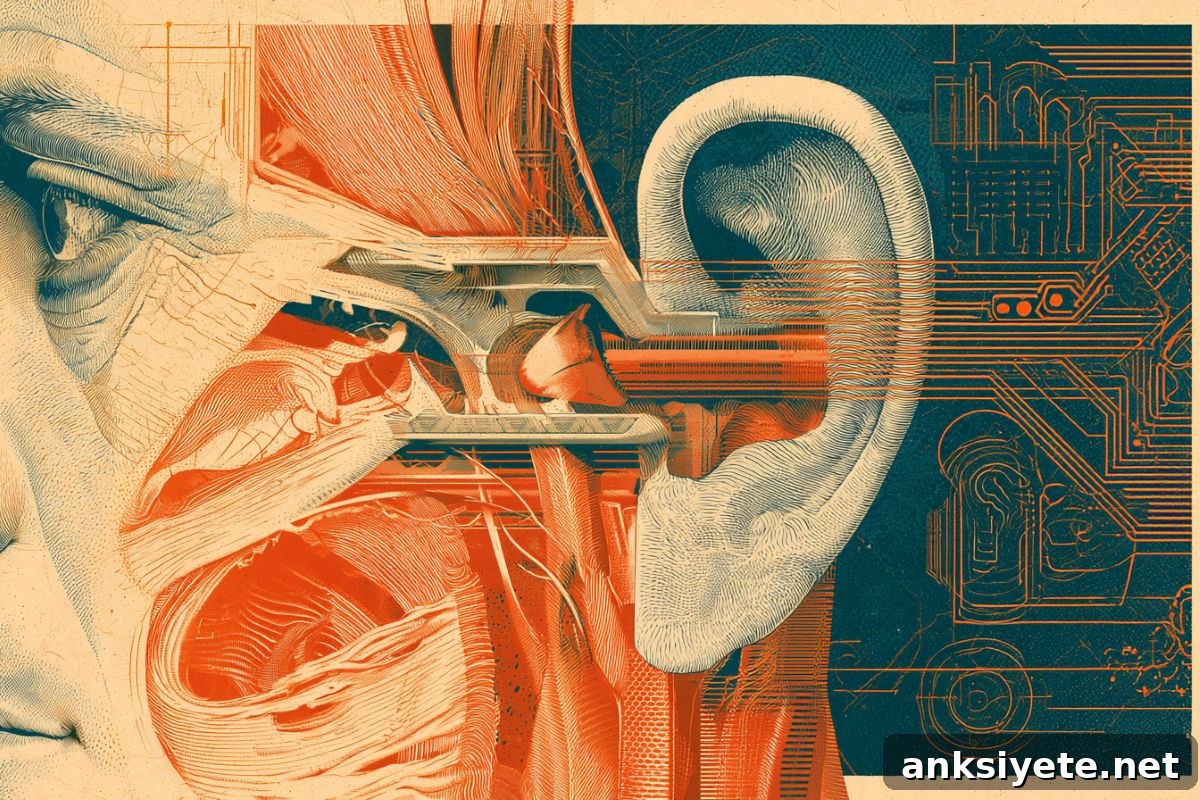
Summary: Researchers have shown that the human brain processes very low-frequency sound—known as infrasound—through a distinct biological pathway. When acoustic waves fall below the range that ordinary auditory hair cells can transduce, the mechanical energy bypasses those sensory cells and instead activates the cochlea’s structural support cells. These support cells produce alternative electrical potentials that stimulate nerve fibers along a different pathway, which helps explain why infrasound is often experienced as an internal hum or bodily sensation rather than a clear, pitched sound.
Key Facts
- The infrasound misconception: Textbooks often state humans cannot hear below about 20 Hz, but experiments show people can perceive infrasound when sound pressure levels are sufficiently high.
- Limitations of normal hair cell transduction: In the cochlea, inner hair cells (IHCs) normally convert mechanical vibrations into neural signals. At very low frequencies, the velocity of these vibrations becomes too small to reliably drive IHCs, limiting their role in perceiving infrasound.
- Support cells assume a role: Structural support cells in the cochlea—cells that usually regulate sensitivity and maintain the inner ear environment—can absorb ultra-low-frequency energy when typical sensory pathways fail.
- Alternative electrical fields: When impacted by infrasound, these support cells generate local electrical potentials. Those fields can influence nearby nerve fibers or hair cell membranes and trigger neural signals that reach the brain.
- Non-linear loudness growth: The alternative pathway yields highly non-linear loudness: small increases in infrasound pressure can produce disproportionately large jumps in perceived intensity, explaining sudden and dramatic increases in how loud a hum feels.
- Individual sensitivity differences: Natural variation in the density, arrangement, and electrical responsiveness of cochlear support cells offers a biological explanation for why some people are highly sensitive to low-frequency hums from heat pumps, ventilation, wind turbines and generators while others notice nothing unusual.
Source: NTNU
Low-frequency sound is perceived differently by the brain, which may explain why some people react more strongly to it.
Sounds below roughly 16 Hz are commonly referred to as infrasound. These signals lack clear pitch and are often considered inaudible in normal listening conditions—but they are perceivable at high enough sound pressure levels.
“Humans can perceive infrasound when the level is sufficiently intense,” says Carlos Jurado, postdoctoral fellow at the Department of Neuromedicine and Movement Science at the Norwegian University of Science and Technology (NTNU).
Low-frequency noise sources include ventilation systems, heat pumps, wind turbines, industrial machinery, transport systems, generators and transformers. Infrasound often registers more as a persistent hum or a physical sensation, which makes standard acoustic measurements and subjective reporting challenging.
How we perceive infrasound
Scientists long debated the mechanisms behind infrasound perception. Jurado and Torsten Marquardt (University College London) investigated these mechanisms and reported their findings in Scientific Reports.
Their work indicates that infrasound engages the inner ear differently from typical audible frequencies. Normally, inner hair cells (IHCs) transduce cochlear vibrations into neural signals that the brain decodes as sound. At ultra-low frequencies, however, the velocity component of the cochlear motion drops so far that IHCs are scarcely activated.
Instead, displacement-sensitive outer hair cells (OHCs) and adjacent support cells become involved. The study proposes that OHCs and support cells generate intracochlear electrical potentials that act on the IHC membrane or on nearby nerve terminals, producing synaptic release and neural excitation without direct mechanical activation of IHCs.
These intracochlear electrical fields plausibly account for perceptual features specific to infrasound: a shallow slope of threshold sensitivity below about 16 Hz and abrupt loudness growth for small increases in sound pressure.
Perceived as a bodily sensation
Because infrasound follows an alternative, non-standard auditory route, listeners often experience it as a heavy, internal vibration or a pervasive hum rather than a clear tone or speech-like sound. That subjective quality aligns with the proposed mechanism: support-cell-generated electrical activity is not optimized to convey detailed acoustic information, so the brain interprets the input as a generalized physical sensation.
This insight offers a physiological basis for widely reported complaints about intrusive low-frequency environmental sounds and helps to explain why noise mitigation for such sources can be both necessary and difficult.
Key Questions Answered:
A: Infrasound bypasses the standard pathway that delivers pitched sounds to the auditory cortex. Instead of activating the sensory hair cells designed for frequency discrimination, ultra-low-frequency waves engage structural support cells and generate unusual intracochlear electrical potentials. That alternative activation produces sensations the brain interprets more as a heavy bodily vibration or internal hum than as a normal sound.
A: The cochlear support cells involved in this mechanism vary between individuals in their density, geometry and electrical sensitivity. People with support cells that are more responsive to low-frequency stimulation will be more likely to experience pronounced sensations or discomfort from nearby infrasound sources.
A: Because perception in the infrasound range depends on support-cell-generated electrical potentials rather than straightforward mechanical transduction, the system behaves non-linearly. Small increases in environmental pressure can cause a large spike in intracochlear electrical activity, producing a sudden and much stronger perceived loudness.
Editorial Notes:
- This article was edited by a Neuroscience News editor.
- The journal paper was reviewed in full.
- Additional context was provided by editorial staff.
About this auditory neuroscience research news
Author: Nancy Bazilchuk
Source: NTNU
Contact: Nancy Bazilchuk – NTNU
Image: The image is credited to Neuroscience News
Original Research: Open access. “Infrasound sensation is mediated by intracochlear electrical potentials” by Carlos Jurado & Torsten Marquardt, Scientific Reports. DOI:10.1038/s41598-026-50179-w
Abstract
Infrasound sensation is mediated by intracochlear electrical potentials
Sound below 16 Hz, commonly termed infrasound, generally lacks tonality and is often assumed to be inaudible. Nonetheless, at sufficient intensity it can be clearly perceived. The underlying perceptual mechanisms have been unclear.
One key factor reducing sensitivity at the lowest frequencies is the velocity-coupled input to inner hair cells (IHCs), which normally convert cochlear mechanics into neural activity. Using non-invasive methods in human participants, the authors show that in the infrasound range, stimulus velocity is reduced so much that displacement-coupled outer hair cells (OHCs) and support cells become involved in neural excitation without mechanical activation of IHCs.
The proposed model describes how OHC- and support-cell-generated electrical potentials act on the IHC membrane or adjacent neural elements to cause synaptic release and auditory sensation. This mechanism accounts for perceptual features specific to infrasound, including the shallow sensitivity curve below 16 Hz and the abnormal loudness growth when sound pressure increases slightly.
This physiological insight may assist in understanding and addressing widespread complaints about very low-frequency environmental sounds.