
Summary: A neuroimaging study links age-related decline in specific white matter circuits to reduced efficiency of executive function in older adults.
Source: UT Dallas
As people age, the brain’s communication pathways gradually degrade, and this decline in circuit integrity can undermine cognitive performance even in otherwise healthy adults.
Researchers at The University of Texas at Dallas are using advanced imaging methods to map how structural changes in the brain relate to declines in thinking and executive abilities across the adult lifespan.
“Our goal is to pinpoint what breaks down in the brain as we age that leads to measurable declines in cognition, even in healthy individuals,” said Dr. Kristen Kennedy, associate professor of psychology in the School of Behavioral and Brain Sciences and a member of UT Dallas’ Center for Vital Longevity. “Each study contributes pieces to that larger puzzle.”
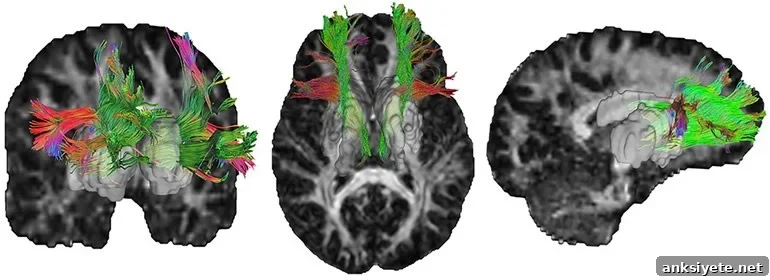
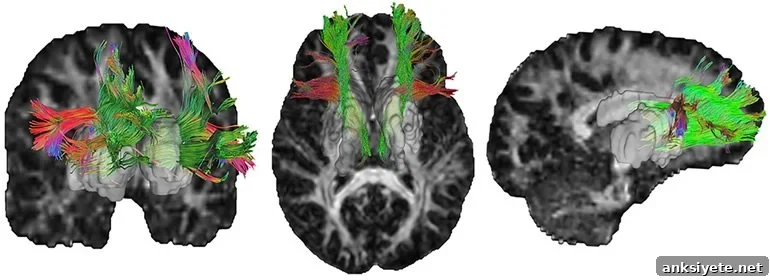
In a paper published online June 7 and in the October issue of Neurobiology of Aging, Kennedy and colleagues report results from 169 healthy participants aged 20 to 94. They combined two complementary imaging approaches to show that degradation of frontostriatal white matter — connections between frontal cortex and the striatum — is associated with reduced executive function and altered brain activation dynamics.
At a basic level, the brain is organized into gray matter regions, which contain neuronal cell bodies and perform the computations that underlie perception, memory and decision making, and white matter pathways, made primarily of myelinated axons, which transmit signals between gray matter regions. Maintaining the integrity of these white matter tracts is essential for efficient communication across brain networks.
Lead author Dr. Christina Webb, a research associate in Kennedy’s lab, emphasized the growing recognition that white matter structure strongly influences cognitive function, particularly during aging.
“Increasing evidence shows that the structural condition of white matter affects how well the brain performs higher-order tasks,” Webb said. “Prior work demonstrated broad relationships between white matter networks and cognition; here we focused specifically on frontostriatal tracts, which are closely tied to executive control.”
The team explored not only structural integrity but also how that integrity relates to the brain’s ability to adjust activity when tasks become harder. Kennedy explained that successful cognitive performance often requires the brain to increase—or “ramp up”—activity in key regions in response to challenge, and that this capacity changes with age.
“Our findings indicate that older adults do not increase gray matter activation to the same extent during demanding tasks,” she said. “One reason appears to be compromised white matter: the electrical and metabolic transmission between neurons becomes less effective as connections degrade.”
To evaluate structural connectivity, the researchers used diffusion tensor imaging (DTI), which measures the directionality of water diffusion in tissue. Webb likened ideal diffusion to water moving through a straw: constrained, directional flow supports fast signal transmission, whereas more diffuse flow corresponds to less efficient structural connections.
They paired DTI with functional MRI (fMRI), recorded while participants performed cognitive tasks, to capture real-time blood-oxygen-level-dependent (BOLD) responses and determine how the brain allocates resources as task difficulty increases.
Combining these structural and functional measures allowed the team to predict cognitive outcomes and then compare those predictions to actual task performance. Although the methods are correlational and do not establish causation, they support a theory in which aging degrades white matter connectivity, limiting the gray matter’s ability to upregulate activity and thereby impairing executive function.
“Our model proposes that age-related increases in white matter diffusivity compromise the structural backbone required for coordinated neural responses,” Kennedy said. “As a result, older adults show reduced dynamic range in neural activation and concomitant declines in executive performance.”
This research reflects a broader shift toward studying healthy neurological aging in addition to disease states. Kennedy noted that understanding the trajectory of normal aging provides a baseline that helps distinguish typical changes from pathological processes.
The study’s cohort has continued to be evaluated over time. Researchers are collecting longitudinal data to track when and how brain changes emerge in individuals, which will allow them to ask whether early differences predict divergent aging trajectories.
“By following the same people across years, we hope to detect the earliest shifts in white matter and function that mark transitions from normal aging toward possible pathology,” Webb said. “Identifying those early changes could inform strategies for monitoring and, ultimately, intervening before significant decline occurs.”
Additional contributors to the research included Dr. Karen Rodrigue, associate professor of psychology, and doctoral student David Hoagey in cognition and neuroscience.
Funding: This work was supported in part by National Institute on Aging grants 5R00AG036848-05, 5R00AG036818 and 5R01AG056535-04.
About this brain plasticity research article
Source:
Garvan Institute of Medical Research
Contacts:
Press Office – UT Dallas
Image Source:
The image is credited to the researchers.
Original Research: Closed access — “Frontostriatal white matter connectivity: age differences and associations with cognition and BOLD modulation” by Kristen Kennedy et al., published in Neurobiology of Aging. Citation: DOI 10.1016/j.neurobiolaging.2020.05.014.
Abstract
Frontostriatal white matter connectivity: age differences and associations with cognition and BOLD modulation
Cortico-striatal circuits are essential for higher cognition, yet age-related effects on the structural pathways that link these regions remain underexplored. This study assessed frontostriatal white matter connectivity in 169 healthy adults aged 20–94 and examined how structural differences relate to executive function and dynamic modulation of BOLD activation in response to task difficulty. Higher frontostriatal mean diffusivity was associated with poorer executive performance, and this negative relationship grew stronger with increasing age. Whole-brain fMRI analyses revealed that frontostriatal diffusivity correlated with reduced BOLD modulation to difficulty specifically in the striatum across two independent tasks. Age moderated these associations: younger and middle-aged participants exhibited diminished dynamic range of difficulty-related modulation as frontostriatal diffusivity increased. Overall, the results underscore the impact of age-related frontostriatal degradation on executive function across the adult lifespan and highlight the importance of measuring brain changes beginning in early to middle adulthood.