
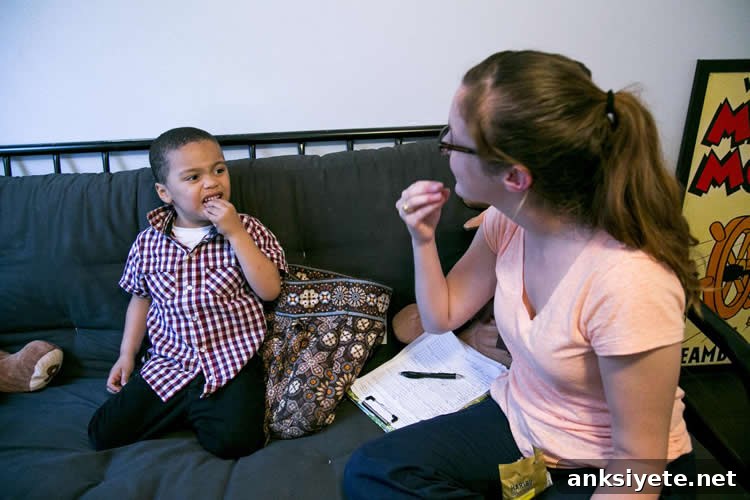
Summary: New research indicates that imitation skills in young children with autism can help predict their later development of intentional, flexible speech.
Source: University of Texas at Austin
Nearly 30 percent of children with autism do not develop flexible spoken language by the end of elementary school. Pinpointing when and how to intervene in early speech development is critical. New research from the University of Texas at Austin identifies early imitation behavior as the strongest predictor of a key developmental step—intentional communication—that precedes flexible speech, offering clearer guidance on timing and targets for early intervention.
Before most babies speak their first words, they combine gestures, eye contact and vocalizations to communicate needs and interests. For example, a toddler might look at a caregiver, point to a toy and make a sound to express a desire. Researchers call this coordinated behavior intentional communication. In children with autism spectrum disorder (ASD), intentional communication is an important indicator of later language outcomes. Until now, however, which early behaviors best predict the growth of intentional communication had not been clearly established.
“Identifying those predictors gives us specific targets for early intervention to increase the chances that children with autism will learn to communicate intentionally and eventually speak,” said Micheal Sandbank, assistant professor of special education at the UT Austin College of Education. “Early, targeted intervention can substantially improve long-term academic and life outcomes for these children.”
Sandbank led a study published in the Journal of Autism and Developmental Disorders that analyzed data from a larger multisite longitudinal project conducted at Vanderbilt University and the University of North Carolina–Chapel Hill. The analysis focused on measuring which early behaviors best forecasted later intentional communication among preverbal preschoolers with autism.
Children in the parent study entered the research between ages two and four and were followed for 16 months. No experimental intervention was provided; instead, participants returned every four months for standardized assessments that tracked the development of intentional communication, language skills, and several candidate predictor behaviors measured early in the study.
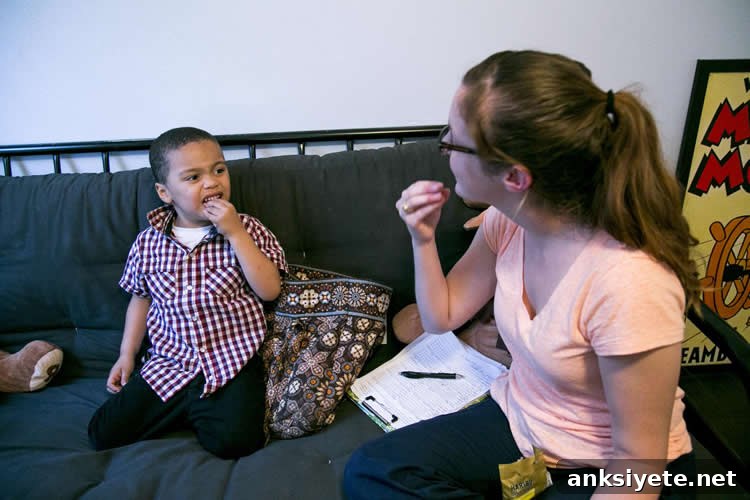
The research team selected five theoretically motivated behaviors as potential predictors of intentional communication growth. These included the child’s ability to imitate actions, their object play skills, and their tendency to follow a caregiver’s point or gaze to share attention. The team also evaluated two central caregiver behaviors: whether parents physically responded to a child’s play actions by joining or imitating the child’s play, and whether parents responded verbally by commenting on or describing the child’s play.
When the data were analyzed, motor imitation—children’s ability to copy actions—emerged as the most powerful predictor of growth in intentional communication. In models that controlled for initial levels of intentional communication, early motor imitation uniquely accounted for a significant portion of later gains in intentional communication.
“We were surprised by how strongly imitation stood out,” Sandbank said. “This finding suggests that play-based strategies developed to encourage imitation of communicative gestures could be particularly effective in helping children move toward intentional communication and later spoken language.”
Although imitation proved to be the strongest single predictor, the researchers emphasized that the other factors—joint attention skills, object play, and caregiver responses—remain important. The new results refine our understanding of the developmental sequence that leads from preverbal behavior to intentional communication and provide clearer guidance on what early intervention approaches might prioritize.
Source: University of Texas at Austin
Image source: Image adapted from the University of Texas at Austin news release.
Original research: The findings are reported in the peer-reviewed article “Predicting Intentional Communication in Preverbal Preschoolers with Autism Spectrum Disorder” by Micheal Sandbank, Tiffany Woynaroski, Linda R. Watson, Elizabeth Gardner, Bahar Keçeli Kaysili, and Paul Yoder, published in the Journal of Autism and Developmental Disorders (online March 4, 2017).
Recommended citation examples (without links):
MLA: University of Texas at Austin. “For Kids With Autism, Imitation Counts for More Than the Highest Form of Flattery.” NeuroscienceNews, April 8, 2017.
APA: University of Texas at Austin (2017, April 8). For kids with autism, imitation counts for more than the highest form of flattery. NeuroscienceNews.
Chicago: University of Texas at Austin. “For Kids With Autism, Imitation Counts for More Than the Highest Form of Flattery.” NeuroscienceNews, April 8, 2017.
Abstract
Predicting Intentional Communication in Preverbal Preschoolers with Autism Spectrum Disorder
Intentional communication has been identified as a value-added predictor of expressive language in preverbal preschoolers with autism spectrum disorder. This study evaluated five theoretically motivated early predictors of intentional communication measured at study entry and four months later. Three of the five predictors showed significant zero-order correlations with intentional communication assessed 12 months after study entry and were included in a linear model that controlled for initial intentional communication scores. After accounting for initial differences, early motor imitation was the only predictor that uniquely accounted for a significant amount of variance in later intentional communication.
The full study details are published under the title given above in the Journal of Autism and Developmental Disorders (online March 4, 2017).