
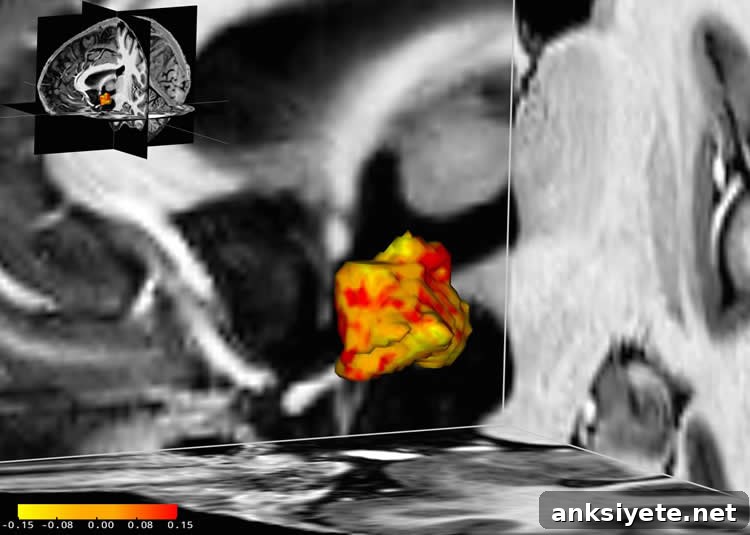
Summary: Researchers report that, on average, the hypothalamus is about five percent larger in people with mood disorders such as major depressive disorder and bipolar disorder compared with individuals without these conditions.
Source: Max Planck Institute.
Depression affects hundreds of millions globally. According to World Health Organization estimates for 2015, roughly 322 million people—about 4.4 percent of the world’s population—experienced depression. Scientists investigating the biological roots of this widespread condition suggest that mood disorders likely arise from a combination of genetic or biological predisposition and environmental stressors experienced over a person’s life.
One biological system strongly implicated in depression is the hypothalamic-pituitary-adrenal (HPA) axis, which governs the body’s response to stress. In a typical stress reaction, the HPA axis prompts the release of cortisol, mobilizing energy and resources to face an immediate challenge. When the threat passes, feedback mechanisms within the HPA axis usually restore balance. In many people with depression or those predisposed to affective disorders, however, this feedback is disrupted. The stress response can remain elevated even in the absence of obvious stressors, producing prolonged hormonal and physiological effects.
Until recently, the specific role of the hypothalamus—the brain’s central coordinator of the HPA axis—in this dysregulation was not well understood. New research using ultra-high-resolution brain imaging provides fresh evidence linking structural shifts in the hypothalamus to mood disorders.
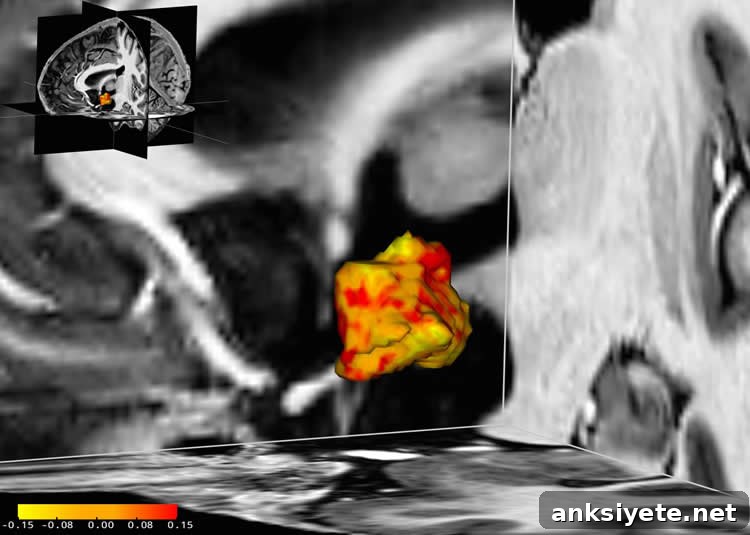
In a study of 84 participants, researchers from the Max Planck Institute for Human Cognitive and Brain Sciences and the Department of Psychiatry and Psychotherapy at the University Clinic in Leipzig used a 7-Tesla MRI scanner to measure hypothalamic volume with exceptional precision. The study included unmedicated and medicated patients with major depressive disorder, individuals with bipolar disorder, and healthy control participants. Using standardized clinical interviews and questionnaires to determine symptom severity, the team examined structural differences while accounting for overall head size and other relevant variables.
Key findings indicate that the left hypothalamus was, on average, approximately five percent larger in participants with mood disorders—both depressive and bipolar—than in the control group. This enlargement was observed regardless of whether patients were taking medication. In one subgroup, greater hypothalamic volume correlated with more severe depressive symptoms, suggesting a potential relationship between structural change and clinical presentation.
These results are notable because prior studies often emphasized functional hyperactivity of stress-related brain regions in mood disorders. The new evidence suggests that heightened activity may be accompanied by or lead to structural remodeling, producing measurable volume increases in specific hypothalamic regions. As one of the study’s senior researchers noted, such changes might reflect chronic overactivation of stress pathways and could contribute to the persistent dysregulation seen in depression and bipolar disorder.
Source: Verena Müller — Max Planck Institute
Publisher: NeuroscienceNews (organized summary)
Image source: Acta Psychiatrica Scandinavica (image credit noted by the original report)
Original research: Schindler, S., Schmidt, L., Stroske, M., Storch, M., Anwander, A., Trampel, R., Strauß, M., Hegerl, U., Geyer, S., & Schönknecht, P. (2018). “Hypothalamus enlargement in mood disorders.” Acta Psychiatrica Scandinavica. (Open access research article published September 19, 2018.)
Hypothalamus enlargement in mood disorders
Objective: This study sought to determine whether hypothalamic volume differs in people with mood disorders when measured in vivo using high-resolution imaging.
Methods: The cross-sectional sample included unmedicated and medicated patients with major depressive disorder, individuals with bipolar disorder, and healthy control participants. Researchers acquired high-resolution T1-weighted images on a 7-Tesla MRI scanner and applied specialized volumetric methods tailored for reliable measurement of the hypothalamus.
Results: A significant group difference emerged for the left hypothalamus when corrected for intracranial volume. Planned comparisons showed the left hypothalamus was roughly 5% larger in each patient group compared with controls. A paired analysis of matched unmedicated patients and controls confirmed this enlargement without the need for additional covariate corrections.
Conclusions: Contrary to expectations of reduced hypothalamic size, the study found increased left hypothalamic volume in uni- and bipolar affective disorders. The effect was left-lateralized and independent of medication status or statistical adjustments. These findings support a growing body of evidence linking stress-related dysregulation and structural asymmetry in the brain, underscoring a potentially pivotal role for the hypothalamus in the biology of mood disorders.
This summary synthesizes the reported findings and emphasizes the possible connection between stress-system dysregulation and structural hypothalamic changes in mood disorders. Further research is needed to clarify causality, time course, and clinical implications for diagnosis or treatment.