
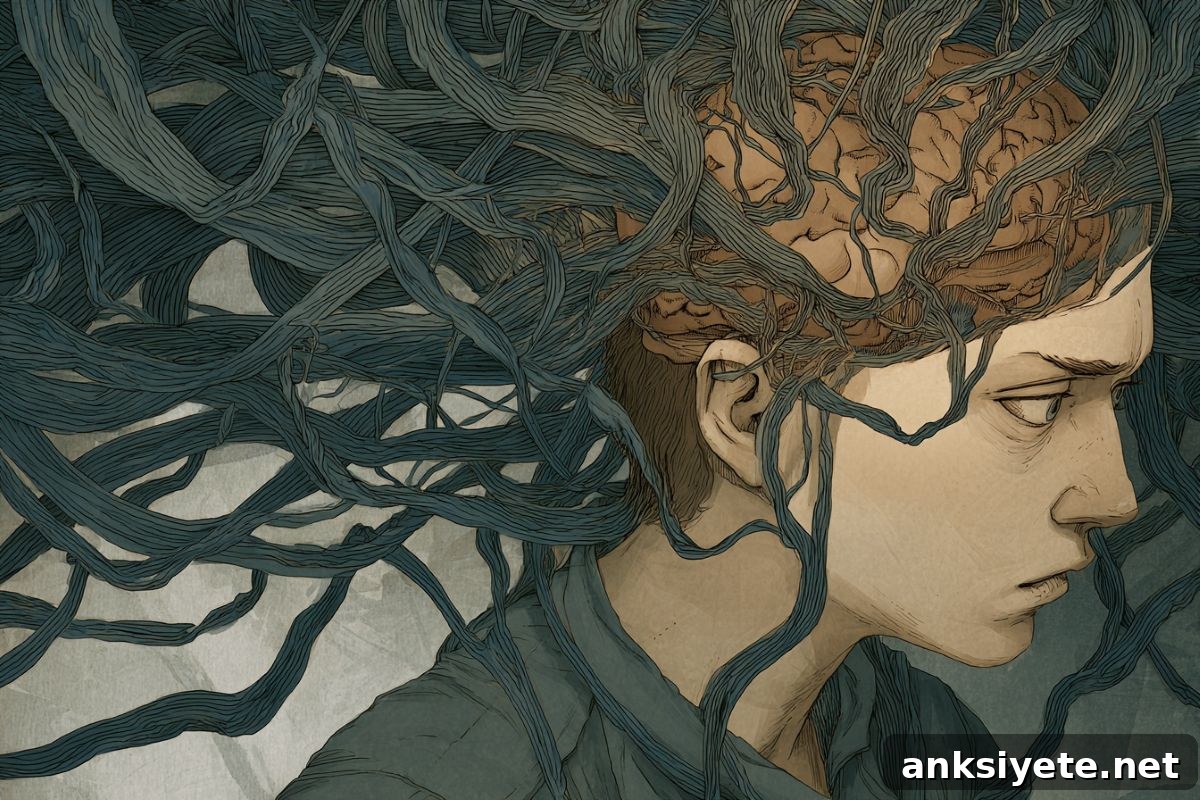
Summary: People who display compulsive traits—features common in conditions such as obsessive-compulsive disorder (OCD), addiction, and some eating disorders—tend to rely on repetitive habits. A new large-scale study shows this is less about an inability to plan and more about uncertainty about how plans will play out. In an online game played by around 2,000 participants, researchers found that individuals with stronger compulsive tendencies were significantly less confident that their long-term plans would produce the expected outcomes, and this uncertainty shifted them toward habitual, short-term choices.
This “planning paralysis” helps explain why model-free, habitual actions (for example, grabbing a frozen pizza) can feel safer than model-based, future-oriented choices (for example, preparing a healthy salad). By identifying uncertainty about future outcomes as the mechanistic link to habit use, the study offers a clearer explanation for the repetitive behaviours that define compulsivity.
Key Facts
- The uncertainty mechanism: Compulsive traits are associated with a decision-making profile where habits are preferred because the person feels less certain about the consequences of longer-term plans.
- Model-free vs. model-based decisions: Model-free choices are automatic and habitual, while model-based choices require mentally simulating future outcomes. Greater compulsivity biases people toward the former.
- Gamified testing: Researchers used a two-step video game to assess how players balance future consequences against immediate uncertainty.
- A spectrum across the population: Compulsive tendencies vary continuously across people, not only among those with clinical diagnoses.
- Clinical implications: Interventions may be more effective if they focus on reducing uncertainty about future outcomes and strengthening internal models, rather than solely trying to break habits.
Source: King’s College London
What are compulsive traits?
Compulsive traits involve a tendency to repeat patterned behaviours. They appear in psychiatric conditions such as OCD, addiction, and eating disorders, but they also occur to varying degrees across the general population. This research explores how those traits relate to different decision-making strategies.
Neuroscientists at King’s College London invited roughly 2,000 people to play an online decision-making game designed to separate habitual choices from planning-based choices. Comparing player choices to computational models, the team found that people scoring higher on measures of compulsivity were both more likely to use habitual strategies and more uncertain about the long-term consequences that underlie planning strategies.
The researchers fitted two computational models to the game data: one representing model-based (planning-heavy) behaviour and the other representing model-free (habitual) behaviour. The models also estimated how certain each participant was about the structure of the task and the likely outcomes of their actions. Across samples, higher compulsivity correlated with slower learning of the task structure and a less precise internal model of how actions lead to future outcomes. That uncertainty mediated the reduced use of goal-directed planning.
“We found that people with more compulsive traits may rely on habits not because they cannot plan, but because they feel less certain about how their actions will play out,” said Sirichat Sookud, the study’s first author. “This provides a more precise mechanistic explanation for repetitive patterns observed in compulsivity.”
To plan or not to plan?
Everyday choices often pit a familiar, effortless habit against a choice that requires considering future consequences. For example, after a long day you might automatically reach for a frozen pizza. Choosing a salad instead requires envisioning long-term benefits like lower cholesterol and improved health. In decision-making terms, choosing the salad depends on an internal model that links current actions to distant outcomes—this is model-based decision making. Reaching for the pizza is model-free: a shortcut that does not rely on mental simulation.
Prior studies have linked reduced model-based decision making to psychiatric symptoms in OCD, addiction, and related conditions. The current study adds an important nuance: people with more compulsive traits form less certain internal models of the world, and that uncertainty pushes them toward habits. As Dr Toby Wise, Senior Research Fellow in Neuroscience at King’s College London, explains, “If the future feels uncertain, you’re more likely to repeat what worked before.”
Using video games to study behaviour
The research used a gamified version of a validated psychological paradigm (the two-step task) to measure decision strategies remotely at scale. The visual, interactive format made it possible to recruit and test large samples online while still applying rigorous computational analyses.
In the task, players fired a cannon at aliens using pink or purple balls kept in two containers. Successful play required two kinds of knowledge: understanding how the colors in the containers related to outcomes (building an internal model) and accounting for the possibility that some balls would explode before hitting targets (uncertainty). Optimal play combined an accurate internal model with an estimate of explosion risk.
While the game mechanics are visually engaging, the task captures real-life processes of future-oriented planning that people use daily, making it a practical tool for measuring these cognitive processes in large samples.
Funding: This research was supported by a Wellcome Trust Career Development Award.
Key Questions Answered:
A: Not exactly. This study suggests compulsivity is more about reduced confidence in the future. When long-term outcomes seem unclear or “blurry,” the brain defaults to actions that worked before. Habits can be an adaptive response when the future feels uncertain.
A: Think of driving in fog: you avoid novel routes and stick to familiar cues. When the future is uncertain, people tend to repeat simple, reliable actions. The study found that people with higher compulsive traits experience greater uncertainty about future consequences, so they rely more on habitual responses.
A: The findings imply that strengthening the internal model of future outcomes—making the path to a goal clearer and more predictable—might encourage model-based planning over habits. Interventions that reduce uncertainty about future rewards could help shift behaviour toward healthier, goal-directed choices.
Editorial Notes:
- This article was edited by a Neuroscience News editor.
- The journal paper was reviewed in full.
- Additional context was added by staff editors.
About this OCD and neuroscience research news
Author: Patrick O’Brien
Source: King’s College London
Contact: Patrick O’Brien – King’s College London
Image: The image is credited to Neuroscience News
Original Research: Open access. “Impaired Goal-Directed Planning in Transdiagnostic Compulsivity Is Explained by Uncertainty About Learned Task Structure” by Sirichat Sookud, Ingrid Martin, Claire M. Gillan, and Toby Wise. Biological Psychiatry: Cognitive Neuroscience and Neuroimaging. DOI: 10.1016/j.bpsc.2025.10.005
Abstract
Impaired Goal-Directed Planning in Transdiagnostic Compulsivity Is Explained by Uncertainty About Learned Task Structure
Background
Reduced use of goal-directed (model-based) decision making is a hallmark of transdiagnostic compulsivity and contributes to excessive reliance on inflexible, habitual behaviours. The source of this impairment has been unclear. The study tested whether these deficits arise from uncertainty within the internal world model that supports goal-directed decisions.
Methods
Researchers adapted a validated gamified decision-making task to measure how individuals form internal models of an environment. They combined task data with computational modeling to identify the mechanisms underlying behaviour and quantify individual differences. Two large samples (a discovery sample and a preregistered replication sample, n = 551 and n = 1,322) completed the task, and longitudinal follow-up assessed the stability of behaviour over weeks and months.
Results
Across discovery and replication samples, individuals higher in compulsivity and intrusive thought learned more slowly and formed less certain representations of task structure. This uncertainty mediated the relationship between compulsive symptoms and reduced use of goal-directed behaviour. Task behaviour showed relative stability over three months and one year and did not predict symptom changes over time.
Conclusions
The findings suggest that greater reliance on habitual behaviours in people with elevated compulsive symptoms stems from a tendency to form less certain internal models of the external world. Because this pattern is stable and linked to symptoms, it may reflect a trait-level vulnerability that shapes compulsive behaviour.