
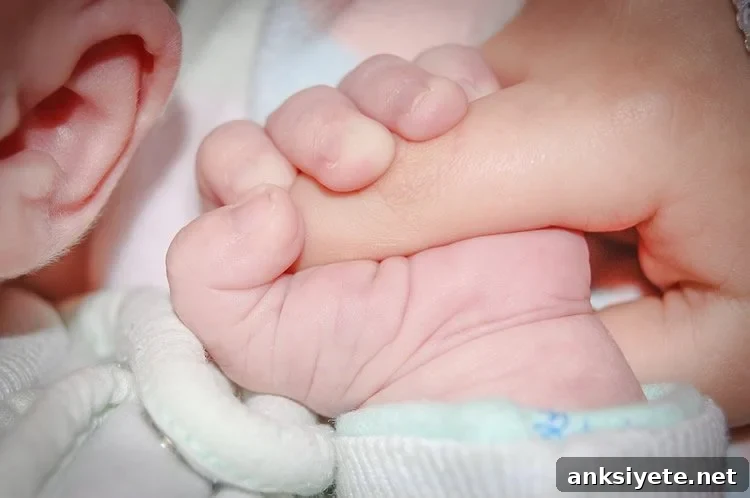
Summary: Light, gentle stroking of an infant at approximately 3 centimeters per second can diminish pain-related brain activity before routine medical procedures.
Gentle Stroking at 3 cm/s Reduces Pain-Related Brain Activity in Infants
Highlights: Researchers report that lightly brushing a baby’s skin at about 3 cm/s lowers brain responses associated with pain. The findings, published December 17 in the journal Current Biology, suggest that a simple, touch-based approach could help comfort newborns during clinically necessary procedures.
Researchers led by Professor Rebeccah Slater of the University of Oxford studied how gentle touch influences pain processing in newborns. Working with colleagues from Liverpool John Moores University, Slater’s team measured infants’ behavioral reactions and brain activity during routine blood tests. Brain signals were recorded using electroencephalography (EEG), which detects small electrical responses from the brain’s surface.
For half of the infants in the study, a trained researcher stroked the skin with a soft brush at the tested speed immediately before the blood test. Previous work by Slater and others has shown that noxious clinical procedures cause a rapid increase in pain-related EEG activity in infants. In this study, stroking at the optimal velocity reduced that pain-evoked brain activity, although reflex limb withdrawal to the heel lance remained present.
“Parents naturally stroke their babies at this optimal speed,” says Slater. “By understanding the neurobiology behind comforting techniques such as infant massage, we can provide clearer guidance to parents and caregivers about how to soothe their babies effectively.”
The stroking speed of approximately 3 cm/s corresponds to activation of a class of skin sensory neurons known as C-tactile (CT) afferents. In adults, CT afferents respond preferentially to slow, gentle stroking and are associated with pleasant touch and reduced pain perception. Until now, it was uncertain whether this mechanism functions in newborns or develops later in life. These results indicate that CT-related responses, and their pain-modulating potential, are already present in early infancy.
What the Study Measured
The team examined both objective brain responses and observable behaviors. EEG recordings tracked noxious-evoked neural activity, while researchers also monitored facial and limb responses to the heel lance. Stroking prior to the clinically required lance reduced the noxious-evoked EEG signal, indicating diminished pain-related processing in the brain. Despite the neural reduction, limb reflexes remained, suggesting a possible dissociation between spinal reflex activity and cortical pain processing in infants.
“We expected stroking to reduce brain activity tied to pain, and we observed that effect,” Slater explains. “The persistence of reflexive limb movement despite lower cortical activity could mean that touch changes how the brain interprets or registers the noxious input while reflex circuits remain active.”
Clinical and Developmental Implications
The study’s findings support the clinical usefulness of gentle stroking as a non-pharmacological option to reduce pain-related brain activity in newborns. This may help explain anecdotal reports and prior smaller studies showing benefits of infant massage and kangaroo care for calming infants, strengthening parent-child bonding, and reducing stress. The research team intends to extend this work to premature infants, whose sensory systems are still maturing, to determine whether the same touch-related benefits apply.
Slater notes that touch-based approaches carry minimal risk of side effects and may offer a practical complement to existing pain-relief strategies in neonatal care. Touch can also foster parental bonding and potentially shorten hospital stays, according to prior work cited by the researchers.
Funding: The research was supported by the Wellcome Trust.
Source: Cell Press (reported by Erin Kohnke). Publisher organized by NeuroscienceNews.com.
Original Research: Gursul D., Goksan S., Hartley C., Schmidt Mellado G., Moultrie F., Hoskin A., Adams E., Hathway G., Walker S., McGlone F., Slater R. “Stroking modulates noxious-evoked brain activity in human infants.” Current Biology. Published December 17, 2018. DOI: 10.1016/j.cub.2018.11.014.
Abstract (Rephrased)
A subclass of C-fibre sensory neurons in hairy skin responds optimally to slow, gentle stroking (about 1–10 cm/s) and promotes affiliative behaviors. In adults, activation of these C-tactile afferents is perceived as pleasant and can reduce pain. Touch-based techniques used to comfort infants during procedures, such as massage and kangaroo care, have shown modest reductions in behavioral and physiological pain measures in some studies. This study tested whether touch can reduce pain-evoked brain activity in infants. Stroking at 3 cm/s before an experimental noxious stimulus or a clinical heel lance attenuated noxious-evoked brain responses. CT fibres may therefore be a biological target for safe, non-pharmacological interventions to modulate pain in early life.
Suggested citation: Cell Press. “Gently Stroking Babies Before Medical Procedures Can Reduce Pain Processing.” NeuroscienceNews. December 17, 2018.