
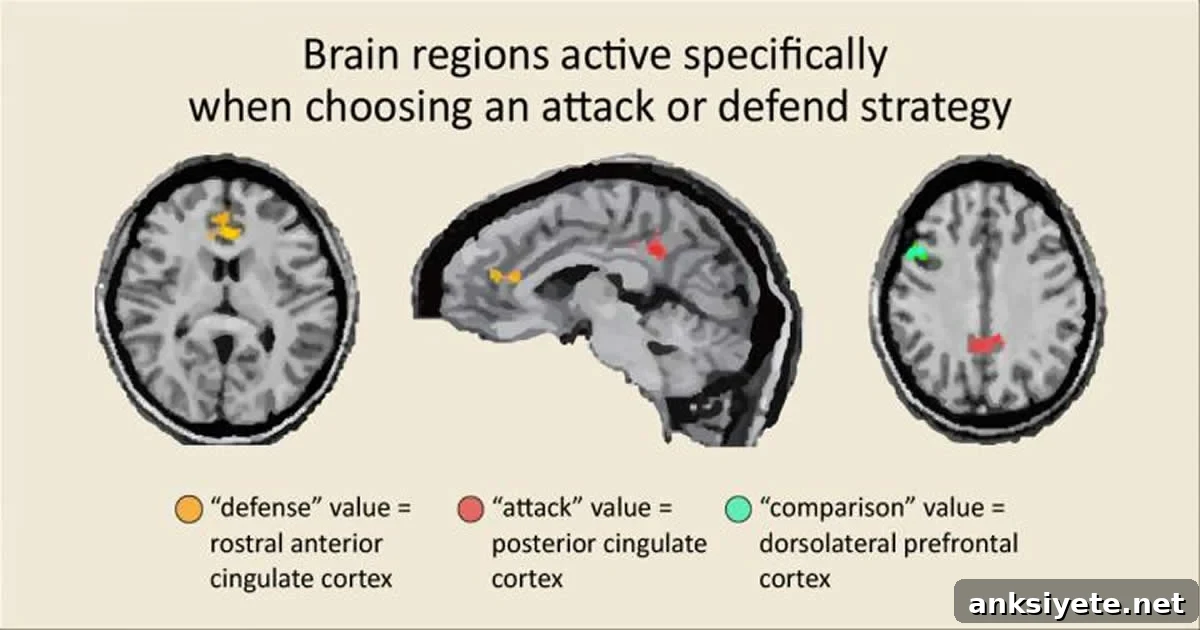
Researchers at Japan’s RIKEN Brain Science Institute have identified specific regions of the cingulate cortex that encode the values of offensive and defensive strategies. By measuring neural activity with functional MRI while experienced amateur players evaluated positions in shogi (Japanese chess), the team found complementary encoding: one cingulate area linked to attack value and another to defense value. These results, published in Nature Neuroscience, clarify how the brain makes rapid strategic choices before fully evaluating all possible moves.
Everyday decisions about whether to press an advantage or protect a position—comparable to a tennis player deciding to approach the net or fall back—are often made quickly and intuitively. To investigate how the brain supports these split-second strategic choices, Keiji Tanaka and colleagues recorded brain activity in high-level amateur shogi players as they viewed board positions and rapidly judged whether an offensive or defensive strategy was best.
Because functional MRI requires participants to remain still, the researchers used shogi positions in which the overall strategy could be clearly categorized as attacking or defending. In some trials players freely decided which strategy to adopt and then selected a move; in matched control trials the players were instructed to adopt a particular strategy (attack or defend) and only had to choose the best move under that instruction. This design separated activity related to deciding the overall strategy from activity related to selecting a concrete move.
Analysis revealed three key brain regions that showed greater engagement when subjects chose a strategy than when they merely selected a move under an instructed strategy. Activity in the posterior cingulate cortex (PCC) was associated with the value of attacking, while activity in the rostral anterior cingulate cortex (rACC) tracked the value of defending. The dorsolateral prefrontal cortex (DLPFC) was active in both contexts and its activity reflected the difference between attack and defense values, suggesting a role in comparing competing strategic values to guide the final decision.
Further statistical modeling showed that activity in rACC and PCC correlated with the computed defense and attack values of each board position, respectively, rather than merely reflecting the final verbal choice of “attack” or “defend.” In other words, these cingulate regions encoded quantitative information about the expected benefit of each strategy. The DLPFC, by tracking the difference between the two values, appears to contribute to comparing those encoded values and steering the ultimate choice.
Behaviorally, players were both faster and more accurate when selecting the overall strategy than when choosing the best specific move. This pattern supports the idea that strategic decisions in this context are driven by rapid, intuitive evaluation of the board configuration—an enhanced perceptual awareness of the relevant pieces and their relationships—rather than by stepwise analytical search of many possible moves.
Tanaka and his team suggest that understanding how the brain represents alternative strategy values can improve models of intuitive decision-making. Such knowledge has potential applications in designing decision-support systems and informing approaches in artificial intelligence that aim to mimic human-like rapid strategy selection.
Source: Adam Phillips — RIKEN
Image source: Image credited to RIKEN.
Original research: Abstract for “Neural encoding of opposing strategy values in anterior and posterior cingulate cortex” by Xiaohong Wan, Kang Cheng and Keiji Tanaka in Nature Neuroscience. Published online April 20, 2015. doi:10.1038/nn.3999
Abstract
Neural encoding of opposing strategy values in anterior and posterior cingulate cortex
Ambiguous situations often require choosing between offensive and defensive strategies. Behavioral evidence indicates that such strategic decisions can precede detailed evaluation of concrete options. To examine the neural basis of rapid strategy choice, we measured brain activity during quick offense-versus-defense judgments in shogi. The rostral anterior cingulate cortex and the posterior cingulate cortex respectively encoded defense and attack strategy values, while the dorsolateral prefrontal cortex compared those values. Regions engaged when selecting specific moves under an instructed strategy did not show correlations with attack or defense values during free strategy decisions. These findings indicate that distinct cingulate representations of alternative strategy values play essential roles in intuitive strategy decision-making.
“Neural encoding of opposing strategy values in anterior and posterior cingulate cortex” by Xiaohong Wan, Kang Cheng and Keiji Tanaka in Nature Neuroscience. Published online April 20, 2015. doi:10.1038/nn.3999