
UCSF study finds measurable brain differences in children with sensory processing disorder
Researchers at the University of California, San Francisco (UCSF) report that children diagnosed with sensory processing disorder (SPD) show altered brain connectivity compared with typically developing peers, and that these differences predict difficulties in auditory and tactile processing. The large imaging study links measurable changes in white matter microstructure to sensory behaviors, offering objective biomarkers that may improve diagnosis and guide personalized treatment.
The study, published January 26, 2016 in Frontiers in Neuroanatomy, is the largest diffusion tensor imaging (DTI) study to date in children with SPD and the first to directly compare white matter tracts between typically developing boys and girls and those with SPD. White matter forms the brain’s wiring, connecting regions that enable perception, cognition and action. Disruption of these pathways can affect how sensory information is transmitted and integrated.
Children with SPD experience atypical responses to sensory input. Symptoms range from hypersensitivity to sounds, sights and touch, to poor fine motor skills, difficulties with attention and challenges regulating emotion. For some families, the unpredictability of symptoms—such as a child tolerating a sound one day and being distressed by it the next—creates confusion and stress.
The researchers enrolled 40 right-handed children with SPD and 41 right-handed typically developing controls, ages 8–12, and assessed brain structural connectivity using diffusion tensor imaging. Behavioral characterization included a parent-report sensory questionnaire (the Sensory Profile), plus direct neurologic assessments: the Acoustic Index of the Differential Screening Test for auditory processing and components of the Sensory Integration Praxis Tests to evaluate tactile processing.
“By comparing white matter in kids with SPD to typically developing children and matching those findings to direct measures of auditory and tactile function, we found strong correlations between white matter integrity and sensory performance,” said senior author Pratik Mukherjee, MD, PhD, a professor of radiology and biomedical imaging and bioengineering at UCSF. “The data support the idea of SPD as a continuum: children with SPD fall at one extreme and sensory-typical children at the other. Importantly, these are objective measurements rather than relying solely on parent reports.”
Examining brain wiring
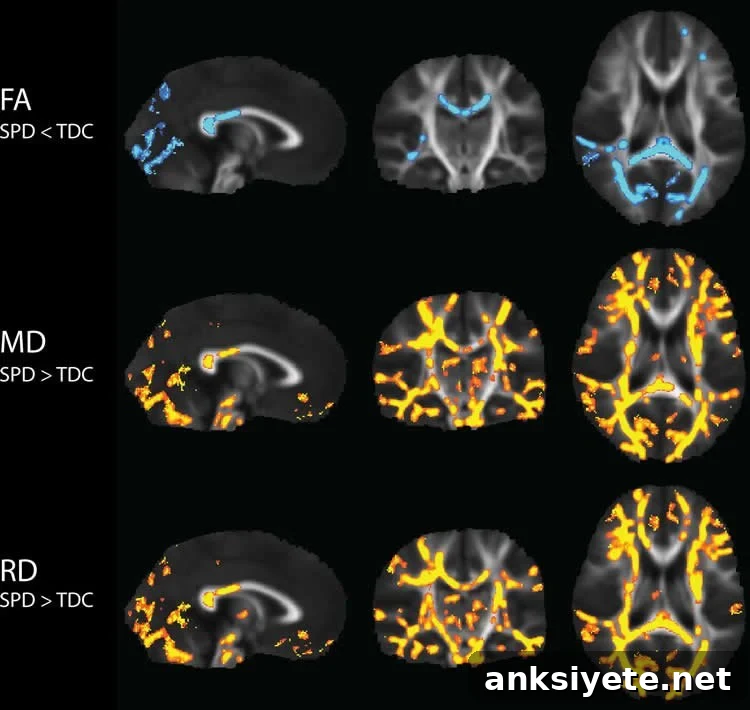
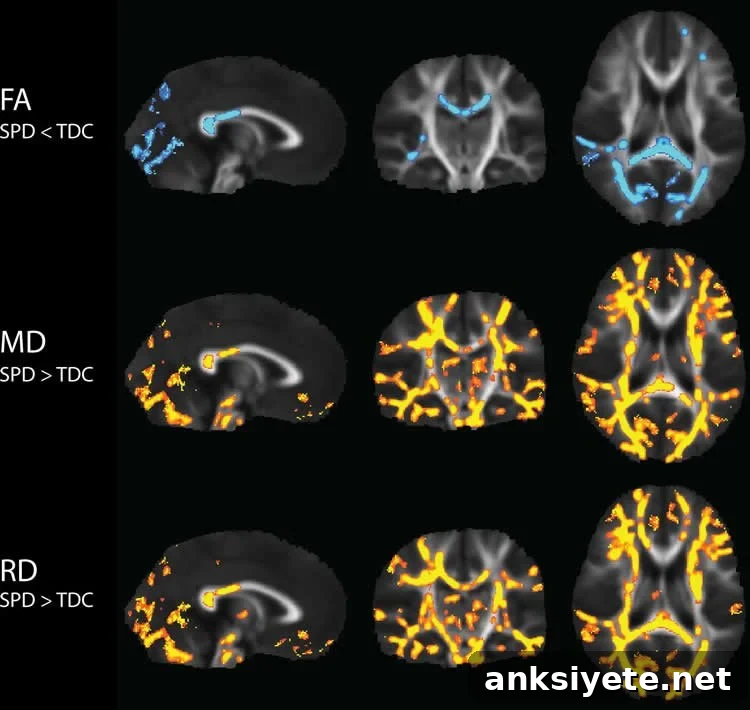
Diffusion tensor imaging maps the microscopic movement of water molecules to reveal the direction and integrity of white matter fibers. In this study, DTI identified abnormal microstructure in white matter tracts that connect auditory, visual and somatosensory systems, including interhemispheric connections between left and right brain regions. These posterior tracts—responsible for relaying sensory information—showed the strongest associations with sensory functioning.
The altered microstructure observed in children with SPD likely changes the timing and coherence of sensory transmission, making it difficult to process and integrate stimuli across modalities. Notably, DTI measures correlated more strongly with the direct neurologic assessments of tactile and auditory processing than with parent-report measures, suggesting the objective tests more closely reflect underlying brain pathology.
“The strong link between neurologic testing and DTI means clinicians can use objective measures to better estimate sensory challenges and tailor treatments,” said Elysa Marco, MD, lead author of the study. “This approach aligns with precision medicine—moving away from one-size-fits-all diagnoses and toward quantifiable biomarkers that help personalize care.”
Pioneering work and clinical context
This research builds on UCSF’s 2013 pilot study demonstrating quantifiable white matter differences in boys with SPD. The earlier work established a biological basis for SPD and raised questions about how those differences compare with other neurodevelopmental disorders and how they appear in girls. The current, larger mixed-gender cohort confirms robust posterior white matter alterations and identifies a wider spatial distribution of microstructural changes.
SPD can be difficult to diagnose because many children with autism also display atypical sensory behaviors—reports suggest as many as 90 percent of children with autism have sensory differences—and SPD is not currently listed as a separate disorder in the Diagnostic and Statistical Manual used by mental health professionals. Consequently, children who have sensory-based dysfunction without the social communication deficits associated with autism have been under-studied.
Co-authors on the study include Yi-Shin Chang, MS; Julia Owen, PhD; Shivani Desai, BS; Anne Brandes-Aitkin, BS; Susanna Hill, BS; Anne Arnett, MA; and Julia Harris, BS, all affiliated with UCSF.
Funding: The work was funded by grants from the Wallace Research Foundation to EJM and PM, and by a gift to EJM. EJM also received neuroimaging support from NIH K23 MH083890. The study benefited from additional contributions from the SPD community to the UCSF Sensory Neurodevelopment and Autism Program (SNAP). The authors report no conflicts of interest relevant to this paper.
Original research: The published study is titled “White Matter Microstructure is Associated with Auditory and Tactile Processing in Children with and without Sensory Processing Disorder” and appears in Frontiers in Neuroanatomy (January 26, 2016). The paper examines white matter fractional anisotropy (FA) and other DTI metrics and reports significant correlations between white matter microstructure and both direct and parent-report measures of sensory function.
Abstract
White Matter Microstructure is Associated with Auditory and Tactile Processing in Children with and without Sensory Processing Disorder
Sensory processing disorders (SPDs) affect a substantial proportion of school-aged children and can lead to cognitive and behavioral challenges for affected individuals and their families. While sensory differences are widely documented in children with autism, children who have sensory-based dysfunction without meeting autism criteria are less well studied. In a prior pilot DTI study, boys with SPD showed altered posterior white matter microstructure that correlated with parent-reported atypical sensory behaviors. In the present, larger mixed-gender cohort (ages 8–12), researchers again found robust posterior white matter alterations in children with SPD and additional, more widely distributed microstructural differences. Fractional anisotropy correlated with parent reports and with direct measures of tactile and non-linguistic auditory function across participants. Direct assessments showed a stronger and more continuous relationship to white matter integrity than parent-report measures. These findings support further investigation of diffusion MRI as a tool to identify biomarkers for diagnosis, prognosis and treatment response in children with SPD, and represent the first demonstration of associations between directly measured tactile and auditory function and white matter microstructure in both SPD and typically developing children.