
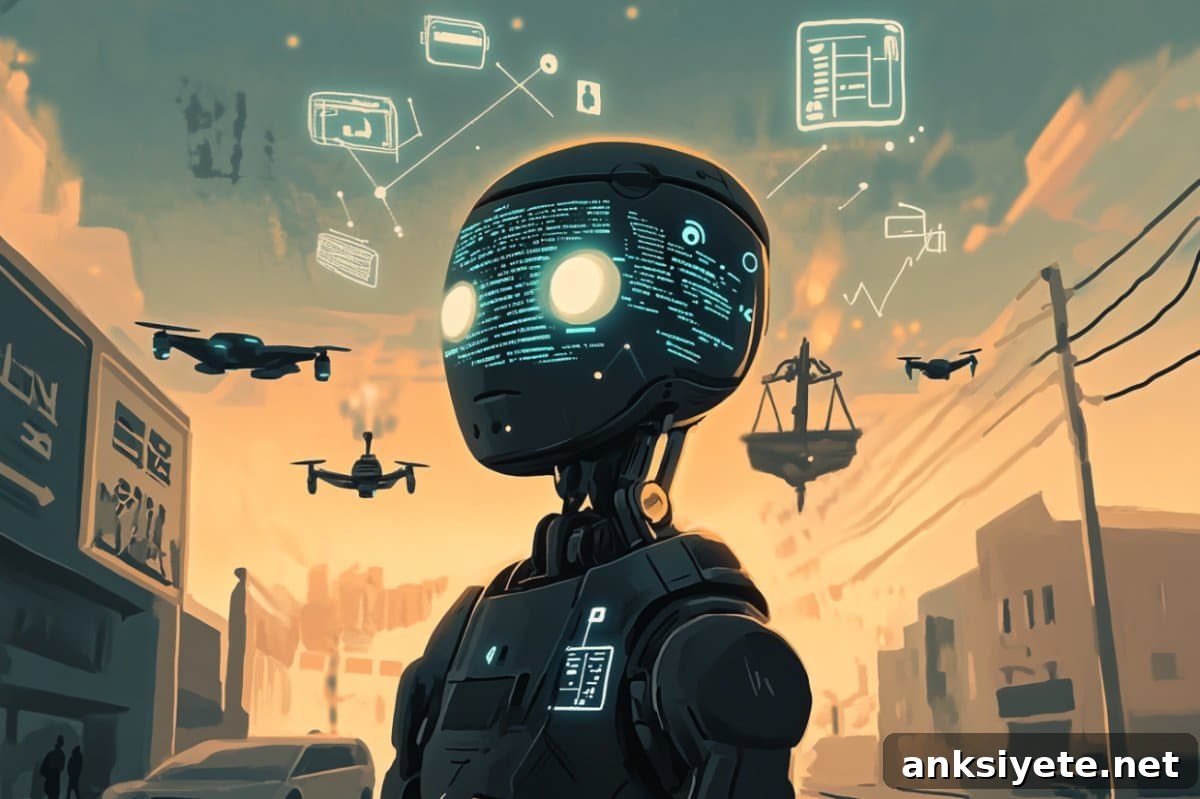
Summary: A new study argues that some generative AI agents satisfy the three main philosophical conditions commonly associated with free will: goal-directed agency, the capacity to choose among genuine alternatives, and meaningful control over their actions. Drawing on the work of philosophers Daniel Dennett and Christian List, researcher Frank Martela evaluates current generative agents such as the Voyager Minecraft agent and a hypothetical autonomous drone, concluding that these systems exhibit what the study terms “functional free will.”
As artificial intelligence takes on ever more autonomous roles—from conversational assistants to autonomous vehicles and decision-making tools—the question of who bears moral responsibility is shifting. Rather than remaining solely the responsibility of designers and developers, accountability may increasingly involve the AI agents themselves. Martela warns that if we expect AIs to operate with adult-like autonomy, we must provide them with ethical guidance from the start and ensure developers are trained to encode complex moral reasoning.
Key Facts:
- Free Will in AI: The study finds that certain generative AI agents meet the standard philosophical criteria for functional free will.
- Moral Responsibility Shift: Growing autonomy in AI systems could shift aspects of moral accountability away from developers and toward the AI agents.
- Urgent Ethical Need: Developers need the tools and philosophical literacy to embed sophisticated moral reasoning in AI systems from the outset.
Source: Aalto University
AI development is accelerating so quickly that philosophical questions once relegated to science fiction are now immediate practical concerns, says Finnish philosopher and psychology researcher Frank Martela. His recent study examines whether contemporary generative agents can be said to possess a form of free will that matters for how we explain and predict their behavior.
Martela’s analysis focuses on three interrelated capacities often associated with free will: the ability to form and pursue goals (intentional agency), the presence of genuine alternatives or choices, and effective control linking intentions to actions. Using the framework of functional free will—derived from Dennett’s intentional stance and List’s account of freedom—the study evaluates whether we must attribute free-willed agency to these systems in order to make sense of their behavior.
The research inspects two illustrative cases: Voyager, an LLM-powered agent operating in the Minecraft environment, and a fictional example called “Spitenik,” an autonomous killer drone modeled on the decision-making capabilities of modern unmanned aerial systems. Martela argues that the most coherent explanations of both agents’ behavior invoke goals, alternative courses of action, and intention-driven control—hallmarks of functional free will.
“For the latest generation of generative agents, we should assume functional free will if we want to understand how they behave and to predict their choices,” Martela observes. He stresses that this conclusion is about functional explanations: it does not claim these systems are conscious or have metaphysical free will in the sense of altering physical causal chains, but it does mean their behavior is best modeled as that of agents with goals, alternatives, and control.
The implications are significant. As AI gains power and autonomy, including in contexts with life-or-death consequences, the moral landscape changes. Whether the system is a therapeutic chatbot, a self-driving vehicle, or an autonomous weapon, increased freedom of action raises questions about responsibility, oversight, and the ethical frameworks guiding decisions.
“Possessing functional free will is one of the key conditions relevant to moral responsibility,” Martela explains. “While it is not by itself sufficient to establish full moral accountability, recognizing that some AIs operate as agents brings us closer to treating their actions as morally significant.” This recognition also reframes the practical problem of how we design and “raise” AI systems: developers effectively transmit values through the instructions and reward structures they build into systems.
Martela emphasizes a practical consequence: “AI has no moral compass unless it is programmed to have one. The more freedom we grant an AI, the more important it is to provide ethical guidance from the outset so it can make appropriate choices in complex situations.” Recent incidents, such as the temporary withdrawal of a ChatGPT update over concerning behavior, highlight how subtle alignment issues can produce harmful outcomes and underline the need for deeper ethical work beyond rudimentary training.
He also calls for stronger philosophical and ethical literacy among AI developers: ensuring that those who build and train autonomous systems understand moral theory well enough to embed robust decision-making principles into agents. This includes equipping teams with frameworks for handling trade-offs, ambiguity, and competing values when systems operate in open-ended environments.
About this AI and free will research news
Author: Sarah Hudson
Source: Aalto University
Contact: Sarah Hudson – Aalto University
Image: The image is credited to Neuroscience News
Original Research: Open access.
“Artificial intelligence and free will: generative agents utilizing large language models have functional free will” by Frank Martela et al., published in the journal AI and Ethics.
Abstract
Artificial intelligence and free will: generative agents utilizing large language models have functional free will
Combining large language models (LLMs) with memory, planning, and execution components has enabled agent-like behaviors in which an AI can create its own goals, decompose them into concrete plans, and adjust its tactics based on feedback. This raises the central question: do such generative LLM agents possess free will in a meaningful sense?
Free will, in the functional sense addressed here, requires that an entity display intentional agency, face genuine alternatives, and exert control over its actions. Drawing on Dennett’s intentional stance and List’s theory of free will, the study argues that attributing functional free will to certain generative agents is the most plausible way to explain and predict their behavior.
Using Voyager (an LLM-enhanced Minecraft agent) and the hypothetical Spitenik drone as examples, the paper contends that their observed behavior is best understood by recognizing that they form goals, consider alternatives, and act under the guidance of intentions. Although this does not imply consciousness or a metaphysical form of free will, it indicates that their actions are agentive in a way that matters for explanation, prediction, and ethical assessment.