Summary: Researchers identify distinct neural processes that occur when people make decisions that benefit themselves versus others.
Source: RIKEN
Is a selfish person simply processing rewards to others differently? A recent study from RIKEN suggests this may be the case. A team led by Hiroyuki Nakahara at the Laboratory for Integrated Theoretical Neuroscience, RIKEN Center for Brain Science, examined 36 healthy volunteers aged 20 to 32 to determine which brain regions engage when people consider giving rewards to others.
The volunteers chose between two options on each trial. Both options offered a baseline reward for the chooser, but one option included an additional monetary bonus for the participant while the other option added a bonus for “others” — a set of well-known charities. The researchers combined functional magnetic resonance imaging (fMRI) with computational connectivity analyses to track how the brain processed these choices.
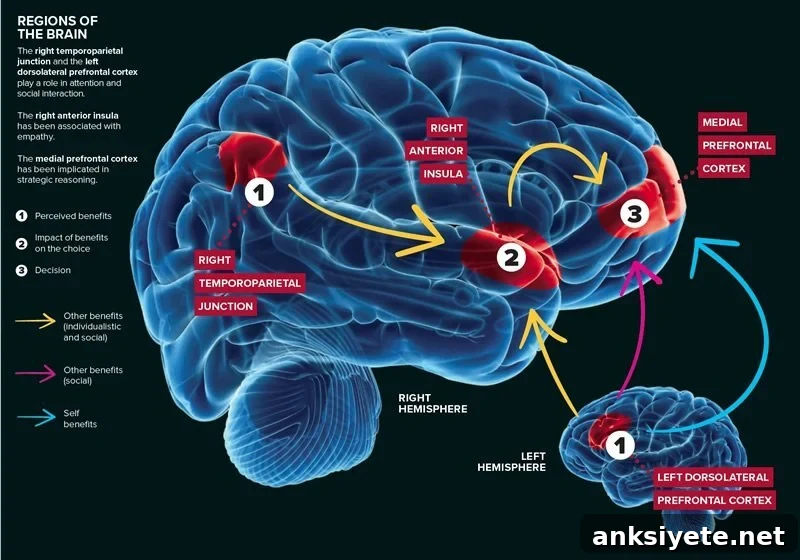
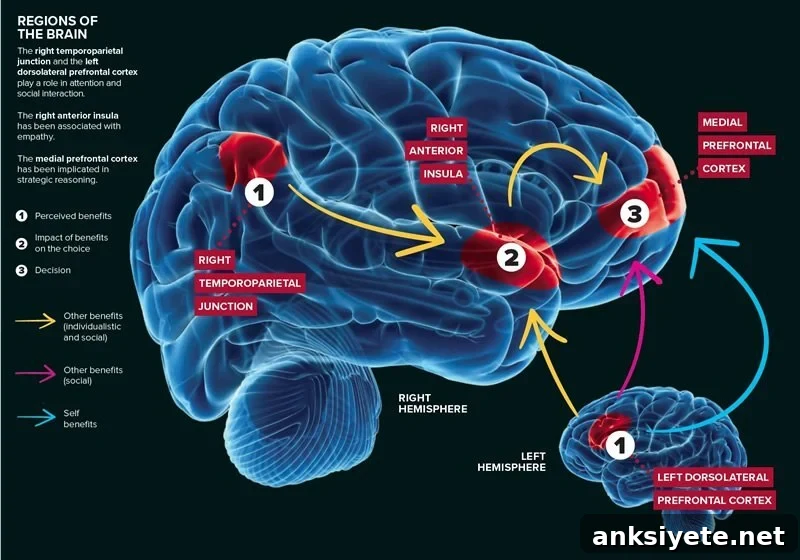
They discovered a three-stage, feedforward cascade that converts the social value of an offer into a self-referenced decision. In stage one, the brain detects the offered benefit to others. This initial detection was associated with activity in the right temporoparietal junction (rTPJ) and the left dorsolateral prefrontal cortex (left dlPFC), areas previously linked to attention control and social cognition.
Stage two involves forming an intermediate, effective value that represents how much the offered bonus for others will actually influence the decision. That effective value corresponded to activity in the right anterior insula (right AI), a hub of the brain’s salience network that has been connected to empathy and the processing of emotionally relevant information.
The final stage is the decision computation itself, reflected by activation in the medial prefrontal cortex (mPFC), a region implicated in strategic reasoning and valuation during choice. Using connectivity analyses, the team showed feedforward processing from rTPJ and left dlPFC to the right AI, and then onward to the mPFC, supporting a sequential transformation from social signal to decision signal.
The researchers then asked whether people who differ in social preferences use this circuitry in different ways. To classify participants, they used the social value orientation (SVO) measure developed by social psychologist Paul A. M. Van Lange. The SVO questionnaire separates people who tend to act prosocially (more generous) from those who tend to be individualistic (more self-oriented).
Although prosocial and individualistic participants sometimes made similar choices, their neural processing differed. Prosocial participants appeared to convert value for others and self in a similar manner, relying on a left dlPFC → mPFC pathway when processing both types of bonus. Individualistic participants, however, showed a different profile. When evaluating the option to give to others, their decisions involved stronger mediation by the right AI during the intermediate, effective-value stage, suggesting they process the implications of others’ rewards differently from self-rewards.
The authors emphasize that these differences are not simply about labels like “altruistic” or “selfish,” but about how people perceive and weight social value. A person who behaves generously may do so because they place higher subjective value on social contribution, or because dispositions such as inequity aversion or guilt influence valuation. The team coined the term “social value conversion” to describe the computation that translates social signals (others’ reward value) into a self-referenced decision value. They propose that social value conversion is a fundamental neural computation that supports diverse forms of social behavior.
The findings provide neural building blocks for studying more complex forms of social decision-making. The authors note that cultural norms, religious beliefs, and regional differences likely shape how people evaluate and respond to others’ needs, and these influences could modulate social value conversion through experience-dependent changes in the brain.
“Through repeated experiences in daily life, these influences become integrated into the neural circuitry that supports social behavior and decision-making,” Nakahara explains. “The basic conversion process would be modulated and combined with those factors to produce a final behavior and choice.”
The study also points toward future research directions, including whether the social value conversion process differs in people with antisocial disorders. Identifying such differences could improve understanding of the neural correlates underlying antisocial behavior.
Nakahara’s group continues to explore social decision-making. Ongoing work includes investigations of how people predict others’ choices to improve their own decisions—an area that may further clarify how social information is incorporated into self-oriented value computation.
Source:
RIKEN
Media Contacts:
Hiroyuki Nakahara – RIKEN
Image Source:
Image credit: Sebastian Kaulitzki.
Original Research:
“Computing Social Value Conversion in the Human Brain.” Haruaki Fukuda, Ning Ma, Shinsuke Suzuki, Norihiro Harasawa, Kenichi Ueno, Justin L. Gardner, Noritaka Ichinohe, Masahiko Haruno, Kang Cheng, and Hiroyuki Nakahara. Journal of Neuroscience. DOI: 10.1523/JNEUROSCI.3117-18.2019 (closed access).
Abstract (summary)
Social signals influence self-oriented valuation and choice, yet the neural computation that integrates others’ reward values into self-referenced decisions has been unclear. This study combined behavioral modeling and fMRI to reveal a three-stage conversion: an offered value for others encoded in rTPJ and left dlPFC, an intermediate effective value represented in the right anterior insula, and a final decision value encoded in the medial prefrontal cortex. Connectivity analyses supported feedforward processing across these stages, and variation in coupling strength distinguished prosocial and individualistic behavioral phenotypes. These results identify a basic neural computation—social value conversion—underlying complex social decision-making.