Summary: Researchers find the social gap between chimpanzees and humans is smaller than previously believed. Systematic observations at a zoo reveal that roughly 10% of actions by either species were imitations of the other, suggesting imitation serves a communicative, not merely a learning, function.
Source: Lund University.
Imitation allows skills, knowledge and innovations to be transmitted across generations and is often considered a cornerstone of human culture — supporting language, technology, art and science. While past research has portrayed nonhuman apes as comparatively poor imitators, especially when measured by their ability to copy solutions to physical problems, this focus has largely emphasized the learning aspect of imitation and has not fully explored its social and communicative roles.
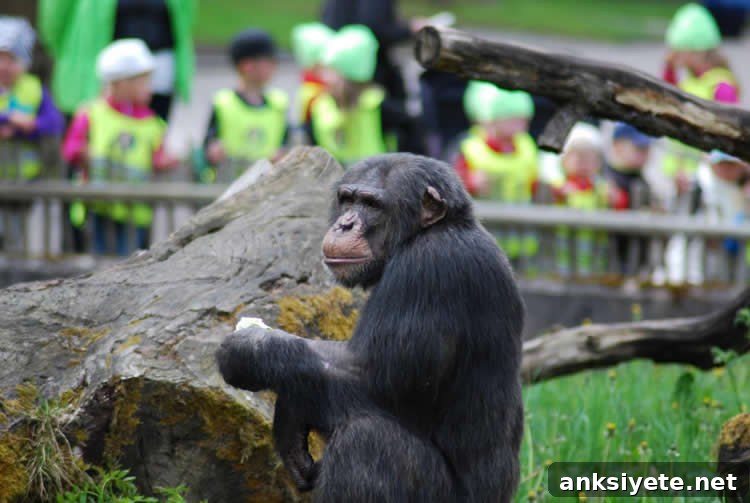
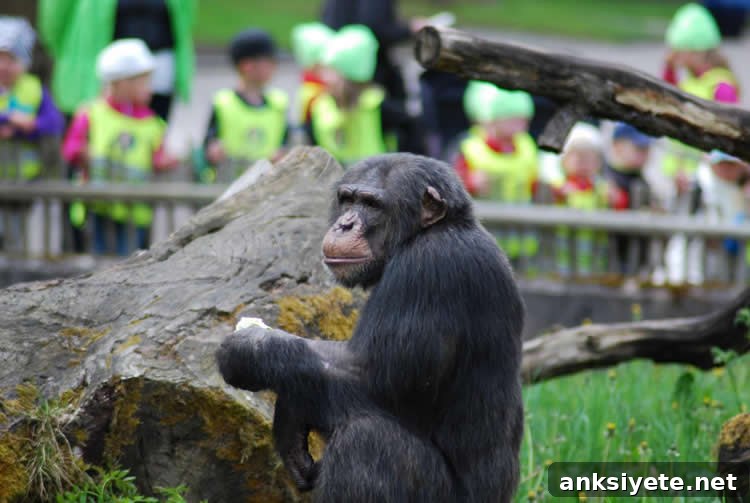
A new observational study from Lund University, published in the journal Primates, examined the interactive side of imitation by recording spontaneous encounters between chimpanzees and zoo visitors at Furuvik Zoo in Sweden. Contrary to the expectation that apes imitate far less than humans, the researchers found that both species imitated one another at similar rates: about 10% of all recorded actions produced by either species were imitative responses directed at the other.
Dr. Tomas Persson, one of the study’s authors, explains that the research took place in a typical zoo environment where chimpanzees and visitors actively attempted to engage one another’s attention. The design focused on naturally occurring exchanges rather than controlled experimental tasks, allowing the team to observe how imitation functions within everyday social interaction.
Both species tended to imitate familiar, routine actions — gestures such as hand clapping, kissing-like gestures, and tapping or knocking on the glass. These copied behaviours were neither novel nor intended to solve a task, indicating that imitation in these interactions was primarily social and communicative. Interactions that included imitation also lasted longer than those without, suggesting that simple imitative gestures help initiate contact and sustain ongoing engagement.
Dr. Gabriela-Alina Sauciuc, who co-led the study with Persson, notes that several interactions developed into extended, game-like exchanges with back-and-forth turns. These sequences resemble how preverbal human toddlers use imitation in play to maintain attention and connection, pointing to a shared social function across species.
The study’s quantitative observations further revealed nuances: physical proximity increased the likelihood of cross-species imitation, and imitative precision was generally higher among visitors than chimpanzees. However, when interactions occurred in closer proximity — for example, in indoor settings — the difference in precision diminished. Four of the five chimpanzees observed produced imitations, and three of those demonstrated comparable imitation rates despite differing overall levels of cross-species engagement.
Importantly, chimpanzees showed signs of imitation recognition: when visitors imitated the chimpanzees’ actions (as opposed to merely copying postures), the apes returned imitation in about 36% of those cases. All four imitating chimpanzees participated in so-called imitative games, sequences of reciprocal copying that appeared to maintain social involvement rather than to instruct or teach.
These findings suggest that intentional imitation in apes may have an evolutionary role beyond the transmission of practical skills. In addition to enabling learning, imitation can serve affiliative and communicative purposes, fostering interaction, attention, and prosocial connection between individuals — and, as this study shows, even across species boundaries.
Source: Gabriela-Alina Sauciuc, Lund University
Image credit: Lund University
Original research: “Spontaneous cross-species imitation in interactions between chimpanzees and zoo visitors” by Tomas Persson, Gabriela-Alina Sauciuc, and Elainie Alenkær Madsen. Published in Primates, online August 16, 2017. DOI: 10.1007/s10329-017-0624-9.
MLA: Lund University. “Both Chimps and Humans Spontaneously Imitate Each Other’s Actions.” NeuroscienceNews, 22 August 2017.
APA: Lund University (2017, August 22). Both Chimps and Humans Spontaneously Imitate Each Other’s Actions. NeuroscienceNews.
Chicago: Lund University. “Both Chimps and Humans Spontaneously Imitate Each Other’s Actions.” NeuroscienceNews, August 22, 2017.
Abstract
Spontaneous cross-species imitation in interactions between chimpanzees and zoo visitors
Imitation plays dual roles in human development: a cognitive role supporting the acquisition and transmission of skills, and a social–communicative role where copying familiar actions helps sustain interaction and encourage prosocial behavior. The communicative dimension of imitation in nonhuman primates has been understudied and sometimes deemed absent. In this observational study, researchers documented spontaneous interactions between chimpanzees and zoo visitors and found both species imitated each other at comparable rates — nearly 10% of observed actions. Imitation appeared to serve a social–communicative function: interactions containing imitative actions lasted significantly longer than those without. Physical proximity increased cross-species imitation. While visitors generally displayed higher imitative precision, this advantage disappeared in close-contact settings. Four of five chimpanzees produced imitations and engaged in imitative games; returned imitation occurred in 36% of cases where visitors imitated chimpanzee actions. These results indicate that nonhuman apes can show spontaneous imitation that supports communication and social bonding, raising new questions about the evolution and functions of imitation.
“Spontaneous cross-species imitation in interactions between chimpanzees and zoo visitors” by Tomas Persson, Gabriela-Alina Sauciuc, and Elainie Alenkær Madsen in Primates. Published online August 16, 2017. DOI: 10.1007/s10329-017-0624-9.