
Summary: A new silicon probe will give researchers a clearer, large-scale view of how neurons and brain regions coordinate to process information.
Source: HHMI.
Neuroscientists seeking to follow cellular conversations across the brain will soon have practical access to a powerful, easy-to-use tool that records neural activity from hundreds of sites at once. Developed through a multi-institution collaboration, these Neuropixels probes promise to reveal how distributed populations of neurons work together to generate behavior and cognition.
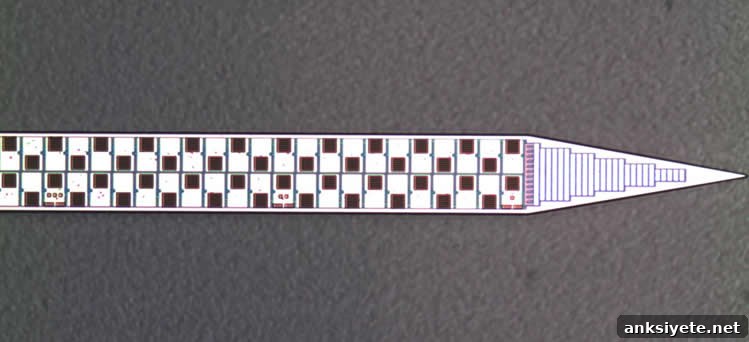
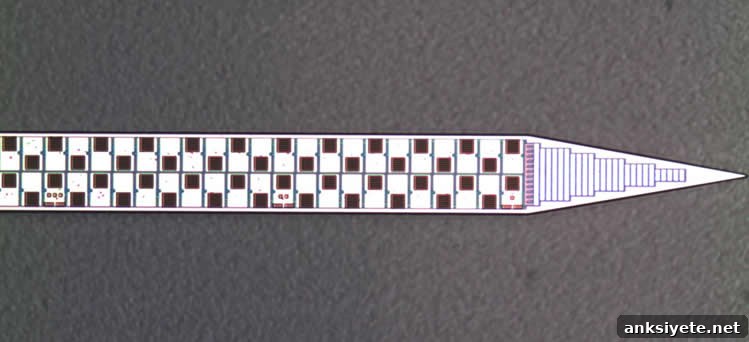
In a $5.5 million collaboration led by researchers at HHMI’s Janelia Research Campus, teams at the Allen Institute for Brain Science and University College London, supported by grants from the Gatsby Charitable Foundation and Wellcome, partnered with imec, a nanoelectronics research center in Leuven, Belgium, to design and test a new generation of high-density neural probes. Over four years they developed the Neuropixels devices—thin, long silicon probes that place nearly 1,000 electrical sensing sites along a single shank so researchers can record well-resolved neural signals from many brain regions simultaneously. The probes and associated methods were reported in Nature (November 9, 2017) and were expected to become commercially available for research labs by mid-2018.
Key advantages demonstrated in the Nature paper include:
- The first implantable device combining a long (10 mm), dense array (100 sites/mm) of recording locations on a single shank.
- Hundreds of clearly separated single-neuron signal traces visible from a single probe.
- Simultaneous recordings across multiple brain regions; for example, more than 700 well-isolated neurons were recorded using two probes in one awake mouse experiment.
- High neuron yield and excellent signal-to-noise ratios without special preparation techniques.
Each Neuropixels probe integrates nearly 1,000 sensing sites along a shaft thinner than a human hair but long enough to access superficial and deep structures in a rodent brain. Timothy Harris, senior fellow at Janelia and lead of the Neuropixels collaboration, highlights that the technology enables recording from large numbers of neurons across multiple brain regions with improved fidelity and reduced experimental complexity.
Prototype Neuropixels probes have already been tested widely. Researchers from the consortium presented prototype data at the Society for Neuroscience annual meeting in November 2017, demonstrating that the probes combined with updated analysis methods can track activity from hundreds or thousands of individual neurons across distant brain structures. At the time of reporting, more than 400 prototype probes were in use at laboratories worldwide, including several labs affiliated with Gatsby and Wellcome, multiple HHMI labs, and large-scale deployments at the Allen Institute.
Christof Koch of the Allen Institute for Brain Science emphasized the potential impact: understanding the cellular code that links large neural assemblies to behavior requires precise measurement tools, and Neuropixels delivers a substantial leap forward in that capability. Matteo Carandini and Kenneth Harris at UCL, who helped guide probe development, noted that Neuropixels bridges a gap that previously forced researchers to choose between single-cell resolution in a small area and broader regional coverage. Now, with appropriate probe placement, experiments can reveal how distributed neurons coordinate at the cellular level.
Albert Lee, a Janelia group leader involved in prototype testing, pointed out that simultaneous access to many brain regions reduces the number of separate experiments needed to form a comprehensive picture of neural activity during a behavior. Instead of performing numerous experiments each focused on a different area, a single Neuropixels recording can capture activity across multiple regions at once.
Neuropixels builds on decades of electrophysiology practice but incorporates two major advances. First, the probes are long enough to traverse and record from many brain regions in a single insertion. Second, electrodes are densely packed along the shank, improving the ability to localize signals to individual cells. Each probe also contains an integrated recording system on the probe base—filtering, amplification, multiplexing, and digitization—so digital, low-noise data can be transmitted directly from the device, reducing size, cost, and hundreds of output wires that traditional setups require.
John O’Keefe of UCL, a lead investigator on the Wellcome and Gatsby grants, supported early British involvement in the project and noted the particular value of Neuropixels for cortical regions related to spatial memory, such as the hippocampus and entorhinal cortex.
The Neuropixels effort began in 2013 with an ambitious aim: to make high-density, high-quality neural recording broadly accessible. Prior to this work, many labs could record from hundreds of neurons but only at high cost and with substantial technical difficulty; standard electrophysiology probes commonly offered only 16–64 sensors per shank. Janelia scientists, collaborating with semiconductor engineers and imec, pursued a new design that combined scalable chip fabrication with neuroscience requirements. Fabricating hundreds of electrodes on a slender, implantable device required capabilities beyond typical academic facilities, so partnering with a professional semiconductor foundry was essential.
Imec contributed its expertise in analog design, deep silicon etch, biocompatible electrode fabrication and SOI CMOS processes to the project, producing probes in modest volumes suitable for research. Barundeb Dutta, chief scientist at imec, noted that this collaboration illustrates a new model where research foundations fund design and fabrication of breakthrough tools that accelerate fundamental science.
Researchers at HHMI Janelia, the Allen Institute, and UCL collaborated with imec to develop Neuropixels probes. The design integrates on-probe signal processing that converts extracellular voltage signals into digitized data optimized for computational analysis, while UCL teams developed analysis methods to extract single-cell activity from the recordings.
Source: Meghan Rosen – HHMI
Publisher: Organized by NeuroscienceNews.com.
Image Source: Timothy Harris Lab, Janelia Research Campus.
Original Research: “Fully integrated silicon probes for high-density recording of neural activity.” Nature. DOI: 10.1038/nature24636
Sensory, motor and cognitive functions depend on coordinated activity of large neuronal populations distributed across multiple brain regions. Traditional extracellular probes achieve excellent temporal resolution but sample only a few dozen neurons per shank, while optical calcium imaging covers larger areas but lacks spike-level temporal resolution and cannot measure local field potentials. Neuropixels probes were designed to bridge these gaps for use in freely moving animals. Each probe provides 384 recording channels that can programmably access 960 low-impedance TiN sites arranged along a single 10-mm long shank with a 70 × 20 μm cross-section. The 6 × 9 mm probe base houses on-chip filtering, amplification, multiplexing, and digitization, enabling direct transmission of digital data. This dense site layout and high channel count yield well-isolated spikes from hundreds of neurons per probe in mice and rats. Using two probes, researchers recorded more than 700 well-isolated single neurons simultaneously from five brain structures in an awake mouse. The small, fully integrated probes allow large neuronal populations across several structures to be recorded in freely moving animals, opening a path toward brain-wide neural recordings during behavior.