
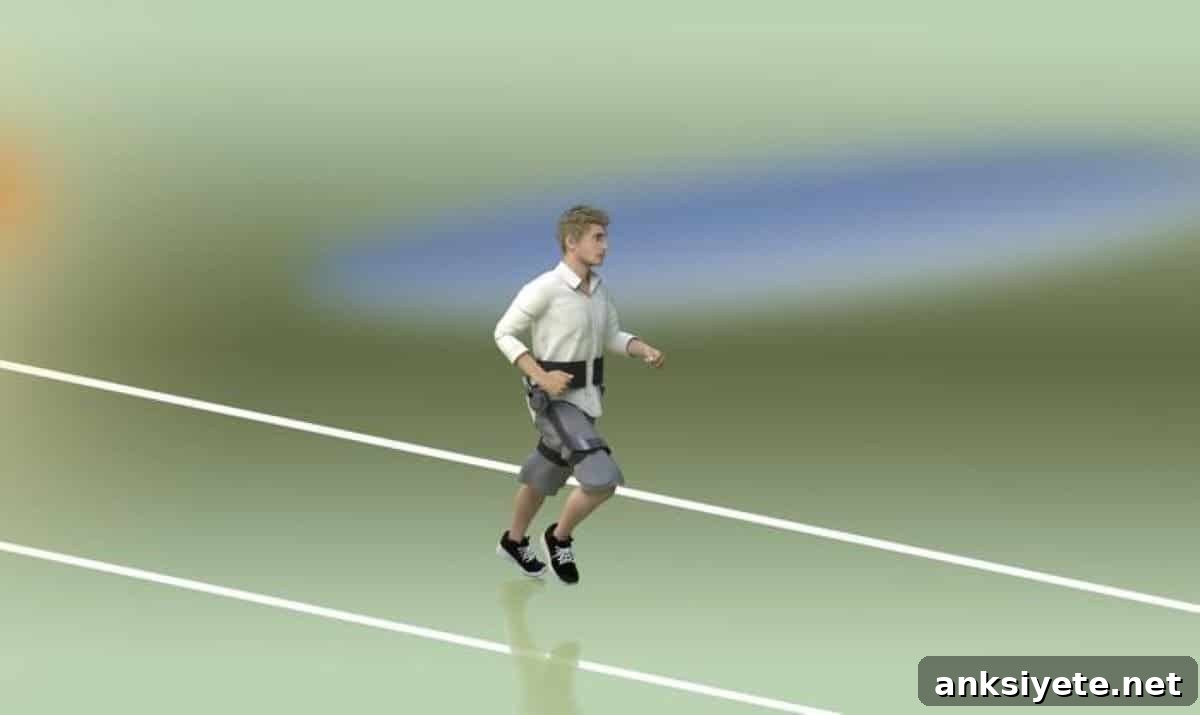
Summary: Researchers have developed an AI-driven, simulation-based method that trains robotic exoskeleton controllers to reduce the metabolic cost of walking, running, and climbing stairs. By learning entirely in simulation, these controllers avoid time-consuming human-in-the-loop experiments and can be adapted to a wide range of assistive devices.
This advance could significantly improve everyday mobility and accessibility for many people, including older adults and those with mobility impairments. In tests reported by the team, participants wearing the exoskeleton used up to 24.3% less energy while walking compared with unaided walking.
Key Facts:
- AI and realistic simulations are used to train exoskeleton controllers without requiring lengthy human experiments.
- In human testing, exoskeleton assistance reduced metabolic energy use by up to 24.3% for walking, 13.1% for running, and 15.4% for stair climbing.
- The simulation-to-hardware approach is broadly applicable to other wearable robots and prosthetic devices.
Source: New Jersey Institute of Technology
Overview: A team led by researchers from New Jersey Institute of Technology and collaborators has demonstrated an experiment-free approach to developing exoskeleton controllers. By combining physics-informed musculoskeletal models, accurate representations of human–robot interaction, and data-driven reinforcement learning, the system learns effective assistance strategies entirely in simulation and then deploys them directly on physical hardware.
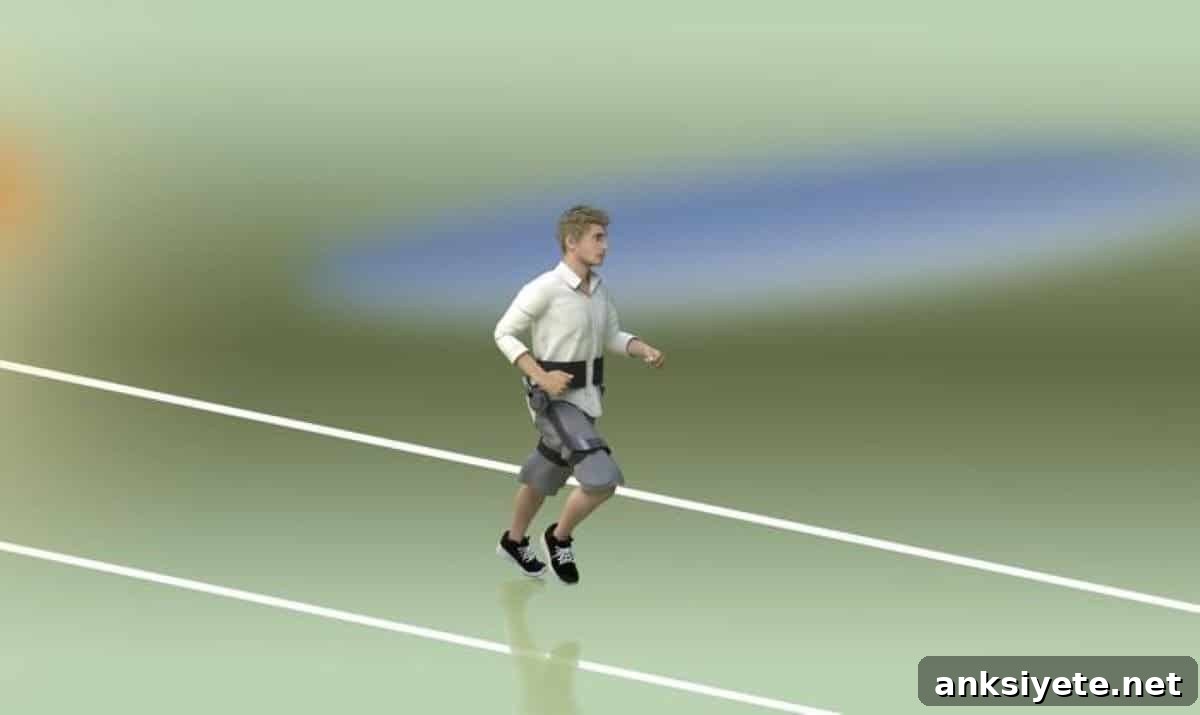
“This approach can be applied to knee or ankle exoskeletons, multi-joint systems, or to above- and below-the-knee prostheses,” said Xianlian Zhou, associate professor and director of NJIT’s BioDynamics Lab. Because the controllers are generated in simulation, the devices can be ready for use immediately and can be updated as models improve, eliminating lengthy per-user tuning sessions.
The method centers on closed-loop simulation that includes models of musculoskeletal dynamics, muscle responses, human–robot interaction, and the exoskeleton controller. This integrated simulation produces realistic, efficient training data that reinforcement learning uses to optimize control policies. The resulting controller is robust enough to transfer to hardware with minimal adjustment, removing the need for extended human subject training typically required to tune assistive devices.
Hao Su, an associate professor of mechanical and aerospace engineering and corresponding author on the study, explains that the framework blends physics-aware modeling with data-driven learning to bridge the gap between simulation and reality. The result is a practical, experiment-free pipeline for developing wearable robotic controllers that directly benefit users.
Shuzhen Luo, the study’s lead author, notes that earlier reinforcement learning successes were often confined to virtual environments or games. This work extends those methods to embodied systems—AI programs that are integrated with physical devices—creating turnkey solutions for wearable robot controller development and accelerating real-world deployment.
Traditionally, exoskeleton users spend hours or more in iterative tuning sessions while the device learns when and how much force to apply. The new approach eliminates this upfront training by delivering a pre-programmed controller capable of immediate assistance. When researchers refine the simulation models, updated controllers can be uploaded to existing units, enabling continual improvement and the potential for individualized, activity-specific assistance.
In human subject tests, participants wearing the custom hip exoskeleton trained in simulation experienced significant reductions in metabolic cost: 24.3% less energy for walking, 13.1% less for running, and 15.4% less for climbing stairs. Although initial testing focused on able-bodied participants, the simulation-first framework is intended to scale to mobility-impaired users, older adults, and people with neurological conditions.
The team is already beginning studies with older adults and people with conditions such as cerebral palsy to evaluate how simulated training transfers to clinical and daily-life use. They are also exploring applications to robotic prostheses and other assistive technologies, aiming to create generalized, scalable strategies for rapid development and broad adoption of wearable robots.
Implications: This experiment-free learning approach could shorten development cycles, lower the barrier to deploying assistive devices, and enable more personalized support for users outside lab settings. By reducing the metabolic cost of basic locomotion tasks, these controllers may help restore independence, ease fatigue, and expand mobility options for a wide range of individuals.
Funding: This research was supported by the National Science Foundation (awards 1944655 and 2026622); the National Institute on Disability, Independent Living, and Rehabilitation Research (award DRRP 90DPGE0019); the Administration for Community Living’s Switzer Research Fellowship Program; and the National Institutes of Health (award 1R01EB035404).
About this AI and neurotech research news
Author: Deric Raymond
Source: New Jersey Institute of Technology
Contact: Deric Raymond – New Jersey Institute of Technology
Image: The image is credited to New Jersey Institute of Technology
Original Research: “Experiment-free exoskeleton assistance via learning in simulation” by Xianlian Zhou et al., published in Nature. The paper describes a learning-in-simulation framework that leverages dynamics-aware musculoskeletal and exoskeleton models together with data-driven reinforcement learning to create a versatile control policy. Deployed on a custom hip exoskeleton, the controller produced reduced metabolic rates of 24.3%, 13.1% and 15.4% for walking, running and stair climbing, respectively.
Abstract
Experiment-free exoskeleton assistance via learning in simulation
Exoskeletons have enormous potential to improve human locomotion, yet development and broad dissemination are often constrained by lengthy human testing and handcrafted control strategies. The study presents an experiment-free method to learn a versatile control policy entirely in simulation. By combining dynamics-aware musculoskeletal and exoskeleton modeling with data-driven reinforcement learning, the framework closes the simulation-to-reality gap without requiring human experiments. When deployed on a custom hip exoskeleton, the learned controller automatically generated assistance across multiple activities and reduced metabolic cost by 24.3% for walking, 13.1% for running, and 15.4% for stair climbing. This approach may provide a scalable strategy for rapid development and wider adoption of assistive robots for both able-bodied and mobility-impaired individuals.