
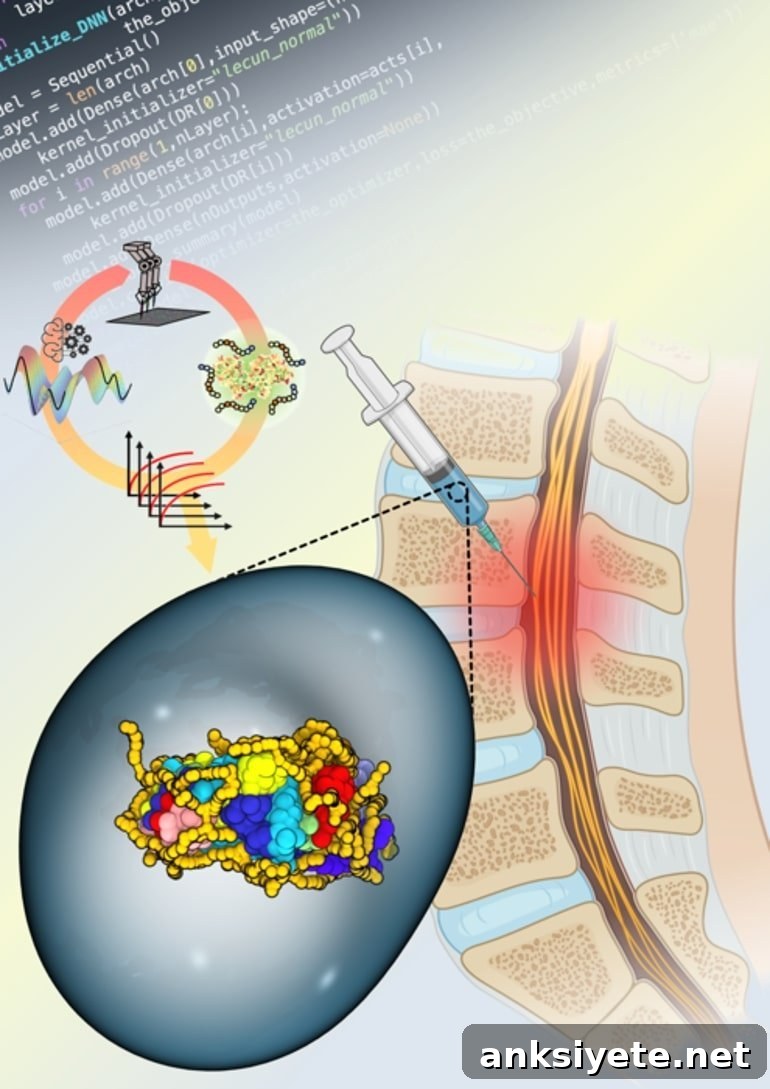
Summary: Using artificial intelligence and robotic automation, researchers have stabilized an enzyme that can break down scar tissue formed after spinal cord injury, extending its activity and opening new possibilities for sustained tissue repair.
Source: Rutgers
Researchers at Rutgers have combined AI-driven design and liquid-handling robotics to develop formulations that stabilize Chondroitinase ABC (ChABC), an enzyme that degrades inhibitory scar components after spinal cord injury and supports neural regeneration.
Published in Advanced Healthcare Materials, the study reports the successful stabilization of ChABC at human body temperature, a key advance because the enzyme normally loses activity within hours at 37 °C. By discovering copolymer-based complexes that protect and prolong enzyme function, the team has taken an important step toward therapies that could reduce scarring and promote recovery after spinal cord injury.
“This study represents one of the first times artificial intelligence and robotics have been used to formulate highly sensitive therapeutic proteins and extend their activity by such a large amount. It’s a major scientific achievement,” said Adam Gormley, the project’s principal investigator and an assistant professor of biomedical engineering at Rutgers School of Engineering in New Brunswick.
Gormley also noted a personal motivation for the work: a close college friend who was paralyzed from the waist down after a mountain biking accident. “The therapy we are developing may someday help people such as my friend lessen the scar on their spinal cords and regain function. This is a great reason to wake up in the morning and fight to further the science and potential therapy,” he said.
Co-lead author Shashank Kosuri, a doctoral student in biomedical engineering at Rutgers, explained the clinical challenge: spinal cord injuries (SCIs) trigger a secondary inflammatory cascade that produces dense glial scar tissue. Among the molecules that make that scar inhibitory are chondroitin sulfate proteoglycans (CSPGs), which block neuronal regrowth. ChABC, a bacterial lyase, can cleave the glycosaminoglycan (GAG) side chains of CSPGs and promote tissue regeneration, but ChABC itself is thermally unstable under physiological conditions and rapidly loses activity.
To address ChABC’s instability, the research team screened a wide variety of synthetic random copolymers that can form protective complexes around enzymes. Using an active machine learning workflow—combining automated PET-RAFT copolymer synthesis, iterative testing with liquid-handling robots, Gaussian process regression modeling, and Bayesian optimization—the team rapidly identified copolymer designs that stabilize ChABC at 37 °C.
Through multiple rounds of this machine-assisted discovery process, the researchers found several copolymer formulations that significantly preserved enzyme activity. One standout copolymer maintained about 30% of ChABC’s activity for up to one week under dilute conditions, a marked improvement over prior stabilization methods and a promising result for potential clinical delivery strategies where prolonged activity is required.
Maintaining enzymatic activity over longer periods could reduce the need for frequent, high-dose infusions, lowering treatment cost and complexity. The copolymer approach protects ChABC in hostile microenvironments typical of injured tissue, helping the enzyme retain functionality long enough to degrade inhibitory CSPGs and support neural repair.
Funding: This research was supported by grants from the National Institutes of Health, the National Science Foundation, and the New Jersey Commission on Spinal Cord Research. The Rutgers team included Adam Gormley, doctoral student Shashank Kosuri, SOE Professor Li Cai, Distinguished Professor Martin Yarmush, and several students from the School of Engineering. Collaborators from Princeton University’s Department of Chemical and Biological Engineering also contributed to the project.
About this AI, robotics and spinal cord injury research
Author: Emily Everson Layden
Source: Rutgers
Contact: Emily Everson Layden – Rutgers
Image: The image is credited to Rutgers
Original Research: Closed access. “Machine-Assisted Discovery of Chondroitinase ABC Complexes toward Sustained Neural Regeneration” by Adam Gormley et al. Advanced Healthcare Materials
Abstract
Machine-Assisted Discovery of Chondroitinase ABC Complexes toward Sustained Neural Regeneration
Chondroitin sulfate proteoglycans (CSPGs) that accumulate after central nervous system injury are major barriers to neuronal regeneration. Chondroitinase ABC (ChABC) degrades the glycosaminoglycan (GAG) chains of CSPGs and promotes tissue repair, but it is thermally unstable and rapidly loses activity at physiological temperature under dilute conditions.
This study reports the discovery of diverse, tailor-made random copolymers that complex with and stabilize ChABC at 37 °C. The copolymer designs vary in chain length and composition and were identified using an active machine learning strategy that iteratively synthesizes copolymers, measures ChABC thermostability upon complexation, models results using Gaussian process regression, and applies Bayesian optimization to guide subsequent designs.
Copolymers were synthesized by automated PET-RAFT, and thermostability was evaluated by retained enzyme activity after 24 hours at 37 °C. Over three iterations of active learning, the team recorded significant improvements in retained enzyme activity and identified high-performing copolymers. Notably, one copolymer preserved nearly 30% of ChABC activity after one week, outperforming common stabilization methods.
Taken together, these findings demonstrate a promising route toward sustained enzymatic activity for neural regeneration and illustrate how machine learning and robotics can accelerate the development of stabilizing formulations for sensitive therapeutic proteins.