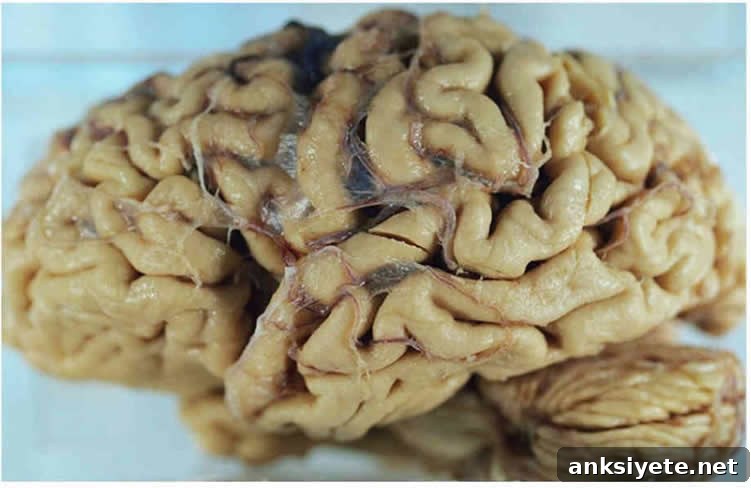
Summary: Researchers at UT Southwestern have neutralized a major genetic risk factor present in up to 80% of people who develop late-onset Alzheimer’s disease. Neutralizing ApoE4 points to new prevention strategies, including the possibility of a vaccine or an oral drug taken long-term to reduce disease risk.
Source: UT Southwestern.
UT Southwestern investigators report a promising new approach to prevent late-onset Alzheimer’s disease by neutralizing the harmful effects of the ApoE4 protein, potentially enabling a safe, widely available therapy that could be started decades before symptoms appear.
Apolipoprotein E (ApoE) is a brain lipid-transport protein that helps distribute cholesterol and other lipids and supports neuronal repair. Human ApoE exists in three common forms—ApoE2, ApoE3, and ApoE4. Carrying the ApoE4 variant greatly increases an individual’s risk of developing late-onset Alzheimer’s disease compared with ApoE2 or ApoE3. ApoE4 is associated with the accumulation of beta-amyloid, the protein that forms plaques in Alzheimer’s brains, and with early dysfunction in neuronal communication.
Joachim Herz, PhD, a molecular biologist and Alzheimer’s researcher at UT Southwestern and the study’s senior author, emphasizes prevention as the primary goal. Late-onset Alzheimer’s typically appears after age 65 and is the leading cause of dementia in older adults. “If the damaging effects of ApoE4 can be blocked early in life, we may be able to prevent or greatly reduce the chance that many people ever develop late-onset Alzheimer’s,” Dr. Herz said.
The research team investigated why ApoE4 interferes with normal neuronal function. Prior work had shown that ApoE4 causes synaptic receptors to be trapped inside intracellular vesicles, but the mechanism of that trapping was not fully understood. UT Southwestern scientists discovered that ApoE4 creates a cellular “traffic jam” in the early endosomal pathway. This traffic jam reduces recycling of endosomal transport vesicles that normally return receptors to the cell surface, impairing synaptic signaling.
The key insight from the study is that the problem stems from altered endosomal pH and the behavior of the ApoE4 protein during acidification. ApoE4 differs from ApoE3 by a single amino acid change that raises its isoelectric point and makes ApoE4 less soluble as endosomes acidify. As a result, ApoE4 unfolds and becomes prone to sticking inside endosomes, causing the recycling block.
To overcome this blockage, researchers targeted NHE6, a protein that functions as a proton leak channel in early endosomes and normally reduces endosomal acidity. By inhibiting NHE6—both pharmacologically and genetically—in rodent models, the team made endosomes more acidic, which in turn prevented ApoE4 from unfolding and becoming trapped. In these experiments, inhibition of NHE6 fully reversed the ApoE4-induced recycling defect for the ApoE receptor Apoer2/Lrp8 as well as for AMPA- and NMDA-type glutamate receptors that are internally co-transported with Apoer2. Restoring receptor recycling also rescued Reelin-mediated regulation of excitatory synapses, a pathway impaired by ApoE4.
These results identify a mechanistic vulnerability that can be exploited for prevention. Rather than attempting to remove amyloid or tau aggregates after they appear, this approach seeks to stop the degenerative cascade at an earlier, upstream step—before plaque and tangle formation and long before clinical symptoms emerge. That strategy could be especially effective for people who carry ApoE4 and are at elevated lifetime risk.
Looking ahead, the next step is to develop small-molecule NHE6 inhibitors that are brain-penetrant, selective, safe, and suitable for long-term use. Small molecules have advantages for broad deployment: they can be produced at relatively low cost, formulated as oral pills, and distributed widely. Dr. Herz notes that an inexpensive, long-term medication that neutralizes ApoE4 risk could function in a preventive role similar to how statins reduce cardiovascular risk across large populations.
Source: James Beltran – UT Southwestern
Publisher: Organized by NeuroscienceNews.com.
Image Source: NeuroscienceNews.com image is in the public domain.
Original Research: Open access research titled “Reversal of ApoE4-induced recycling block as a novel prevention approach for Alzheimer’s disease” by Xunde Xian, Theresa Pohlkamp, Murat S Durakoglugil, Connie H Wong, Jürgen K Beck, Courtney Lane-Donovan, Florian Plattner, and Joachim Herz in eLife. Published October 30, 2018.
DOI: 10.7554/eLife.40048
UT Southwestern. “A Pathway to a Vaccine and Drugs for Late Onset Alzheimer’s.” NeuroscienceNews. December 17, 2018.
Abstract
Reversal of ApoE4-induced recycling block as a novel prevention approach for Alzheimer’s disease
The ApoE4 genotype is the most prevalent and clinically significant genetic risk factor for late-onset Alzheimer’s disease. Evidence supports that the underlying problem is a trafficking defect in early endosomes. ApoE4 differs from ApoE3 by a single amino acid change that increases its isoelectric point and promotes structural changes when endosomal vesicles become acidic. In rodent models, pharmacological and genetic inhibition of NHE6, the main proton leak channel in early endosomes, fully reversed the ApoE4-induced recycling block affecting the ApoE receptor Apoer2/Lrp8 and AMPA- and NMDA-type glutamate receptors that are co-endocytosed in complex with Apoer2. Inhibition of NHE6 also restored Reelin-mediated modulation of excitatory synapses impaired by ApoE4. These findings support a novel preventive strategy against late-onset Alzheimer’s disease based on restoring endosomal trafficking and receptor recycling.