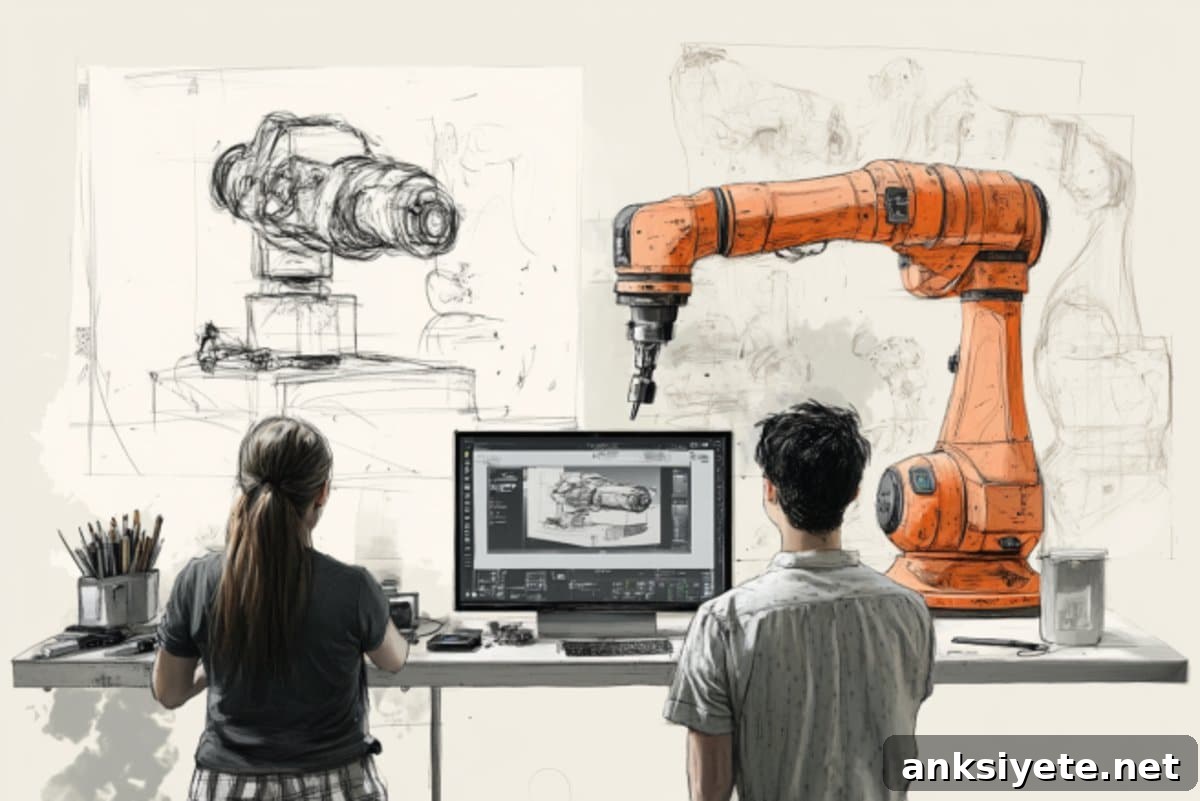
Summary: New research finds that people judge AI systems as more creative when they observe not only the finished product but also the creative process and the robot performing the work. In controlled experiments using identical drawings, participants consistently rated creativity higher as they were shown more of the act itself.
Surprisingly, the robot’s physical form had little influence on these judgements, calling into question earlier assumptions about design-driven bias. These results affect how we design, evaluate, and present creative AI systems—and they also prompt reflection on how we assess human creativity.
Key Facts:
- Perception Matters: Creativity ratings rose when viewers saw the process and the robot, not just the finished piece.
- Robot Shape Irrelevant: Two distinct robot designs produced similar creativity assessments.
- Design Implications: Presentation and transparency shape how people perceive AI creativity, raising ethical and practical questions for designers.
Source: Aalto University
What makes people think an AI system is creative?
The researchers show that a large part of the answer lies in how much of the creative act people are allowed to see.
These findings have immediate implications for how we study and build creative AI, and they also raise broader questions about how we evaluate creativity in other people.
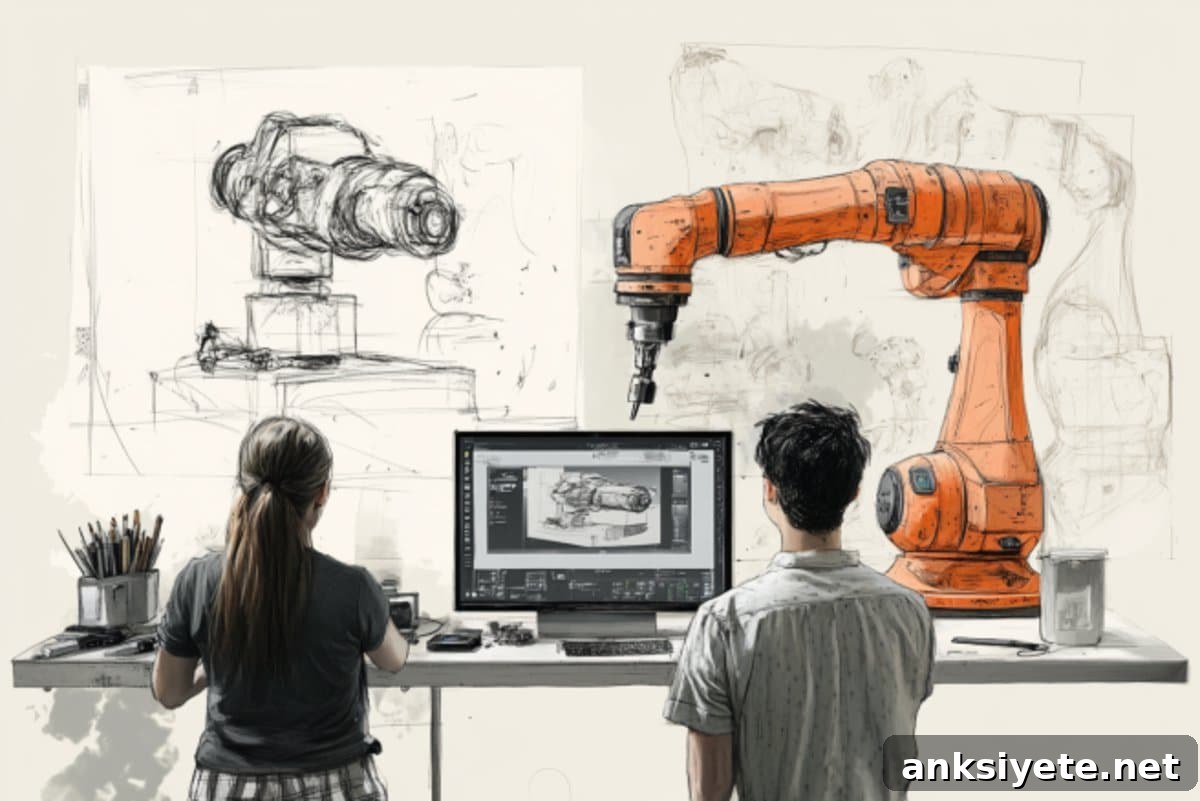
“AI is playing an increasingly large role in creative practice. Whether we should call it creative is a different question,” says Niki Pennanen, lead author of the study. Pennanen, who studies AI at Aalto University and has a background in psychology, worked with colleagues from Aalto and the University of Helsinki to test whether observers rate a robot as more creative when they witness more of the creative act.
In the experiment, participants first evaluated creativity based only on still-life drawings produced by robots. They were told the robots used AI, but in reality the robots were programmed to reproduce drawings commissioned from an artist. This controlled approach let the researchers measure perceptions of creativity while keeping the visual output identical across conditions.
Next, participants evaluated the same drawings when shown a video of the drawing process—the lines appearing on the page—without seeing the robot itself. Finally, participants rated the drawings when they could see the entire sequence: the final product, the drawing process, and the robot producing the work.
Across these stages, ratings of creativity increased as viewers were exposed to more information about how the works were made. “The more people saw, the more creative they judged the work to be,” says Christian Guckelsberger, assistant professor of creative technologies at Aalto and the study’s senior author. “To our knowledge, this is the first controlled study separating product, process, and producer to measure their distinct effects on perceived creativity.”
The power of perception
Understanding how people assess the creativity of robots and other artificial systems matters for design and for ethical deployment. Revealing process and producer information can enhance perceived creativity, but that raises trade-offs. Designers could intentionally display process to increase engagement with co-creative systems, yet doing so might also mislead users about how creative a system truly is if the underlying mechanisms remain unchanged.
“Our results expose a human bias: presentation affects judgment,” says Guckelsberger. “Making these biases visible helps designers and users understand how a system’s presentation alters perception, which is critical for fairness and transparency.”
For researchers, the findings carry methodological weight. If assessments of creativity depend on presentation, future studies must control for exposure to product, process, and producer. Past comparisons of creative systems that ignored presentation differences may need re-evaluation to avoid misleading conclusions.
The study also raises a deeper question: if perceiving process and producer influences judgments of machine creativity, does the same hold for how we evaluate human creators? The team plans to explore that possibility in future work.
Does shape matter?
To test whether robot morphology affects creativity judgements, the experiments used two different physical designs: a sleek, arm-like robot and a more mechanical plotter-style robot. Keeping every other element identical across conditions was technically challenging, and the team invested significant effort to ensure rigor.
Contrary to prior hypotheses, the researchers found no significant difference in creativity ratings between the two robot forms. “We were surprised by that result,” says Pennanen. The team intends to follow up to understand this counterintuitive outcome and to identify other factors—such as robot likeability or participants’ prior experience with AI and robotics—that might shape creativity assessments.
The authors also note the need to validate these findings across different artistic genres and other creative domains. To encourage replication and extension, the study follows open science practices so others can build on the work.
As AI becomes a routine collaborator in creative fields, understanding the factors that shape our perception of machine creativity is essential for thoughtful design, responsible communication, and a clearer picture of what creativity means when humans and machines create together.
About this AI and creativity research news
Author: Sarah Hudson
Source: Aalto University
Contact: Sarah Hudson – Aalto University
Image: The image is credited to Neuroscience News
Original Research: Open access. “Is AI truly creative? Turns out creativity is in the eye of the beholder” by Niki Pennanen et al., ACM Transactions on Human-Robot Interaction
Abstract
Is AI truly creative? Turns out creativity is in the eye of the beholder
Creative AI systems are increasingly embedded in everyday life, yet we still lack clarity about what leads people to call an AI “creative.” Drawing on existing theory and experiments, this study examines how perception of the creative act beyond the final product affects assessments of robot creativity.
Using a 3 × 2 factorial design, the researchers varied perceptual evidence—product, process, and producer—and tested two robot morphologies. In two lab experiments on visual art (N = 30 and N = 60), participants evaluated identical drawings produced by two physical robots across three levels of exposure.
Results show that human judgments of robot creativity increase as observers are shown more evidence of the creative process and the producer. The study found no significant effect of robot morphology, offering a refined understanding that contrasts with some earlier claims. Exploratory analyses point to additional influences, including perceived robot likeability and participants’ prior experience with AI and robotics.
These insights provide empirical grounding for design decisions, support fairness and validity in system comparisons, and deepen our understanding of the human relationship with creative AI—knowledge that is important for responsible adoption of these systems in society.