
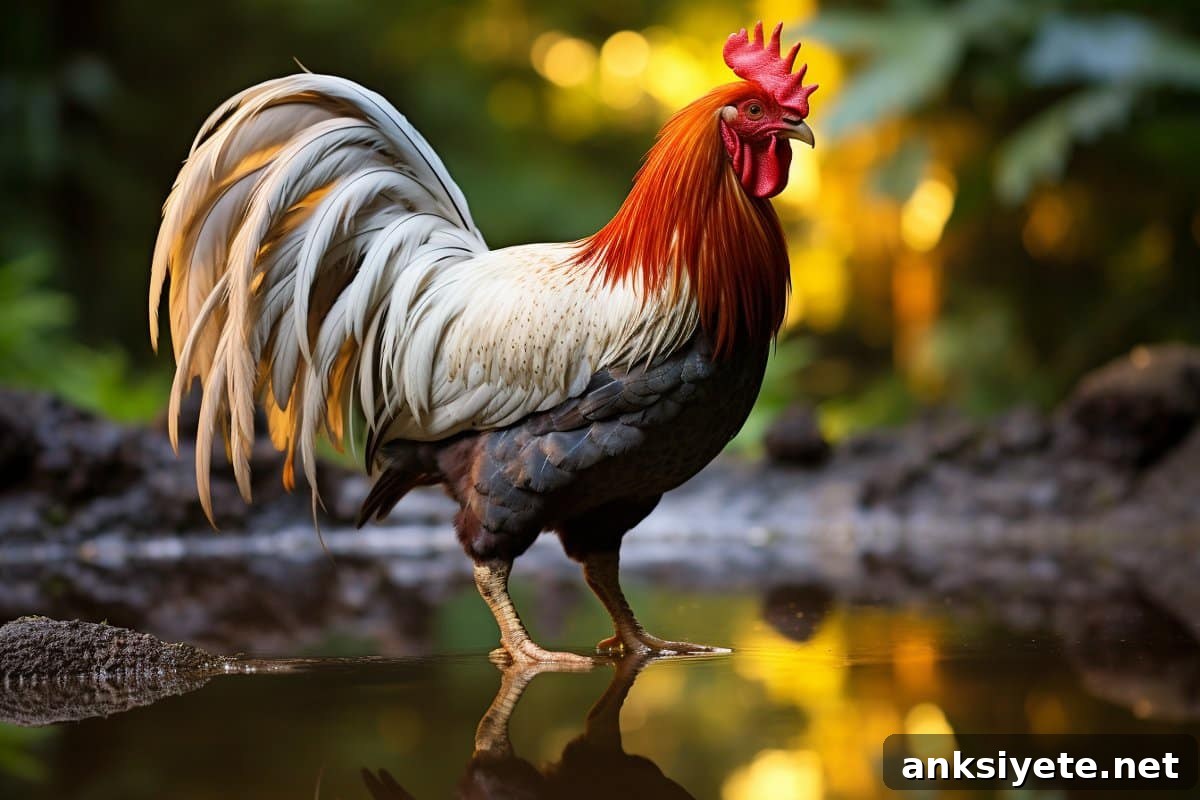
Summary: Long underestimated, chickens are now central to new research on animal self-awareness. Recent experiments with roosters suggest they may recognize their own reflections under certain conditions.
Scientists observed that roosters sometimes respond to a mirror in ways that indicate self-recognition, but the outcome depends heavily on how the test is set up. These findings call into question the universal applicability of traditional mirror tests and emphasize the importance of testing animals in situations that reflect their natural behavior.
The study, led by teams from the Universities of Bonn and Bochum together with MSH Medical School Hamburg, is published in the journal PLOS ONE.
Key Facts:
- Roosters may identify their reflection as themselves, a possible sign of self-awareness.
- The classic mirror “mark test” can miss self-recognition in species whose natural behavior isn’t considered; context and ecological relevance matter.
- Roosters usually emit alarm calls to warn conspecifics of a predator, but this calling pattern changes when they encounter their mirror image.
Source: University of Bonn
Think chickens just peck and lay eggs? Farmers and ethologists know otherwise. Over years of behavioral research, scientists have documented complex social and cognitive abilities in domestic fowl. The current study explores one of the most debated questions in animal cognition: can non-primate species recognize themselves?
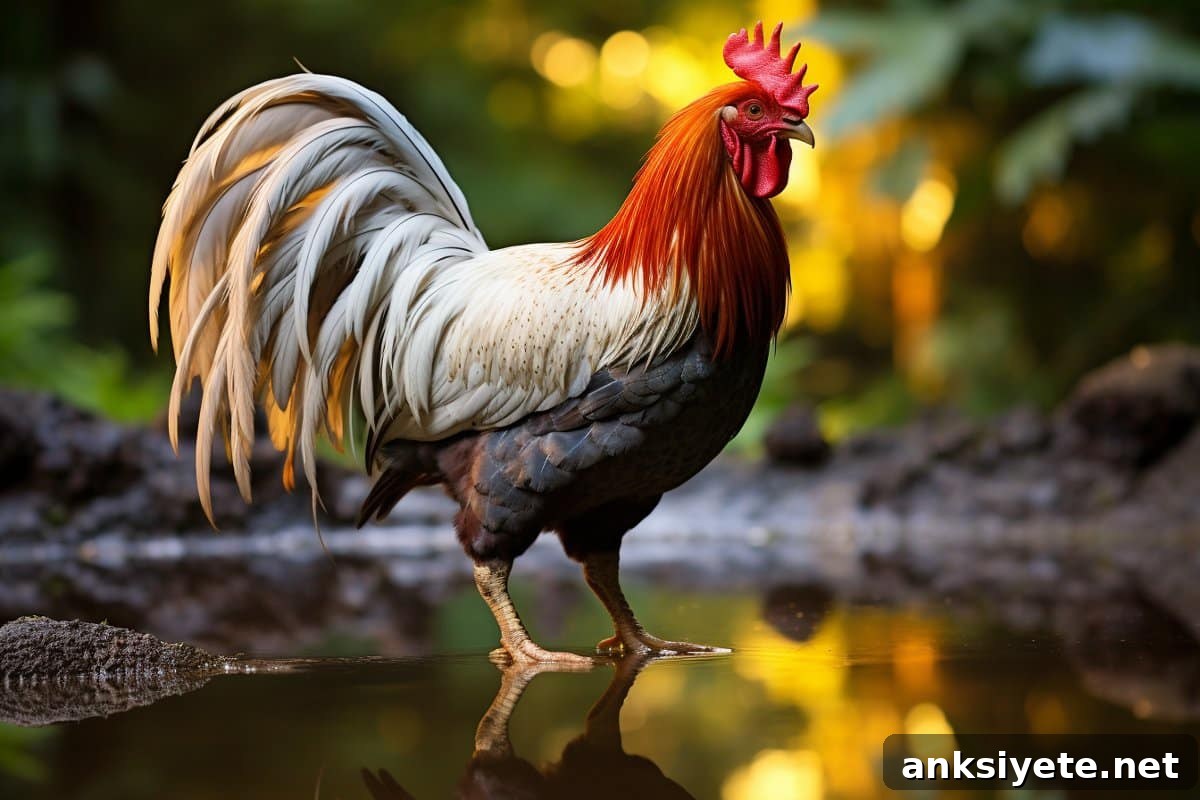
Doctoral student Sonja Hillemacher and Dr. Inga Tiemann from the Institute of Agricultural Engineering at the University of Bonn, together with Prof. Onur Güntürkün from Ruhr University Bochum, designed an experiment that embeds the mirror test in an ecologically meaningful context for chickens.
Traditional mirror tests—especially the “mark test” in which a visible mark is placed on an animal so it can only be seen in a mirror—have long been used to infer self-recognition. If an animal uses the mirror to investigate the mark on its own body, researchers interpret this as evidence of self-awareness. Yet the mark test produces false negatives for some species and may fail when the testing environment does not align with the animal’s natural behaviors.
Adapting the experiment to ecologically relevant behavior
The research team sought to create a mirror test that leverages a rooster’s natural responses. Roosters typically perform alarm calls to warn flockmates of aerial predators, but they remain silent when alone to avoid attracting danger. The scientists used this well-established behavior as the basis for their adapted mirror test.
At the University of Bonn’s Frankenforst campus, the team built a test arena with two compartments separated by a grid that allowed visual contact. A hawk silhouette was projected over one compartment to simulate a predator. Each rooster was tested three times in different conditions: alone, with another male present, and with a mirror in place of the grid.
Across 58 roosters and multiple trials, results were clear: roosters produced 77 alarm calls when a conspecific was visible, but only 17 alarm calls when they were truly alone. When a mirror replaced the grid, roosters produced far fewer alarm calls—25 during 174 mirror trials—indicating that they did not behave as if another bird were present.
These findings suggest that many roosters did not interpret their reflection as a separate individual to be warned, supporting the possibility that they recognized the reflection as their own. The researchers acknowledge an alternative interpretation—that roosters might have seen the reflection as an odd conspecific that mimicked them and therefore chose silence—so further tests are needed to rule out this explanation.
When the classic mark test was applied to the same birds, the roosters did not display behaviors that would indicate mirror-guided inspection of the mark. This contrast underscores the study’s main point: embedding tests in ecologically relevant contexts can reveal cognitive abilities that standard procedures may miss.
Prof. Onur Güntürkün summarizes the implication: in a generic test situation a rooster might not show self-recognition, but under the natural pressure of a predator threat its behavior suggests it perceives the reflection as itself rather than as another rooster. The authors argue that this ecologically grounded approach could be valuable when studying self-recognition across a wide range of species and has implications for discussions of animal welfare and rights.
About this self-awareness research news
Author: Sonja Hillemacher
Source: University of Bonn
Contact: Sonja Hillemacher – University of Bonn
Image: Image credited to Neuroscience News
Original Research: Open access. “Roosters do not warn the bird in the mirror: The cognitive ecology of mirror self-recognition” by Sonja Hillemacher et al., published in PLOS ONE.
Abstract
Roosters do not warn the bird in the mirror: The cognitive ecology of mirror self-recognition
Touching a mark on one’s own body after seeing it in a mirror is often taken as evidence of self-awareness and has been documented primarily in great apes and a few other species. However, the mark-test paradigm can produce false negatives and may obscure a gradual evolutionary continuum of self-recognition. The authors hypothesized that self-recognition might be more widespread when assessed in ecologically relevant contexts. They developed such an approach for chickens (Gallus gallus domesticus), exploiting roosters’ natural tendency to alarm-call to warn conspecifics of aerial predators but remain silent when alone. Individual roosters were tested alone, with another male present, or with a mirror while a hawk silhouette was flown above. Roosters mainly emitted alarm calls when another individual was present but not when alone or when exposed to their reflection. In contrast, the same birds failed the traditional mirror-mark test. These results indicate that chickens may recognize their reflection as their own and highlight how cognitive abilities are often closely tied to ecological context.