Summary: A new study finds that conscious feelings are strongly shaped by bodily feedback. Researchers mapped the structure of subjective feelings and found they cluster into five main categories: positive emotions, negative emotions, cognitive processes, somatic states, and illnesses.
Source: University of Turku.
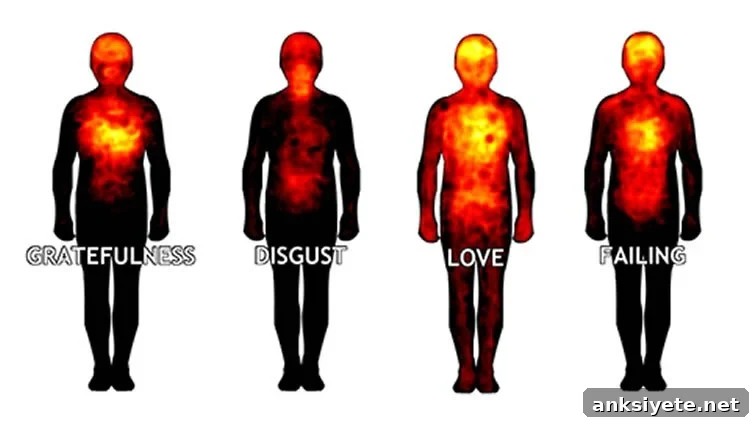
People continuously experience a changing stream of subjective feelings, interrupted only during sleep or deep unconsciousness. Finnish researchers have now shown that these feelings organize into five primary categories—positive emotions, negative emotions, cognitive functions, somatic states, and illnesses—and that all these categories are closely tied to bodily sensations.
“These results indicate that conscious feelings arise in large part from bodily feedback,” says Associate Professor Lauri Nummenmaa from Turku PET Centre. “While consciousness depends on brain processes and we typically perceive it as located ‘in the head,’ signals from the body make a substantial contribution to many types of subjective experience.”
The researchers propose that emotions give our experiences their pleasant or unpleasant character and that, across evolution, conscious feeling may have developed to signal tissue damage, well-being, and internal states—functions that could have later supported the development of language, thought, and reasoning.
“Subjective well‑being is a crucial determinant of human flourishing,” Nummenmaa adds. “Pain and negative emotions are closely linked to many physical and mental illnesses. Our findings illuminate how bodily states and illnesses affect subjective well‑being and they underline how cognitive and emotional states are embodied.”
The study used a large online survey involving 1,026 participants. In the first phase, participants rated 100 distinct feeling states on multiple dimensions: how strongly each feeling is experienced in the body versus the mind, how emotional it is, and how controllable it feels. In a second phase, participants judged the similarity between different feelings and indicated where in the body they experienced each feeling.
By combining basic-dimension ratings, similarity judgments, bodily sensation maps, and a neuroimaging meta-analysis, the researchers constructed a comprehensive “feeling space.” Nonlinear dimensionality reduction revealed five coherent clusters within that space: positive emotions, negative emotions, cognitive processes, somatic states and illnesses, and homeostatic states. Across this feeling space, bodily sensations were prominent, and the strength of bodily sensations correlated with the strength of mental experiences associated with each feeling.
For a subset of feelings, the team also examined neural similarity using the NeuroSynth meta-analysis database, which synthesizes results from thousands of brain‑imaging studies. The analysis showed that subjective similarity between feelings related both to their basic dimensions (emotional valence, mental experience, bodily sensation) and to the topography of bodily sensations associated with each feeling.
Overall, the study presents a structured map of subjective feelings that emphasizes three themes: categorical organization, emotional valence, and embodiment. All examined feelings carried emotional valence, and bodily sensations were integral to how those feelings were experienced and organized.
Funding: The research was supported by the European Research Council (ERC) and the Academy of Finland.
Source: University of Turku
Publisher: Organized by NeuroscienceNews.com.
Image source: Image credit to University of Turku.
Original research: Open access research “Maps of subjective feelings” by Lauri Nummenmaa, Riitta Hari, Jari K. Hietanen, and Enrico Glerean in PNAS, published August 28, 2018.
doi: 10.1073/pnas.1807390115
University of Turku. “Bodily Sensations Give Rise to Conscious Feelings.” NeuroscienceNews, 29 August 2018.
Abstract
Maps of subjective feelings
Subjective feelings are a central feature of human life. The study defined the organization and determinants of a feeling space composed of 100 core feelings spanning cognitive and affective processes, somatic sensations, and common illnesses. The feeling space was derived from a combination of basic-dimension ratings, similarity mapping, bodily-sensation mapping, and neuroimaging meta-analysis. A total of 1,026 participants completed online surveys in which they assessed, for each feeling, the intensity of four hypothesized dimensions (mental experience, bodily sensation, emotion, and controllability), judged subjective similarity across the 100 feelings, and indicated the bodily topography associated with each feeling. Neural similarity for a subset of feelings was obtained from the NeuroSynth database, based on data aggregated from thousands of brain-imaging studies. The analyses showed that all feelings carried emotional valence and that bodily-sensation salience paralleled the salience of mental experience for each feeling. Nonlinear dimensionality reduction uncovered five feeling clusters: positive emotions, negative emotions, cognitive processes, somatic states and illnesses, and homeostatic states. The organization of the feeling space was best explained by emotional valence, mental experience, and bodily sensation. Subjective similarity between feelings was associated with these basic dimensions and with the bodily-sensation maps. These findings reveal a categorical, emotional, and embodied map of subjective feelings.