
MRI reveals distinct brain structural differences in adult earthquake survivors with and without post-traumatic stress disorder (PTSD), a new study reports in Radiology.
Post-traumatic stress disorder (PTSD) is an anxiety disorder that can develop after exposure to a life-threatening or severely injurious event. Common symptoms include intrusive memories, nightmares, emotional numbing, heightened arousal, avoidance of reminders of the trauma, and intense guilt or fear. Lifetime prevalence estimates in the U.S. reach about 6.8 percent, underscoring the public health importance of understanding the biological changes associated with PTSD.
This study investigated how PTSD after a major earthquake relates to structural brain differences measured with high-resolution 3.0T magnetic resonance imaging (MRI). The researchers aimed to identify gray and white matter changes associated specifically with PTSD—beyond the effects of experiencing the same traumatic event—and to examine how those anatomic changes correlate with clinical severity and time since trauma.
Participants were recruited from a large survey of 4,200 survivors of a devastating earthquake in western China. All included survivors had direct exposure to the destruction, injuries, or deaths caused by the earthquake. After initial screening with the Clinician-Administered PTSD Scale (CAPS) by trained psychologists, individuals with CAPS scores of 50 or higher underwent psychiatric evaluation to confirm PTSD diagnosis and rule out other psychiatric disorders. People with a prior psychiatric history, substance dependence, or relevant medical conditions were excluded.
The final sample included 67 adults diagnosed with PTSD and 78 matched healthy survivors who experienced the same traumatic event but did not develop PTSD. Every participant underwent 3.0T MRI to acquire three-dimensional T1-weighted anatomical images. The research team analyzed cortical thickness across the cerebral cortex, volumes of 14 subcortical gray matter structures, and five subregions of the corpus callosum using specialized morphometric software. Statistical comparisons used general linear models, and region-specific measures were correlated with clinical scores.
Key findings
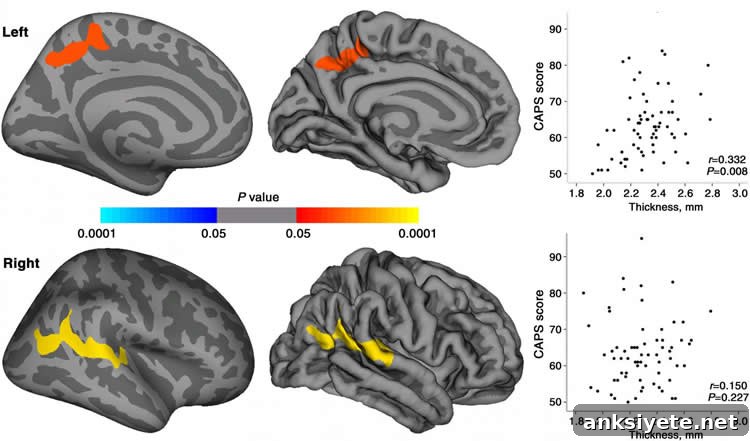
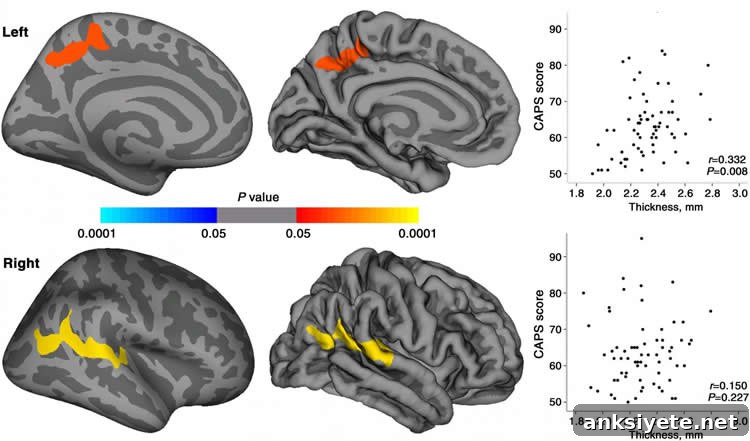
- Patients with PTSD showed greater cortical thickness in several regions, including the left precuneus, the right superior temporal gyrus, and the inferior parietal lobule, compared with healthy survivors who experienced the same earthquake.
- PTSD patients also exhibited reduced volume in the posterior portion of the corpus callosum, a major white matter tract connecting the brain’s hemispheres.
- PTSD severity (CAPS scores) correlated positively with cortical thickness in the left precuneus. Across all survivors, smaller posterior corpus callosum volumes were associated with higher PTSD ratings; in PTSD patients, reduced posterior corpus callosum volume was negatively correlated with left precuneus cortical thickness.
Interpretation and implications
These results indicate that PTSD is associated with structural alterations in both gray and white matter relative to similarly traumatized individuals who do not develop the disorder. Notably, early in PTSD the gray matter changes observed were increases in cortical thickness rather than the decreases more commonly reported in chronic or other PTSD studies. The authors suggest that increased cortical thickness could reflect neuroinflammatory processes, endocrine-related trophic responses, or functional compensatory mechanisms in the early stages of PTSD.
The left precuneus, implicated by this study, plays a role in visual processing and episodic memory. Its altered thickness in PTSD patients may relate to vivid visual flashbacks and heightened visual memory retrieval commonly reported in PTSD.
Funding: Supported by the National Natural Science Foundation and the Program for Changjiang Scholars and Innovative Research Team in University.
Source: Linda Brooks – RSNA. Image credit: Radiological Society of North America.
Original research: “Posttraumatic Stress Disorder: Structural Characterization with 3-T MR Imaging” by Shiguang Li, Xiaoqi Huang, Lingjiang Li, Fei Du, Jing Li, Feng Bi, Su Lui, Jessica A. Turner, John A. Sweeney, and Qiyong Gong. Radiology. Published online March 1, 2016. DOI: 10.1148/radiol.2016150477.
Abstract (condensed)
Purpose: To identify cerebral structural changes linked to PTSD after a major earthquake and to relate these changes to clinical severity and time since trauma using 3-T MRI.
Materials and Methods: A prospective, ethics-approved study enrolled 67 PTSD patients and 78 survivors without PTSD, scanned 7–15 months after the earthquake. Cortical thickness and subcortical volumes were analyzed and compared between groups; correlations with clinical measures were assessed.
Results: PTSD patients had increased cortical thickness in the right superior temporal gyrus, inferior parietal lobule, and left precuneus, and reduced posterior corpus callosum volume. Left precuneus thickness correlated with PTSD severity; posterior corpus callosum volume correlated negatively with PTSD ratings.
Conclusion: PTSD is associated with both gray and white matter alterations early after trauma. Increased cortical thickness may reflect neuroinflammatory or trophic responses or functional compensation, offering potential targets for early identification of individuals at risk for persistent PTSD.