
Summary: A new, custom-built microscope gives neuroscientists an unprecedented close-up view of how a synapse works in living tissue.
Source: Washington University School of Medicine in St. Louis.
Custom-built microscope reveals how neurons communicate at the synapse
The brain contains an immensely complex network of nerve cells that exchange electrical and chemical signals at remarkable speed. Researchers at Washington University School of Medicine in St. Louis have developed a custom-built microscope that provides the closest live view yet of functioning nerve synapses, allowing scientists to observe the fine-scale dynamics that underpin neuronal communication.
Understanding what happens at a synapse — the tiny junction where one neuron transmits information to another — is essential for building accurate models of brain networks and for studying disorders such as depression, Alzheimer’s disease and schizophrenia, the researchers say. Their work appears in the journal Neuron.
Imaging active neurons, even those grown in culture, is technically demanding because synapses are extremely small and they move, making it difficult to maintain focus at the high magnifications required. “Synapses are nanoscale machines that transmit information,” said Vitaly A. Klyachko, PhD, an associate professor of cell biology and physiology at the School of Medicine and senior author on the study. “They are below the resolution of conventional light microscopes, so activity in the active zone often appears blurred.”
To address this, the team built a microscope optimized for live-cell synapse imaging. It combines an exceptionally sensitive camera with mechanical and thermal stability at body temperature, but the real advance lies in the image analysis techniques used to interpret the data. “Our approach lets us resolve synaptic events with high precision,” Klyachko said.
Until now, the closest structural views of synaptic active zones came from electron microscopy, which achieves resolution at the tens-of-nanometers scale but can only image fixed or frozen samples. Electron microscopy requires dehydrated, embedded, thin-sliced and metal-coated samples, so it cannot reveal dynamic processes in living cells. “Electron microscopy has given us beautiful static images,” Klyachko noted, “but we wanted a way to observe synapses functioning in real time.”
A synapse consists of a tiny cleft between two neurons: a presynaptic terminal that packages neurotransmitters into synaptic vesicles and a postsynaptic side that receives those chemical signals. When a neuron fires, vesicles fuse with the presynaptic membrane in the active zone and release neurotransmitters across the gap to bind receptors on the neighboring cell, completing the signal transfer.
One long-standing question is whether the active zone contains a single preferred release spot or multiple distinct sites where vesicles can fuse and release their contents. “If you imagine the active zone as a shower head, is it a single jet or more of a rain shower?” Klyachko asked.
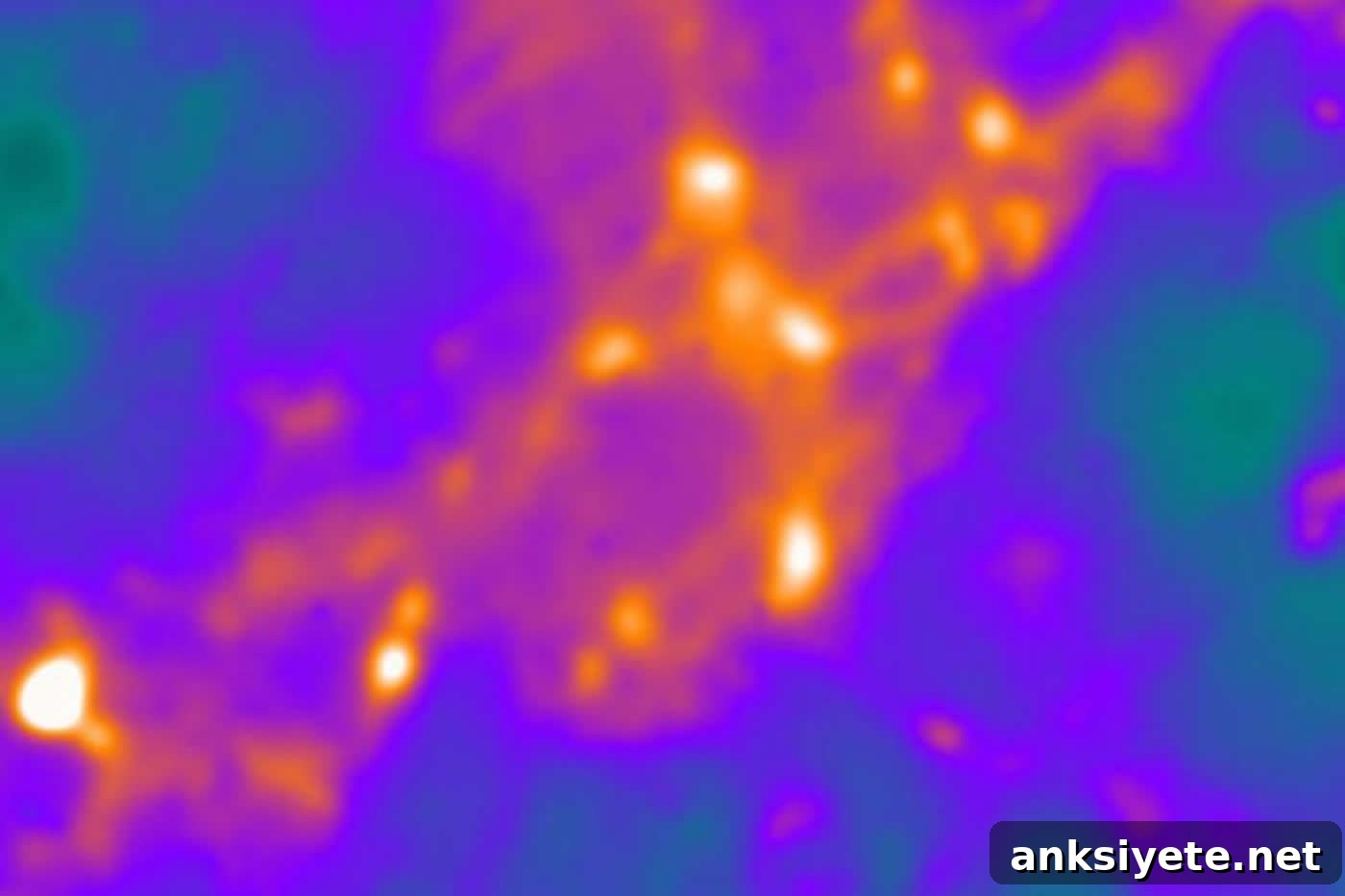
Using their specialized microscope and advanced analysis, first author Dario Maschi, PhD, and Klyachko found that the active zone behaves more like a rain shower than a single jet. Rather than a lone fusion site, each active zone contains roughly ten distinct release sites that are repeatedly reused. These sites are not used continuously; there is a refractory-like pause of about 100 milliseconds before an individual site can be used again. When vesicle release rates increase, activity shifts from central release sites toward the periphery of the active zone.
“Neurons can fire tens to hundreds of times per second, so having multiple release sites makes functional sense,” Klyachko said. “If one site has just been used, others can continue transmitting the signal.”
The researchers emphasize that they are probing the fundamental machinery of brain signaling. Their findings indicate that release sites are finely tuned; even small changes in their spatial or temporal properties could have physiological consequences and may contribute to disease. “Before we can study how synapses malfunction in disease, we need to define precisely how healthy synapses operate,” Klyachko added.
Funding: This work was supported in part by the Esther A. & Joseph Klingenstein Fund, the Whitehall Foundation and the McDonnell Center at Washington University.
Source: Julia Evangelou Strait, Washington University School of Medicine in St. Louis.
Image credit: Dario Maschi.
Original research: Maschi, Dario, and Vitaly A. Klyachko. “Spatiotemporal Regulation of Synaptic Vesicle Fusion Sites in Central Synapses.” Neuron. Published online March 23, 2017. doi:10.1016/j.neuron.2017.03.006
Abstract summary
Spatiotemporal Regulation of Synaptic Vesicle Fusion Sites in Central Synapses
Highlights
- Individual release events detected with approximately 27 nm precision in hippocampal synapses.
- Multiple, distinct release sites exist within single hippocampal synapses.
- Spatiotemporal properties of release sites change with neuronal activity.
Summary
The number and accessibility of vesicle release sites within the synaptic active zone are key determinants of neurotransmitter release, yet these parameters were not previously well defined in living central synapses. Combining nanoscale live imaging with refined image analysis, the authors detected individual vesicle fusion events with ~27 nm localization precision in single hippocampal synapses under physiological conditions. Their results reveal multiple distinct release sites distributed across the active zone that are repeatedly reused. Higher activity reduces reuse frequency and shifts release toward the active zone periphery. These findings define fundamental spatiotemporal properties of release sites in small central synapses and demonstrate activity-dependent modulation of those sites.