
A new UCL study funded by the Medical Research Council (MRC) shows that the possibility of receiving a painful electric shock causes more stress than knowing you definitely will or will not be shocked.
Published in Nature Communications, the study demonstrates that uncertainty itself—rather than the presence or absence of threat—drives acute stress. Participants experienced the highest stress when the chance of being shocked was 50%, while situations with 0% or 100% probability produced the lowest stress. The researchers also found that people whose stress responses closely tracked uncertainty were better at predicting whether they would be shocked, suggesting that stress signals can help guide risk judgments.
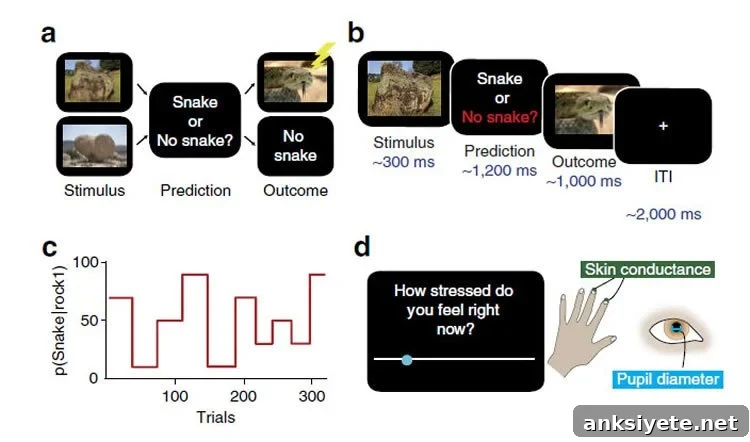
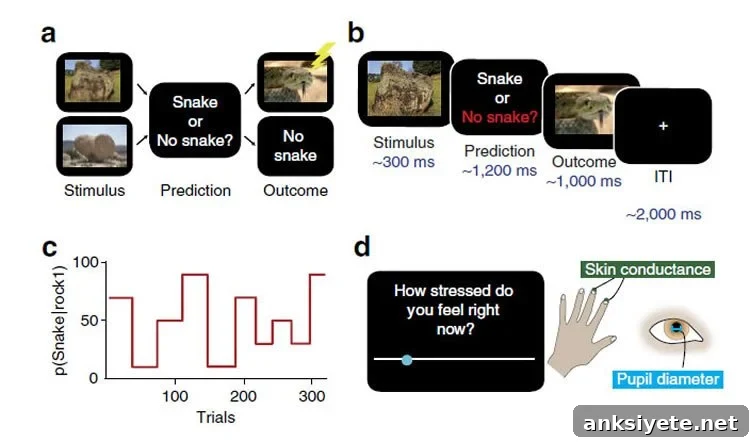
The experiment recruited 45 volunteers who played a computer-based task in which they turned over virtual rocks that might hide snakes. Before lifting each rock, participants guessed whether a snake would appear. When a snake was present, volunteers received a mildly painful electric shock to the hand. Over the session, different rocks had different probabilities of revealing a snake, and these probabilities changed over time to create varying levels of uncertainty.
To quantify each participant’s uncertainty about a particular rock, the team used a hierarchical Bayesian learning model that inferred subjective uncertainty from the participants’ choices. Those model-derived uncertainty estimates aligned closely with both self-reported stress and objective physiological measures: pupil dilation and skin conductance (sweating). Salivary cortisol measurements confirmed that the shocks produced measurable endocrine stress responses.
“Using our model we could predict how stressed our subjects would be not just from whether they got shocks but from how uncertain they were about those shocks,” says lead author Archy de Berker (UCL Institute of Neurology). “It turns out that it’s worse to not know whether you will be shocked than to know you definitely will or definitely won’t. We saw the same pattern in physiology—people’s pupils dilated and they sweated more when uncertainty was higher.”
The finding—quantifying how uncertainty drives stress—matches many everyday experiences. Co-author Dr Robb Rutledge (UCL Institute of Neurology and Max Planck UCL Centre for Computational Psychiatry and Ageing Research) says: “When applying for a job you’ll often feel calmer if it’s clearly a long shot or if you’re confident of success. The most stressful scenario is the in-between: not knowing. That uncertainty generates anxiety in situations from waiting for medical results to delays on public transport.”
While stress is often framed as harmful in modern life, the study also points to a possible adaptive role. Participants whose physiological and subjective stress responses rose most sharply during high uncertainty were better at learning which rocks were likely to hide snakes. In other words, appropriately tuned stress reactions can improve performance when learning under uncertainty.
“From an evolutionary perspective, tuning stress responses to environmental uncertainty may have had survival value,” explains senior author Dr Sven Bestmann (UCL Institute of Neurology). “Stress can sharpen attention and learning about unpredictable, potentially dangerous elements in the environment. Today, many modern systems reduce everyday uncertainty—taxi apps that show vehicle location and real-time transport boards are examples that ease anxiety by providing clearer information. Yet unspecified delays and missing updates can still produce the same uncertainty-driven stress we observed in the lab.”
Source: Harry Dayantis – UCL
Image Credit: The image is credited to de Berker et al.
Original Research: Full open access research: “Computations of uncertainty mediate acute stress responses in humans” by Archy O. de Berker, Robb B. Rutledge, Christoph Mathys, Louise Marshall, Gemma F. Cross, Raymond J. Dolan and Sven Bestmann. Published online March 28, 2016. DOI: 10.1038/ncomms10996
Abstract
Computations of uncertainty mediate acute stress responses in humans
This study investigates how subjective estimates of uncertainty shape both emotional and physiological stress responses. Participants learned probabilistic associations between visual cues and electric shocks while the researchers measured endocrine, autonomic, and ocular markers of stress. Using a hierarchical Bayesian learning model, they quantified how different forms of subjective task uncertainty evolved and how those estimates predicted stress dynamics. Subjective stress, pupil diameter, and skin conductance all tracked irreducible uncertainty. Individuals whose subjective and physiological responses were more tightly tuned to uncertainty also showed better task performance, suggesting an adaptive function for stress in learning under uncertain threat. These results provide new insight into how stress responses are generated and the potential role they play in guiding behavior when outcomes are uncertain.