
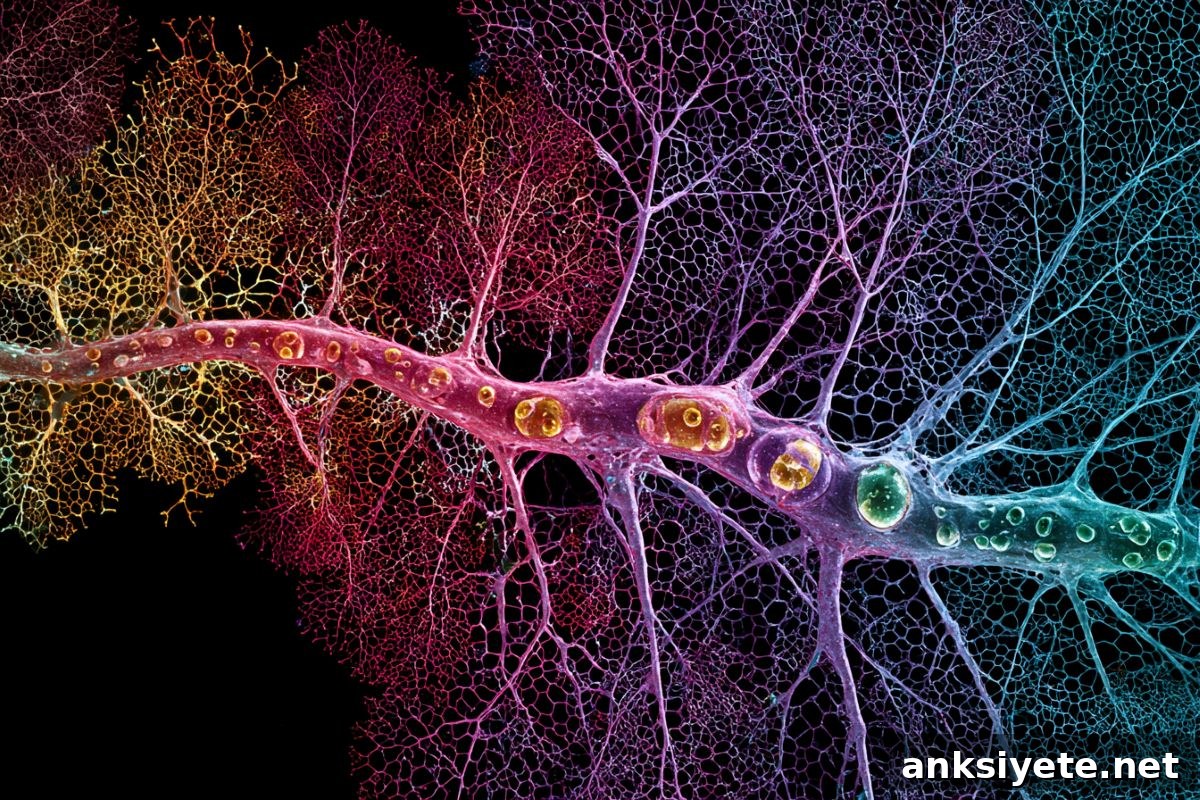
Summary: A new study identifies the organizational rules that shape how neurons in the primary visual cortex integrate thousands of synaptic inputs. By imaging both neuronal somas and individual dendritic spines in awake mice as they viewed moving visual patterns, researchers at the Picower Institute for Learning and Memory (MIT) traced how synapses are arranged and how their activity relates to a cell’s overall electrical output.
The study shows that synaptic inputs are not randomly distributed across a neuron’s dendritic tree. Instead, their influence depends on several consistent factors, including proximity to the soma, local clustering of spines, and the synapse’s tuning for visual features such as orientation.
Key Facts
- The Proximity Rule: A synapse’s influence on the neuron’s output is strongly related to its distance from the cell body; spines closer to the soma are more likely to drive somatic activity and align with the neuron’s firing preference.
- The 5-Micron Neighborhood: Synapses form small neighborhoods within roughly 5 micrometers where nearby spines tend to act together and sharpen the cell’s visual response, while spines just beyond this boundary participate less in that coordinated activity.
- Orientation Dominance: Among several measured factors, a spine’s selectivity for stimulus orientation is the single best predictor of whether its activity correlates with the soma’s response.
- Dendritic Specialization: Visually responsive neurons have considerably more active spines on their long apical dendrites than unresponsive neurons, although both apical and basal dendrites follow the same organizing principles relating distance and local clustering to somatic correlation.
Source: Picower Institute at MIT
Background: The primary visual cortex is specialized for processing basic features of visual input, but not every neuron in that region responds to visual stimuli. Each cortical neuron receives thousands of excitatory inputs from distributed circuits, and the neuron must integrate this heterogeneous input to decide whether to fire an action potential. Understanding which inputs are prioritized and how they are organized is essential for explaining how cortical circuits compute sensory information.
In this study, led by postdoctoral researcher Kyle Jenks and senior author Mriganka Sur, Newton Professor of Neuroscience, the team used genetically encoded calcium indicators to image activity at two scales simultaneously: the soma and individual dendritic spines of layer 2/3 excitatory neurons in mouse visual cortex. Mice viewed drifting black-and-white gratings at multiple orientations while two-photon in vivo imaging recorded calcium transients that report synaptic and somatic activity.
By imaging both visually responsive neurons and neurons that appeared unresponsive at the soma but nevertheless carried visually responsive spines, the investigators were able to dissect which synaptic properties and spatial features predict alignment with somatic responses.
Methods and approach
Neurons were engineered so that calcium surges in dendritic spines and in the soma produced detectable fluorescence. This allowed the researchers to quantify, for each spine, its tuning to stimulus orientation, response reliability, and the degree to which its activity correlated with somatic responses. The dataset included 11 somatically responsive neurons and 11 somatically unresponsive neurons, with many spines tracked across apical and basal dendritic branches.
Main findings
Distance from the soma matters: In somatically responsive cells, proximal spines showed higher correlation with the soma than distal spines. Likewise, back-propagating somatic signals that could influence spine alignment were more detectable near the soma.
Local clustering: Responsive neurons displayed local clusters of spines whose tuning was correlated. Spines within approximately 5 micrometers tended to act together, forming functional enclaves; spines just outside those clusters were less likely than chance to share that correlated activity, suggesting discrete pockets of coordinated input that sharpen responses.
Apical versus basal branches: Basal dendrites received relatively more raw visual input overall, but visually responsive neurons had significantly more visually responsive spines on their apical dendrites than unresponsive neurons. Both apical and basal spines adhered to the proximity and clustering rules linking spatial arrangement to somatic correlation.
Orientation selectivity is most predictive: Using statistical modeling that included factors such as stimulus selectivity, response reliability, dendritic branch type, and distance from the soma, the researchers found that a spine’s orientation tuning was the strongest single predictor of how well that spine’s activity correlated with the soma.
The authors conclude that excitatory synaptic inputs to layer 2/3 neurons in mouse visual cortex are organized both globally and locally. This organization reflects somatic responsiveness and tuning, branch type, radial distance from the soma, and local correlations among neighboring spines.
These rules provide a baseline for future studies of visual processing and circuit dysfunction. Documenting normal synaptic organization will help identify how genetic mutations or developmental disorders alter connectivity and affect sensory computation. The findings may also improve models of how neurons integrate large numbers of synaptic inputs to produce coherent output signals.
In addition to Mriganka Sur and Kyle Jenks, authors include Gregg Heller, Katya Tsimring, Kendyll Martin, Asrah Rizvi, and Jacque Pak Kan Ip. Funding was provided by the National Institutes of Health, the Simons Foundation Autism Research Initiative, and the Freedom Together Foundation.
Key Questions Answered:
A: Even within visual cortex, neurons receive diverse inputs from many circuits. A neuron may be driven by non-visual inputs or its internal synaptic configuration may prioritize signals other than the visual stimuli presented, even when some of its spines respond to light-driven input.
A: The team used genetically encoded calcium indicators that make active dendritic spines and somas fluoresce when calcium levels rise. Two-photon in vivo imaging allowed them to monitor synaptic and somatic activity in real time while mice viewed controlled visual stimuli.
A: Many neurodevelopmental and genetic conditions alter how neurons form and maintain synaptic connections. By establishing how synapses are typically organized in visual cortex, researchers gain a reference to detect where and how circuit assembly diverges in disease.
Editorial Notes:
- This article was edited by a Neuroscience News editor.
- The journal paper was reviewed in full.
- Additional context was added by staff editors.
About this visual neuroscience research news
Author: David Orenstein
Source: Picower Institute at MIT
Contact: David Orenstein – Picower Institute at MIT
Image: The image is credited to Neuroscience News
Original Research: Open access. “Functional organization of dendritic spines in mouse visual cortex layer 2/3 neurons” by Kyle R. Jenks, Gregg R. Heller, Katya Tsimring, Kendyll B. Martin, Asrah Rizvi, Jacque Pak Kan Ip, and Mriganka Sur. iScience. DOI: 10.1016/j.isci.2026.115861
Abstract
Functional organization of dendritic spines in mouse visual cortex layer 2/3 neurons
Cortical neurons receive heterogeneous excitatory synaptic inputs, yet the organizational principles governing their distribution across the dendritic arbor remain poorly understood. Using two-photon in vivo calcium imaging, this study examined how synaptic visual inputs to dendritic spines of mouse visual cortex layer 2/3 excitatory neurons are organized both globally and locally.
In visually responsive neurons, sharply tuned proximal spines showed higher somatic tuning correlation than distal spines. Responsive neurons had more responsive spines on their apical dendrites and higher pairwise tuning correlations between spines than unresponsive neurons. Although pairwise tuning correlations between spines did not vary significantly with distance from the soma, spines on responsive neurons were locally clustered based on correlated tuning. The findings indicate that visual input is organized, not random, and that organization relates to somatic correlation, distance from the soma, branch type, and local spine correlations.