
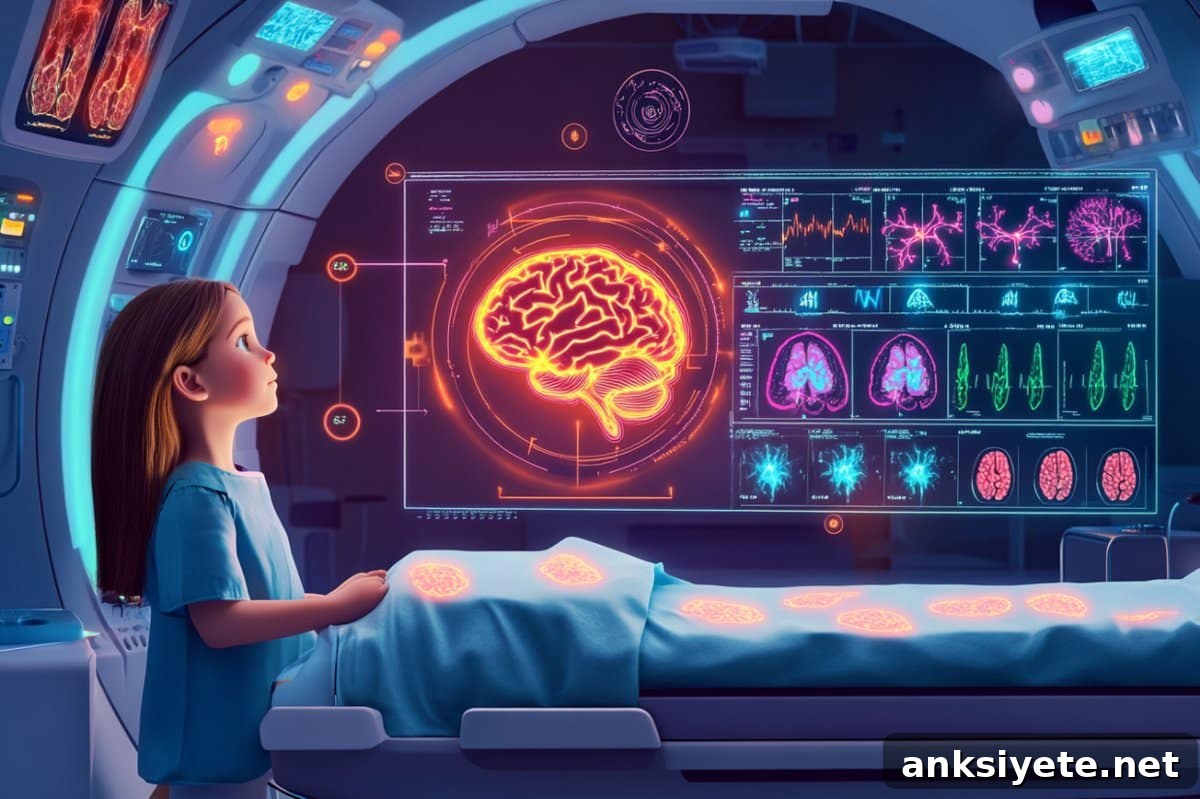
Summary: Researchers have developed an artificial intelligence (AI) model that analyzes sequences of post-treatment brain MRIs to predict tumor recurrence in children with gliomas. Using a temporal learning approach that interprets subtle changes across multiple scans taken over time, the model substantially improves prediction accuracy compared with conventional single-scan methods.
In their multicenter study, investigators trained deep-learning algorithms on thousands of postoperative MR images and found that feeding the model multiple timepoints raised predictive performance to between 75% and 89% accuracy for one-year recurrence. The gains plateaued once the model received about four to six scans per patient, indicating an efficient balance between information and imaging burden.
Key Facts:
- Temporal learning advantage: A model trained on multiple post-treatment MRIs predicted glioma recurrence with accuracy in the 75–89% range, outperforming single-scan analyses.
- Efficient imaging: Predictive performance increased as more historical scans were provided but generally plateaued after four to six timepoints.
- Clinical potential: Temporal models could help tailor MRI follow-up—reducing scans for low-risk patients and prompting earlier intervention for those at high risk.
Source: Mass General
Overview
Artificial intelligence is increasingly capable of detecting patterns in large medical imaging datasets that may elude human observers. The new study demonstrates that temporal deep learning—training models to learn from ordered sequences of images—can be applied to postoperative MRI surveillance in pediatric glioma to improve individualized risk prediction for recurrence.
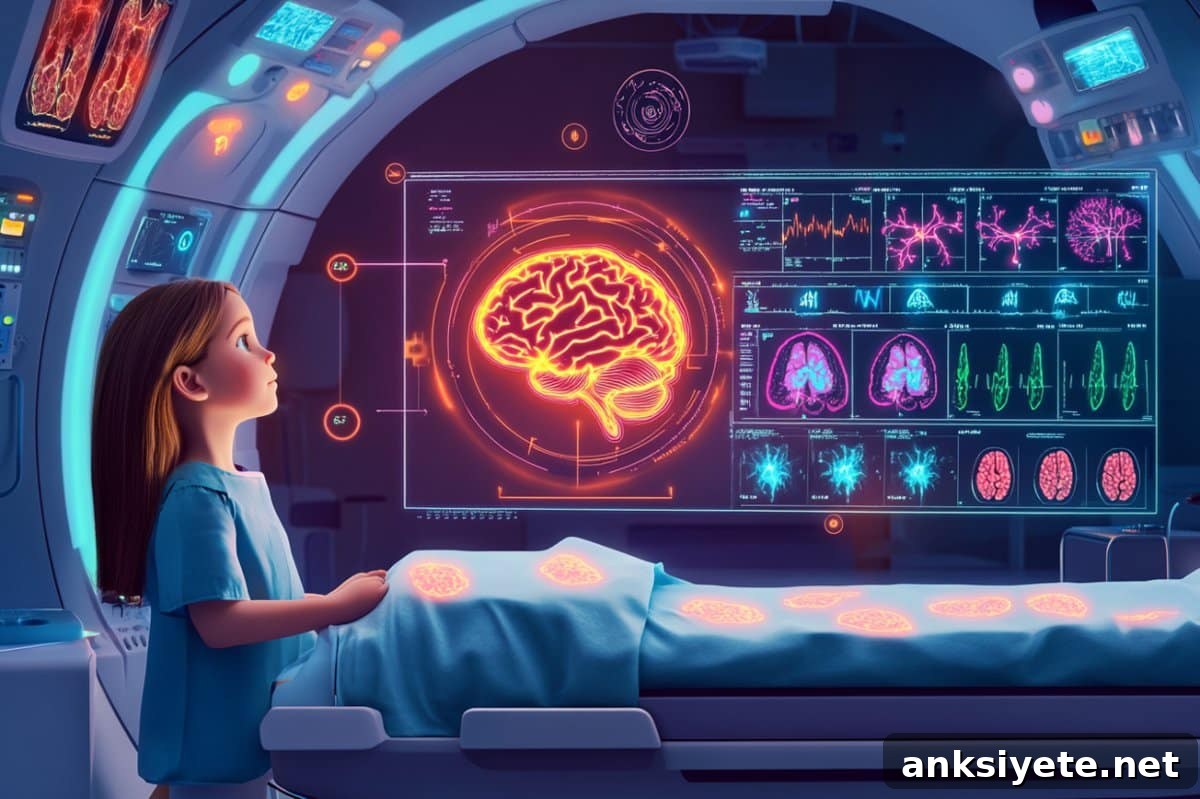
Investigators from Mass General Brigham, Boston Children’s Hospital, and Dana-Farber/Boston Children’s Cancer and Blood Disorders Center used nearly 4,000 MR scans from 715 pediatric patients to train and test their temporal deep-learning framework. Their findings are published in The New England Journal of Medicine AI.
“Many pediatric gliomas can be cured with surgery, but relapses can be devastating,” said Benjamin Kann, MD, corresponding author and member of the Artificial Intelligence in Medicine (AIM) Program at Mass General Brigham. “Because predicting who will recur is difficult, children often undergo frequent, long-term MRI surveillance. Temporal AI models offer a way to identify patients at higher risk earlier while potentially reducing unnecessary imaging for those at lower risk.”
The investigators addressed challenges common to rare disease research—limited datasets and variability—by pooling data across institutions. They applied a self-supervised temporal learning strategy that first trains a model to order a patient’s postoperative MRIs chronologically. This pretext task encourages the model to learn patterns of subtle change over time. The pretrained model is then fine-tuned to predict one-year recurrence based on a patient’s historical scans.
Compared with conventional single-scan approaches, the temporal method improved recurrence prediction substantially. The study reported performance gains across both low- and high-grade gliomas, with area under the receiver operating characteristic curve ranging from approximately 75% to 89% and meaningful increases in F1 scores. The model’s benefit increased incrementally as more prior scans were available, typically reaching a plateau between three and six images depending on the dataset.
Although promising, the authors emphasize that further validation in diverse clinical settings is needed before routine clinical use. Their next steps include prospective trials to determine whether AI-informed risk stratification can safely reduce surveillance imaging for low-risk patients or support earlier, targeted adjuvant therapy for those at high risk of recurrence.
“We have shown that AI can analyze longitudinal imaging—not just isolated scans—and use those temporal patterns to make clinically relevant predictions,” said first author Divyanshu Tak, MS, of the AIM Program. “This approach could be applied to many clinical scenarios that rely on serial imaging to monitor disease.”
Authorship: In addition to Benjamin Kann and Divyanshu Tak, Mass General Brigham authors include Biniam A. Garomsa, Anna Zapaishchykova, Zezhong Ye, Maryam Mahootiha, Tafadzwa Chaunzwa, Hugo JWL Aerts, and Daphne Haas-Kogan. Additional contributors include Sridhar Vajapeyam, Juan Carlos Climent Pardo, Ceilidh Smith, Ariana M. Familiar, Kevin X. Liu, Sanjay Prabhu, Pratiti Bandopadhayay, Ali Nabavizadeh, Sabine Mueller, and Tina Y. Poussaint.
Funding: This research was supported in part by the National Institutes of Health/National Cancer Institute (U54 CA274516 and P50 CA165962) and the Botha-Chan Low Grade Glioma Consortium. The authors also acknowledge the Children’s Brain Tumor Network (CBTN) for imaging and clinical data access.
About this brain cancer and AI research news
Author: Alexandra Pantano
Source: Mass General
Contact: Alexandra Pantano – Mass General
Image credit: Neuroscience News
Original Research (closed access): “Longitudinal Risk Prediction for Pediatric Glioma with Temporal Deep Learning” by Benjamin Kann et al., NEJM AI. DOI and publisher details are reported in the original article.
Abstract
Longitudinal Risk Prediction for Pediatric Glioma with Temporal Deep Learning
Background
Pediatric glioma recurrence causes significant morbidity and mortality, but recurrence timing and severity are heterogeneous and difficult to forecast using existing clinical and genomic markers. As a result, most children undergo frequent, long-term MRI surveillance regardless of individualized risk. Longitudinal deep-learning analysis of serial MRI scans offers a potential path to improved, individualized recurrence prediction, though progress has been limited by data availability and conventional machine-learning methods.
Methods
The team developed a self-supervised temporal deep-learning approach tailored for longitudinal imaging. A multistep model encodes a patient’s serial postoperative MRIs and is first trained on a pretext task to classify the correct chronological order of scans. After pretraining, the model is fine-tuned to predict one-year recurrence from the last available postoperative scan by leveraging the patient’s earlier surveillance images. The approach was evaluated on 3,994 scans from 715 pediatric patients at three institutions, covering low- and high-grade gliomas.
Results
Temporal learning improved recurrence prediction performance (F1 score) by up to 58.5% compared with traditional single-scan approaches across datasets, with area under the receiver operating characteristic curve values ranging roughly from 75% to 89%. Prediction performance rose as more historical scans were available and typically plateaued between three and six scans, depending on the dataset.
Conclusions
Temporal deep learning enables robust longitudinal medical imaging analysis and shows promise as a point-of-care decision-support tool for pediatric brain tumors. The method may be adaptable to other cancers and chronic conditions that rely on serial surveillance imaging. (Funded in part by NIH/NCI and the Botha-Chan Low Grade Glioma Consortium.)