
Advanced neurotechnologies—wireless EEG and robotized TMS—enable the first successful human brain-to-brain transmission
An international team of neuroscientists and robotics engineers has demonstrated the feasibility of direct brain-to-brain communication between two people. Published in PLOS ONE, the study reports the successful transmission of simple messages over the internet between intact scalps of human subjects located thousands of miles apart, using noninvasive electrophysiological recording and stimulation technologies.
“We wanted to determine whether it is possible to read brain activity from one person and inject brain activity into another, and to do so across great physical distances by leveraging existing communication networks,” explains coauthor Alvaro Pascual‑Leone, MD, PhD, Director of the Berenson‑Allen Center for Noninvasive Brain Stimulation at Beth Israel Deaconess Medical Center and Professor of Neurology at Harvard Medical School. “Given the global reach of the internet, our question became: can we bypass spoken or written language and establish direct brain‑to‑brain communication between participants located far from each other?”
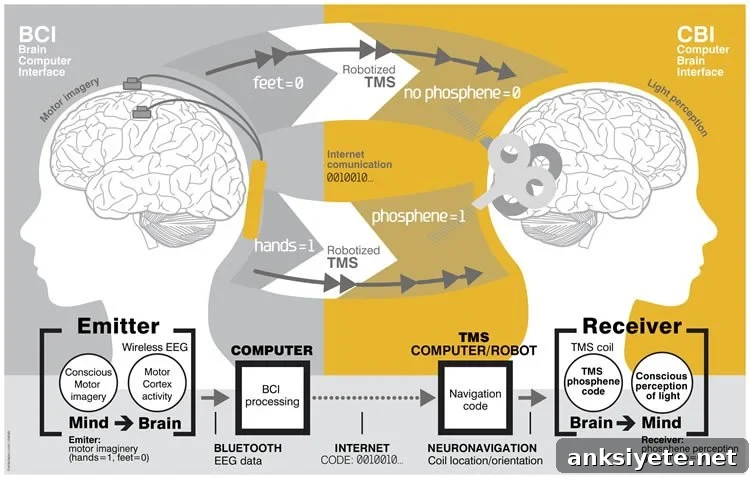
The research team answered that question affirmatively. Using a combination of internet‑linked electroencephalography (EEG) and robotized, image‑guided transcranial magnetic stimulation (TMS), investigators successfully transmitted the greetings “hola” and “ciao” from a sender in India to a receiver in France. The sender’s EEG signals were converted into binary code; that binary code was transmitted over the internet to the remote site; and a computer‑brain interface delivered the coded information to the receiver’s visual system through carefully targeted TMS pulses.
Previous brain‑computer interface (BCI) research has focused mainly on communication between a human brain and a computer, where recorded scalp EEG signals are decoded into control commands for external devices such as prosthetic limbs, robots, or assistive technologies. This study extends that paradigm by adding a second human brain at the receiving end—a computer‑brain interface (CBI) that noninvasively induces conscious percepts in the receiver.
Four healthy adult volunteers, aged 28 to 50, took part in the experiments. One participant acted as the BCI sender, producing specific motor imagery patterns (imagined hand or foot movements) that encoded binary information. Three other participants served as CBI receivers, who experienced the incoming information as phosphenes—brief flashes of light in their peripheral vision—elicited by neuronavigated TMS. The senders’ motor imagery was recorded with wireless EEG electrodes and translated into binary sequences; these sequences were transmitted electronically to the remote site; then the CBI subsystem converted the bits into distinct TMS stimulation patterns that generated phosphenes corresponding to binary values. Receivers decoded the patterns to reconstruct the original message.
In practice, the sender’s team converted the greetings “hola” and “ciao” into pseudo‑random binary streams and transmitted those streams from India to France. At the receiving site, automated TMS pulses produced patterned phosphenes that the receiver perceived and decoded into the original letters. The subjects reported seeing the phosphenes as intended, and the messages were reconstructed correctly despite the minimal sensory cues available. A second experiment conducted between participants in Spain and France produced similar results. Overall, the combined experiments yielded a low total error rate—approximately 15 percent across encoding and decoding stages (about 11 percent decoding error and 5 percent encoding error).
“By combining wireless EEG with robotized TMS, we directly and noninvasively transmitted information from one human brain to another without speech or handwriting,” says Pascual‑Leone. “Demonstrating this capability across thousands of miles provides a crucial proof‑of‑principle for future brain‑to‑brain communication systems and suggests potential new ways to complement or bypass traditional language‑based communication.”
Study coauthors include Carles Grau, Giulio Ruffini, Romuald Ginhoux, Alejandro Riera, Thanh Lam Nguyen, Hubert Chauvat, Michel Berg, and Julià L. Amengual. The project received partial support from EU FP7 FET Open HIVE, the Starlab Kolmogorov project, and the Neurology Department of the Hospital de Bellvitge.
Contact: Bonnie Prescott – Beth Israel Deaconess Medical Center
Source: Beth Israel Deaconess Medical Center press release
Image Source: Figure adapted from Grau et al., PLOS ONE (open access)
Original research: “Conscious Brain‑to‑Brain Communication in Humans Using Non‑Invasive Technologies” by Grau et al., published online August 19, 2014 in PLOS ONE (doi:10.1371/journal.pone.0105225).
The published abstract summarizes the approach: combining a BCI based on voluntary motor imagery‑controlled EEG changes with a CBI that induces conscious perception of phosphenes via neuronavigated, robotized TMS, while taking care to minimize alternative sensory cues. The experiments transmitted pseudo‑random binary streams encoding words between emitter and receiver subjects across long distances. Results provide a proof‑of‑principle for conscious, noninvasive brain‑to‑brain communication and open research avenues in cognitive, social, and clinical neuroscience, as well as ethical discussion about future “hyperinteraction” technologies.