
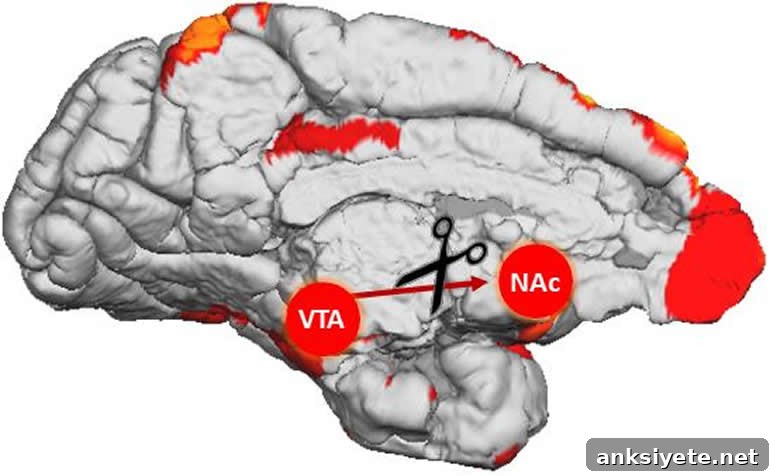
Summary: Researchers temporarily switched off the neural pathway between the ventral tegmental area and the nucleus accumbens in primate models, which reduced motivation but did not impair reinforcement-based learning.
Source: KU Leuven
For the first time, neurophysiologists from KU Leuven, Harvard and Kyoto University have reversibly and selectively disrupted a connection between two brain regions in awake, behaving primates while simultaneously monitoring whole-brain activity. This targeted disconnection reduced the animals’ willingness to exert effort for a larger reward but left their ability to learn reward contingencies intact. The study, published in Neuron, could guide more precise treatments for psychiatric and neurological disorders involving motivation and reward processing.
Learning and motivation are core to adaptive behaviour. From infants mastering motor skills to adults acquiring professional expertise, reward signals shape what we learn and how hard we are willing to work. Motivation determines whether effort is invested to obtain a larger payoff. This raises a key question in neuroscience: which neural circuits drive the willingness to expend effort, and which support learning about reward contingencies?
Wim Vanduffel and colleagues tested whether a specific dopaminergic pathway is necessary for motivation or for reward-driven learning. In one behavioural task, monkeys faced a trade-off between effort and reward: they could expend more effort to obtain a larger amount of orange juice or expend less effort for a smaller amount. Two simple visual shapes on a screen indicated the different effort–reward contingencies. For example, a red triangle signalled a larger juice reward but required the animal to sustain gaze longer, whereas a blue circle signalled a smaller, easier-to-obtain reward. Choosing the larger reward therefore required stronger motivation.
In a separate reinforcement-learning task, monkeys chose between two shapes that differed only in the probability of receiving the same-sized juice reward. They quickly learned to prefer the more reliably rewarded stimulus and adapted their choices when those reward probabilities were covertly reversed, demonstrating flexible reinforcement-based learning.
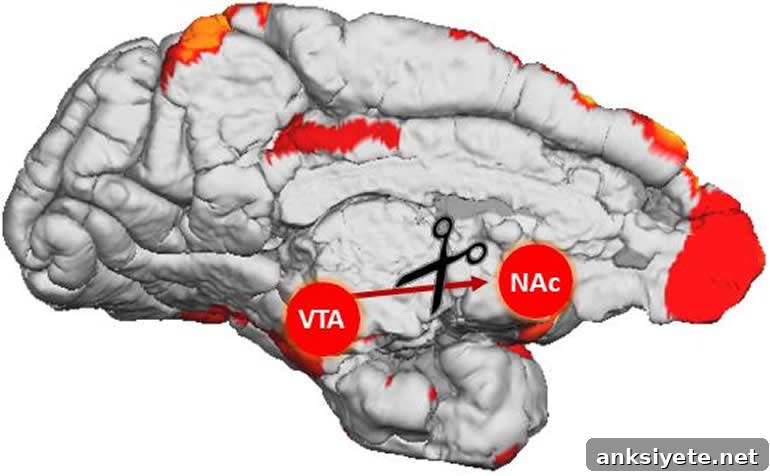
The team then used a viral double-infection technique to reversibly inactivate the unidirectional projection from the ventral tegmental area (VTA) to the nucleus accumbens (NAc), a principal dopamine pathway of the brain’s reward system.
Decrease in motivation
When the VTA→NAc pathway was selectively silenced, the monkeys’ behaviour changed markedly in the effort-versus-reward task: they shifted toward choosing the low-effort, smaller reward almost exclusively. In contrast, performance in the reinforcement-learning task was unaffected; animals continued to learn which stimulus was more profitable and to reverse their choices when reward contingencies changed. These results indicate that the mesoaccumbal projection is critical for sustaining high-effort motivated behaviour but is not required for all forms of reinforcement-based learning.
Functional MRI recorded during pathway inactivation revealed an unexpected pattern: fronto-temporal cortical regions displayed increased functional connectivity, i.e., more synchronous activation across these areas. This network-level change correlated with the observed drop in motivated effort, suggesting that disrupting the VTA→NAc pathway alters broader cortical dynamics associated with motivation.
Pathway-selective manipulation in primates
“This is the first demonstration of reversible, pathway-selective inactivation in behaving primates while recording whole-brain activity,” explains Professor Vanduffel. Previous approaches typically targeted entire brain regions, affecting all their projections and making it difficult to ascribe function to a single pathway. Earlier pathway-selective experiments in primates did not combine cognitive testing with whole-brain monitoring. Contrary to much of the rodent literature, which has emphasized mesoaccumbal contributions to reinforcement learning, these primate results show a stronger role for this pathway in motivating effortful behaviour.
Implications for psychiatry
Altered motivation—either reduced or excessive—features prominently across many psychiatric conditions, including depression, obsessive-compulsive disorder, addiction, anxiety disorders, bipolar disorder and schizophrenia. By demonstrating that a single projection can be modulated without affecting other outputs from the same source nucleus, this pathway-selective approach points toward interventions that target specific circuits rather than whole brain regions. Such precision could improve therapeutic effects while limiting side effects compared with methods that non-selectively modulate entire areas and all their connections.
About this neuroscience research article
Source:
KU Leuven (news release)
Contacts:
Wim Vanduffel – KU Leuven
Image Source:
Image credited to Wim Vanduffel et al.
Original Research: Open access
“Selective Mesoaccumbal Pathway Inactivation Affects Motivation but Not Reinforcement-Based Learning in Macaques” by Pascaline Vancraeyenest, John T. Arsenault, Xiaolian Li, Qi Zhu, Kenta Kobayashi, Kaoru Isa, Tadashi Isa, and Wim Vanduffel. Neuron.
Abstract
Selective Mesoaccumbal Pathway Inactivation Affects Motivation but Not Reinforcement-Based Learning in Macaques
Highlights
• Reversible inactivation of the VTA-to-NAc pathway was achieved in monkeys
• Mesoaccumbal circuit inactivation reduced high-effort motivational behaviour
• Unexpectedly, this perturbation did not affect reinforcement-based learning
• The inactivation increased functional connectivity mainly in fronto-temporal circuits
Summary
Rodent studies have implicated the mesoaccumbal circuit in reinforcement-based learning, where phasic VTA activity and phasic dopamine release contribute to learning signals. However, rodent evidence also suggests that tonic VTA activity and associated accumbal dopamine release help regulate sustained motivational states. The impact of sustained and selective blockade of this circuit in primates was previously unknown. Using a double-infection viral vector technique, the authors achieved selective, unidirectional, and reversible blockage of the primarily dopaminergic mesoaccumbal projection in macaques. This manipulation increased network-level functional connectivity—particularly across fronto-temporal cortex—without impairing performance on an object discrimination reversal task. In contrast, sustained mesoaccumbal inactivation strongly reduced motivation in an effort-based decision task. These results indicate that, in primates, the mesoaccumbal pathway is essential for high-effort motivation but not for all forms of reinforcement-based learning.