

Summary: Researchers find that infants as young as six months can make simple probability estimates.
Source: Max Planck Institute.
One of the human mind’s most powerful abilities is drawing generalisations from limited data. Adults rely on implicit probability estimates to represent regularities in the world and to guide decisions. Until recently, it was unclear when in development this capacity first emerges. Researchers at the Max Planck Institute for Human Cognitive and Brain Sciences (MPI CBS) in Leipzig, in collaboration with the University of Uppsala, report that infants as young as six months already show a basic sense of probability.
Throughout life we constantly estimate how likely different events are, using those estimates to weigh risks and benefits. The question of when humans begin using probability information is central to understanding cognitive development: can infants detect which events are more probable than others, and how sensitive are they to differences in likelihood?
The team tested 75 infants aged six, 12 and 18 months using short animated sequences. Each animation showed a container filled mostly with one colour of balls and a minority of another colour. The machine in the animation drew samples that were placed into two receptacles: one sample was dominated by the common colour and the other by the rare colour. In one condition the odds were extremely skewed, so that drawing the rare-colour sample was 625 times less likely than drawing the common-colour sample—making the mostly-rare-colour outcome highly improbable.
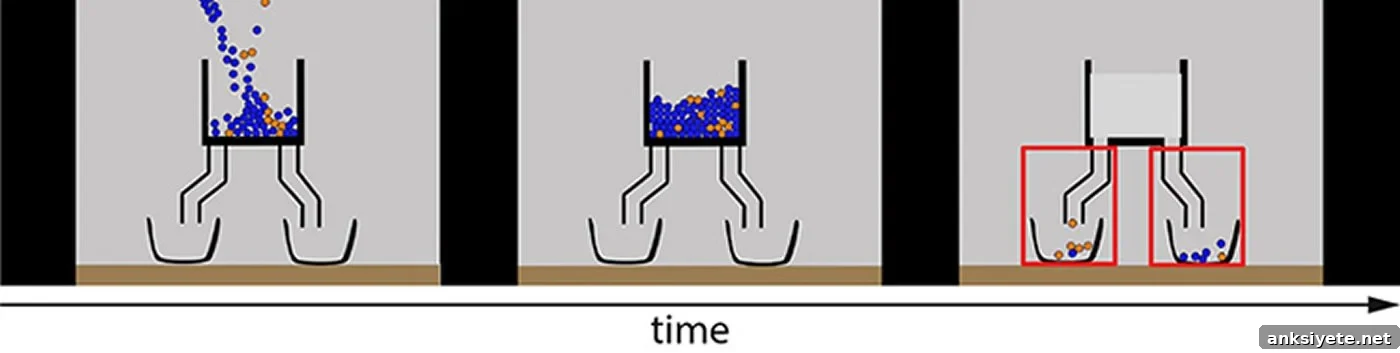 Infants looked longer at the container filled with the rare-coloured balls, suggesting they were surprised by the unlikely outcome. Image credit: MPI CBS.
While infants watched the films, researchers tracked their gaze to determine whether they looked longer at the likely or the unlikely outcome. Across age groups, infants consistently gazed longer at the unlikely samples when the difference in base rates was large. The longer looking time toward the improbable outcome is interpreted as a marker of expectancy violation: infants expected the common outcome and were surprised when the rare outcome occurred.
To rule out simple colour preferences, the researchers repeated trials with different colour pairs, including green and red, and still observed the same pattern. This supports the interpretation that infants responded to relative likelihood rather than to colour attraction.
Beyond demonstrating that six-month-olds are sensitive to probability, the study probed how infants respond when the difference in likelihood is harder to detect. When the ratio between the common and rare items was reduced—making the two outcomes more similar—the infants’ looking behaviour shifted. In a condition where the common colour was only nine times more likely than the rare colour, infants tended to look longer at the likely (common-colour) sample rather than the unlikely one.
The authors suggest a plausible explanation: as the contrast between outcomes decreases, the informational complexity increases and infants may focus on the more familiar-looking subset to better encode and process the scene. Prior studies show that when processing demands rise, infants often preferentially attend to familiar stimuli to support encoding. Regardless of the precise mechanism, the results demonstrate that infants’ sensitivity to probability depends on the magnitude of the likelihood difference and on the complexity of the sample.
Overall, the findings indicate that a rudimentary capacity to distinguish events by their relative likelihood is present by six months of age and that this capacity is modulated by the difficulty of the discriminations infants must make. Looking patterns showed similar qualitative effects across the three age groups examined, suggesting that the basic sensitivity to likelihood is established early in infancy and remains observable into the second year.
Study details: The study tested infants aged 6, 12, and 18 months (N = 75) using animated sequences in which a machine drew samples from a box containing different-coloured balls. The difference in likelihood between two simultaneously presented events was manipulated across trials. Infants’ looking patterns varied with the magnitude of the difference in likelihood and with sample size.
Source institution: Max Planck Institute for Human Cognitive and Brain Sciences (MPI CBS), Leipzig.
Original research: “Infants Distinguish Between Two Events Based on Their Relative Likelihood” by Ezgi Kayhan, Gustaf Gredebäck, and Marcus Lindskog, published in Child Development. Published online October 3, 2017. DOI: 10.1111/cdev.12970
Likelihood estimation helps cope with uncertainty. This study examined infants’ sensitivity to differences in the likelihood between two events. Infants aged 6, 12, and 18 months viewed animated movies of a machine drawing likely and unlikely samples from boxes containing different-coloured balls. The magnitude of difference in likelihood varied across trials. Infants’ looking patterns were sensitive to the magnitude of those differences and were influenced by the number of items in the samples. Qualitative patterns were similar across age groups, indicating early emerging sensitivity to relative likelihood.
These findings contribute to our understanding of how early cognitive systems represent statistical properties of the environment and how infants use probabilistic information when forming expectations about events.