Key Questions Answered
Q: How does exercise help people with Parkinson’s at the brain level?
A: Extended adaptive cycling appears to alter neural activity in motor-related brain regions, suggesting exercise can reactivate or reshape circuits affected by Parkinson’s disease.
Q: What sets this study apart?
A: Investigators recorded real-time signals from implanted deep brain stimulation (DBS) devices before and after a multi-session cycling program, linking measurable neural changes with clinical motor improvements.
Q: Did participants get better?
A: Yes. After 12 adaptive cycling sessions, participants showed changes in motor-related brain signals and reported improvements in symptoms such as gait, walking ability, and energy.
Summary: A new pilot study indicates that long-term adaptive cycling can produce measurable changes in brain signals in people with Parkinson’s disease, offering a window into how exercise eases motor symptoms. Using DBS implants to monitor local field potentials (LFPs) in the subthalamic nucleus (STN), researchers tracked neural activity across 12 sessions of dynamic cycling and found that meaningful changes emerged over the course of the program.
The study, conducted at University Hospitals and the VA Northeast Ohio Healthcare System through the Cleveland Functional Electrical Stimulation (FES) Center, suggests exercise may promote network-level neuroplasticity that extends beyond the immediate implant site.
Unlike prior research that primarily documented clinical benefits, this investigation sought to decode the neural mechanisms underlying those improvements by leveraging second-generation DBS systems that can record local field potentials from the STN. The findings are published in the June 2025 issue of Clinical Neurophysiology.
The pilot study, supported by a VA Merit Award and philanthropic funds to the Department of Neurology at University Hospitals, was led by neurologist Aasef Shaikh, MD, PhD. Prajakta Joshi, a lead author, is a PhD candidate in biomedical engineering working in the Shaikh Lab at the Cleveland VA Medical Center.
Dr. Shaikh explained that previous work established dynamic cycling as beneficial for Parkinson’s tremor. The addition of neural recordings during a sustained exercise regimen allowed the team to visualize how prolonged activity might rewire motor circuits.
About the Study
Nine people with Parkinson’s disease, several of whom were military veterans, completed up to 12 adaptive cycling sessions over four weeks (100 total sessions across participants). All participants already had DBS implants for motor symptoms. Local field potentials from the STN were recorded before and after cycling to evaluate both immediate and longer-term neural changes.
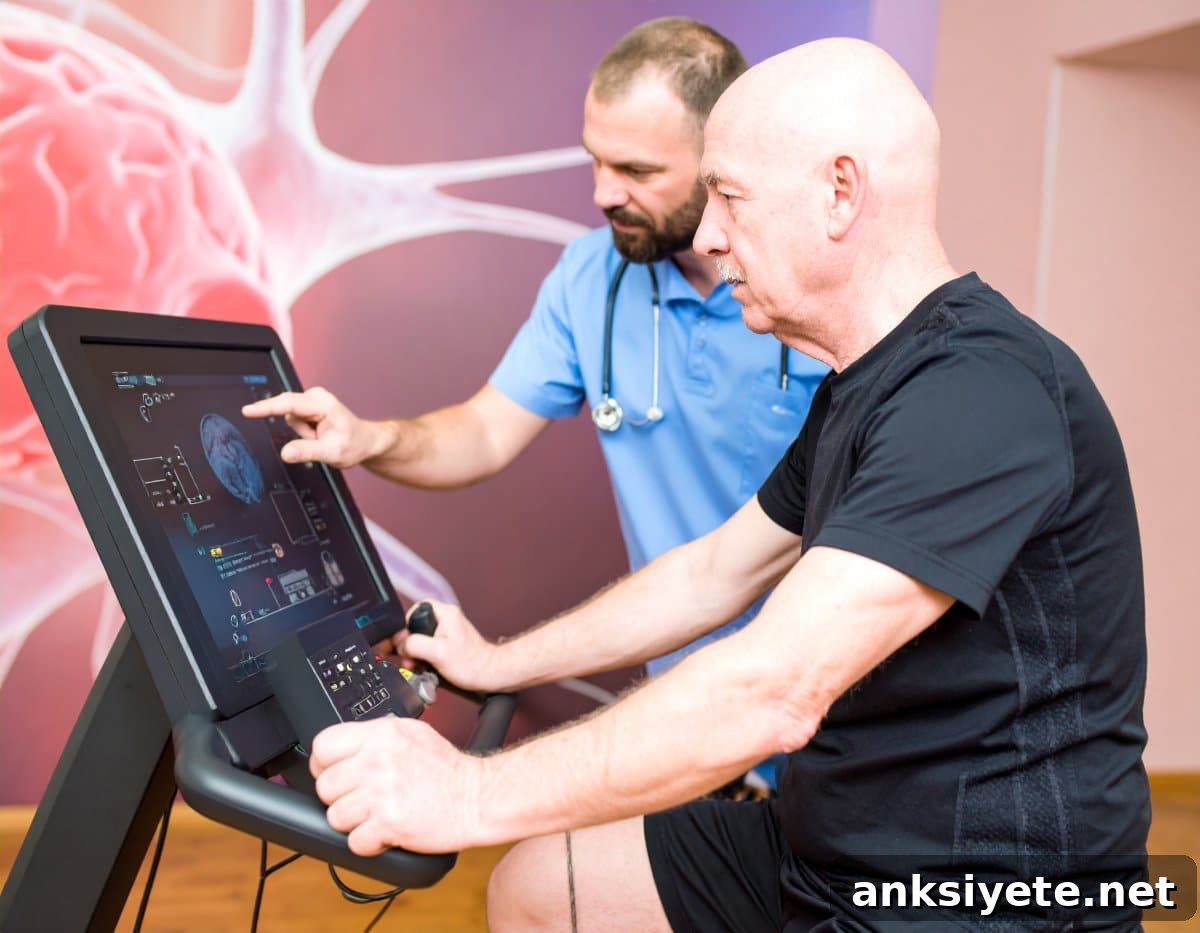
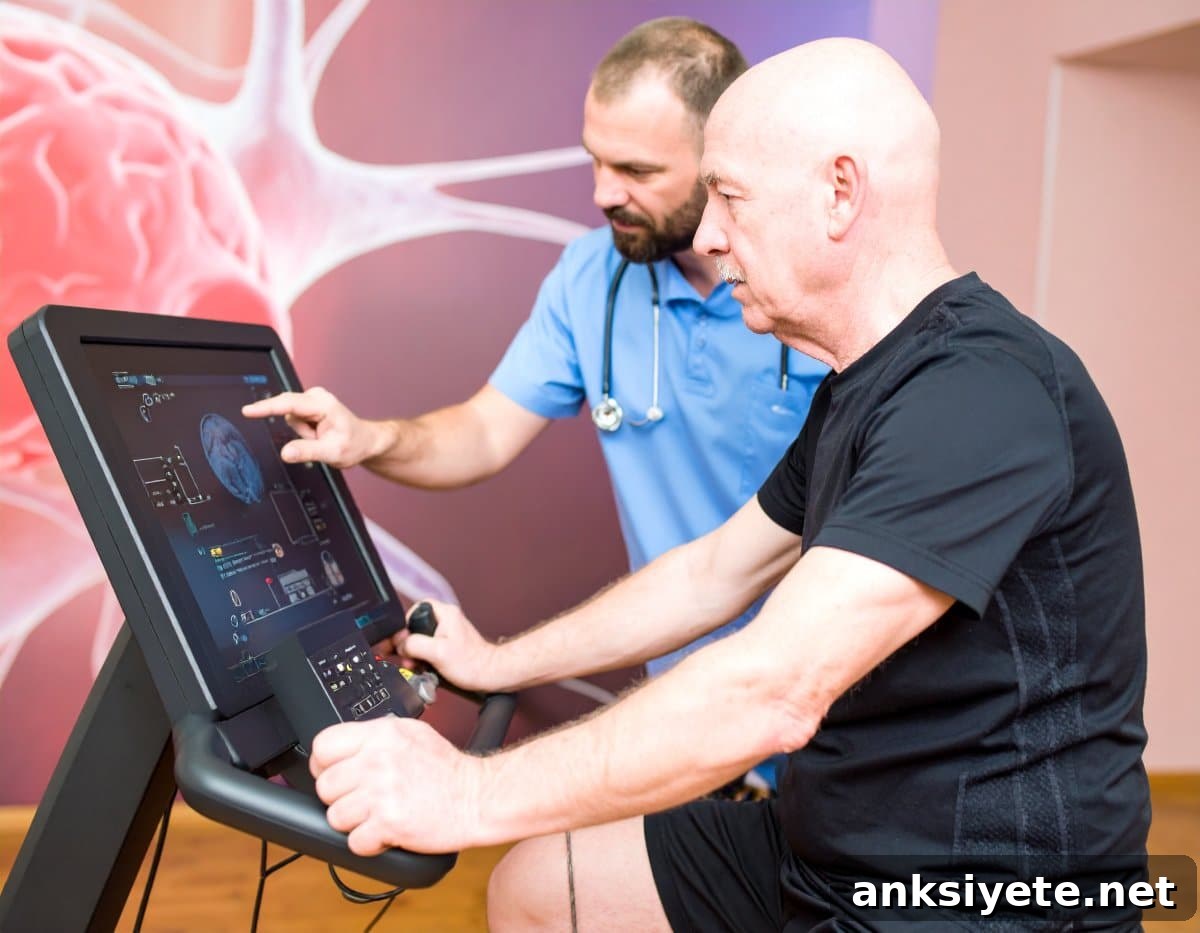
The adaptive bikes used in the study actively adjusted resistance and motor assistance in real time. Participants were encouraged to maintain a target cadence of roughly 80 rpm for about 30 minutes while interacting with a game-like screen that translated pedaling intensity into on-screen feedback (for example, keeping a balloon afloat). The bike’s algorithm alternated assistance and resistance to keep the rider engaged and varying effort, a feature researchers believe enhances therapeutic benefit without causing undue fatigue.
Key Findings
- No immediate neural changes: Single-session recordings did not show significant immediate shifts in STN activity.
- Measurable long-term effects: After the full 12-session program, the dorsolateral region of the STN showed increased spectral power and changes in the 1/f exponent of the LFP power spectrum, indicating altered neural dynamics associated with motor control.
- Regional specificity: The ventral STN did not demonstrate the same response, suggesting exercise-related changes may be localized to motor-relevant subregions.
- Network implications: Because DBS recordings sample only the implanted site, the authors propose that broader upstream and downstream circuits are likely involved, and that exercise may induce a network-level reorganization that drives symptom improvement.
Lead author Joshi highlighted the potential of these results to inform personalized, exercise-based therapies for Parkinson’s, while noting that further research is needed to map the full network effects and confirm causality.
Patient Experience
Participants reported functional benefits. Amanda “Mandy” Ensman, 59, who has lived with Parkinson’s for 12 years, said regular cycling improved her gait, walking endurance, and overall energy. Following the study, she continues physical therapy at InMotion, a gym offering Parkinson’s-focused classes.
Study Details and Citation
Author: Ansley Kelm
Source: University Hospitals Cleveland Medical Center
Contact: Ansley Kelm, University Hospitals Cleveland Medical Center
Image credit: Neuroscience News
Original Research (open access): Electrophysiological correlates of dynamic cycling in Parkinson’s disease — A. Shaikh et al., Clinical Neurophysiology (June 2025)
Abstract (condensed)
Objective
This study examined how dynamic cycling influences neural activity in the subthalamic nucleus (STN), a central node in basal ganglia circuits disrupted by Parkinson’s disease, to better understand mechanisms behind exercise-induced motor improvements.
Methods
Nine participants completed up to 12 adaptive cycling sessions over four weeks, producing 100 total sessions. Local field potentials (LFPs) from DBS electrodes in the STN were recorded before and after cycling. Analysis measured dominant spectral frequencies, spectral power, and the 1/f exponent to capture both rhythmic and aperiodic neural dynamics.
Results
While acute, single-session effects were minimal, repeated sessions produced increases in power and in the 1/f exponent in the dorsolateral STN, indicating sustained alterations in neuronal activity. The ventral STN showed no comparable changes.
Conclusion
Prolonged adaptive cycling modifies STN neurophysiology in Parkinson’s disease. These results support the role of sustained exercise in promoting neuroplastic changes relevant to motor symptom relief and warrant further study to define circuit-level mechanisms and optimized, personalized exercise interventions.