
Enjoy a good scare? You’re not alone, according to a Kansas State University psychological sciences professor.
For many people, Halloween is a night of candy, costumes and playful frights. Ghosts, ghouls and jump scares are part of the holiday’s appeal, and that element of fear can actually be beneficial, says Don Saucier, an associate professor of psychological sciences at Kansas State University’s College of Arts & Sciences.
Saucier explains that fear has an evolutionary purpose. “Fear is adaptive,” he says. “Fear keeps us safe. We are afraid of heights because we know we can fall, and we are afraid of the dark because it holds the unknown.” In other words, fear evolved to protect us from real threats by motivating caution and avoidance in risky situations.
But if fear exists primarily to promote survival, why do people deliberately seek it out in a controlled setting, such as on Halloween? Saucier offers two complementary reasons: cultural ritual and physiological arousal.
First, fear is woven into the cultural fabric of Halloween much like gift giving is woven into Christmas. The holiday invites people to play with fear in ways that are understood and accepted by their social group. Dressing up, staging spooky scenes and visiting haunted attractions are shared rituals that signal participation in the festivities.
Second, the physical sensations that accompany fear — faster heart rate, trembling hands, shortness of breath and sweating — produce an arousal state. In a safe, managed environment such as a haunted house or a spooky party, that arousal is interpreted as excitement rather than real danger. As Saucier puts it, when the threat is clearly nonthreatening, “feeling fear becomes fun.”
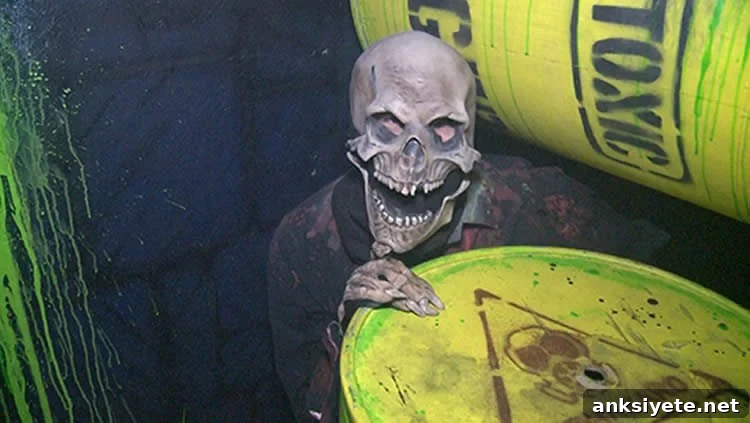
That dynamic helps explain a growing trend: people willingly paying to enter intense haunted attractions that sometimes require waivers. The psychological payoff goes beyond the momentary fright. “There is a social aspect to haunted houses,” Saucier says. “Halloween becomes a competition where people subject themselves to immense fear to gain social status. They try to become a ‘survivor.’”
Haunted attractions function as culturally sanctioned challenges: participants test their limits, compare their reactions to others, and often tell the story afterward as proof of bravery or endurance. Because most people experience these attractions in small groups, surviving a particularly intense scare becomes a shared anecdote that strengthens social bonds.
“Some researchers argue that happiness comes from experiences,” Saucier notes. Experiences that involve emotion and novelty are remembered more vividly than routine activities. When people go through a haunted house with friends, the combination of fear, relief and social interaction makes the event more meaningful and memorable.
The communal dimension of fear also encourages people to seek out support. When frightened, people instinctively look for reassurance and consolation from those around them. This mutual support during a frightening but ultimately safe experience can deepen friendships and create lasting memories, which is part of what makes Halloween outings so appealing year after year.
In short, enjoying fear on Halloween combines evolutionary wiring, physiological arousal and social dynamics. Fear signals real danger in one context and shared entertainment in another. The holiday transforms an ancient protective mechanism into a source of excitement, social connection and memorable experiences.
Source: Darrah Tinkler – Kansas State University
Image Source: The image is adapted from the Kansas State University press release
Original Research: We will provide a link to the research when it is made available.