
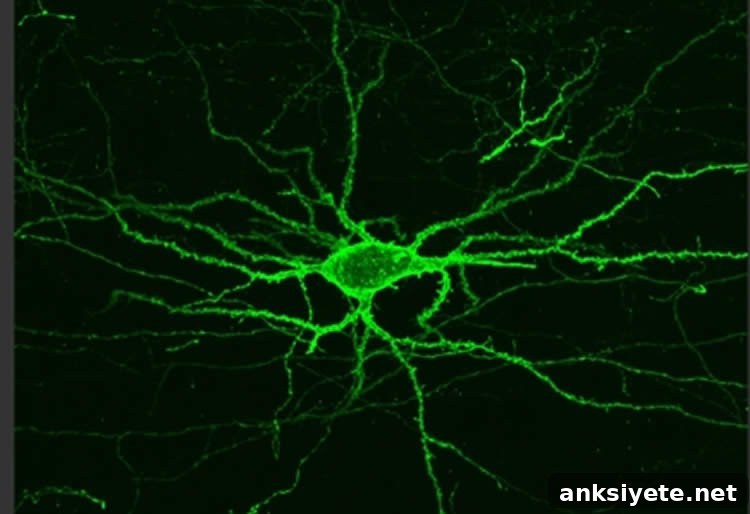
Summary: A new optogenetics-based method enables optical imaging of neuronal electrical activity without electrodes, according to MIT researchers.
Source: MIT.
Neurons communicate through rapid electrical impulses that underlie behavior, sensation, thought, and emotion. Traditionally, researchers record these signals with electrodes inserted into brain tissue, a process that can be technically challenging and time-consuming.
Scientists at MIT have developed an alternative approach that measures electrical activity optically. They engineered a light-sensitive protein that embeds in neuronal membranes and emits voltage-dependent fluorescence. This fluorescent reporter can reveal how the membrane potential of individual neurons changes on a millisecond timescale, enabling researchers to observe electrical signaling across many cells simultaneously.
“Using an electrode is like listening to only one side of a phone conversation,” says Edward Boyden, associate professor of biological engineering and brain and cognitive sciences at MIT. “With an optical voltage sensor, we can record activity from many neurons in a circuit and observe how they communicate with one another.”
Boyden, who is also affiliated with MIT’s Media Lab, McGovern Institute for Brain Research, and Koch Institute for Integrative Cancer Research, is the senior author of the study published in Nature Chemical Biology. The paper’s lead authors are postdoctoral researchers Kiryl Piatkevich and Erica Jung.
Imaging voltage
For more than twenty years, researchers have sought reliable fluorescent indicators that report membrane voltage rather than using electrodes. The challenge is finding proteins that are highly voltage-sensitive, fast enough to follow rapid action potentials, and photostable so they do not fade under imaging light.
To solve these problems, the MIT team used directed protein evolution combined with high-throughput robotic screening. They created millions of mutant variants of a microbial rhodopsin-derived sensor and screened them automatically in cultured mammalian cells to identify candidates with ideal brightness, membrane localization, and response speed.
“We take a gene, create millions of variants, and then use automated screening to pick the best performers,” Boyden explains. “This reproduces the power of natural evolution in the laboratory, but much faster and with precise selection for the properties we need.”
Starting from a previously developed protein called QuasAr2, the researchers generated 1.5 million mutants and imaged each cell to find proteins that localized to the membrane and produced strong fluorescence. After successive rounds of mutation and selection — including a second round that produced around eight million candidates — they isolated a top-performing variant named Archon1.
Mapping the brain
Archon1 has several key strengths: once the gene is delivered to neurons, the Archon1 protein inserts into the plasma membrane, where voltage changes are most accurately detected. It responds quickly to membrane potential changes, emits bright red fluorescence when illuminated with reddish-orange excitation light, and is photostable enough for extended imaging sessions.
The team demonstrated Archon1’s utility in live tissue and small transparent organisms. They recorded electrical activity in mouse brain slices, and in intact zebrafish larvae and the worm Caenorhabditis elegans, where optical access is straightforward. In those systems, Archon1 reports voltage as changes in red fluorescence intensity, allowing millisecond-resolution optical recordings of neuronal firing and subthreshold activity.
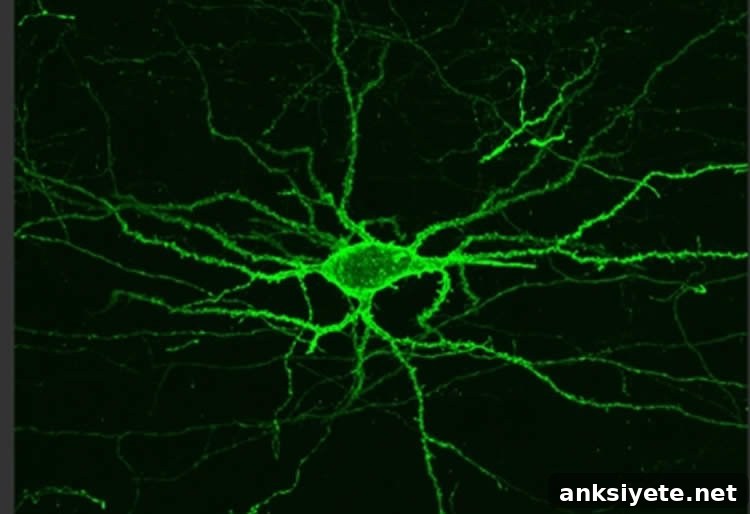
Importantly, Archon1 is compatible with existing optogenetic actuators that use non-red wavelengths. The researchers showed they could stimulate a neuron with blue light while simultaneously using Archon1 to record the resulting responses in downstream neurons. Such combinations enable causal experiments that both manipulate and read out neural circuit activity optically.
Adam Cohen, the Harvard scientist who helped develop earlier rhodopsin-based indicators, praised the high-throughput screening approach. He noted that previous efforts required laborious cloning and manual electrophysiological tests for each mutant, whereas the MIT group’s automated pipeline accelerates discovery of effective fluorescent voltage sensors.
The MIT team is now applying Archon1 to measure brain activity in awake, behaving mice. Boyden expects that voltage imaging with sensors like Archon1 will allow researchers to map small neural circuits in detail and to observe the computations that generate specific behaviors.
“We will be able to watch neural computations unfold,” he says. “Over the coming years we aim to solve some small circuits completely, and that work could bring us closer to understanding the electrical basis of thoughts and feelings.”
Funding: This research received support from the HHMI-Simons Faculty Scholars Program, the IET Harvey Prize, the MIT Media Lab, the New York Stem Cell Foundation Robertson Award, the Open Philanthropy Project, John Doerr, the Human Frontier Science Program, the Department of Defense, the National Science Foundation, and the National Institutes of Health, including an NIH Director’s Pioneer Award.
Source: Anne Trafton – MIT
Publisher: Organized by NeuroscienceNews.com.
Image Source: Image credited to the researchers.
Original Research: The study appears in Nature Chemical Biology.
MLA: MIT. “Seeing the Brain’s Electrical Activity.” NeuroscienceNews, 26 February 2018.
APA: MIT (2018, February 26). Seeing the Brain’s Electrical Activity. NeuroscienceNews.
Chicago: MIT. “Seeing the Brain’s Electrical Activity.” Published February 26, 2018.